analyze the personal, relational and legal consequences of sending and viewing sexually explicit images and messages under Missouri law, explain how posting personal information can harm the safety and mental health of yourself and others, decide when a digital situation needs a trusted adult, and write a personal plan for using social media safely, legally and respectfully.
Instruction
Family note. This lesson includes content on sexually explicit images and sextortion described in the parent/guardian notice at the start of Lesson 6.1. A student a parent or guardian has excused completes the alternative activity at the end, for equal credit.
Your digital life. In 2023, 77% of U.S. high school students used social media several times a day, and 16% reported being electronically bullied in the past year (CDC, national YRBS). As an online student, you probably spend even more of your day on screens. That makes the choices about what you share, and with whom, some of the most important safety decisions you make.
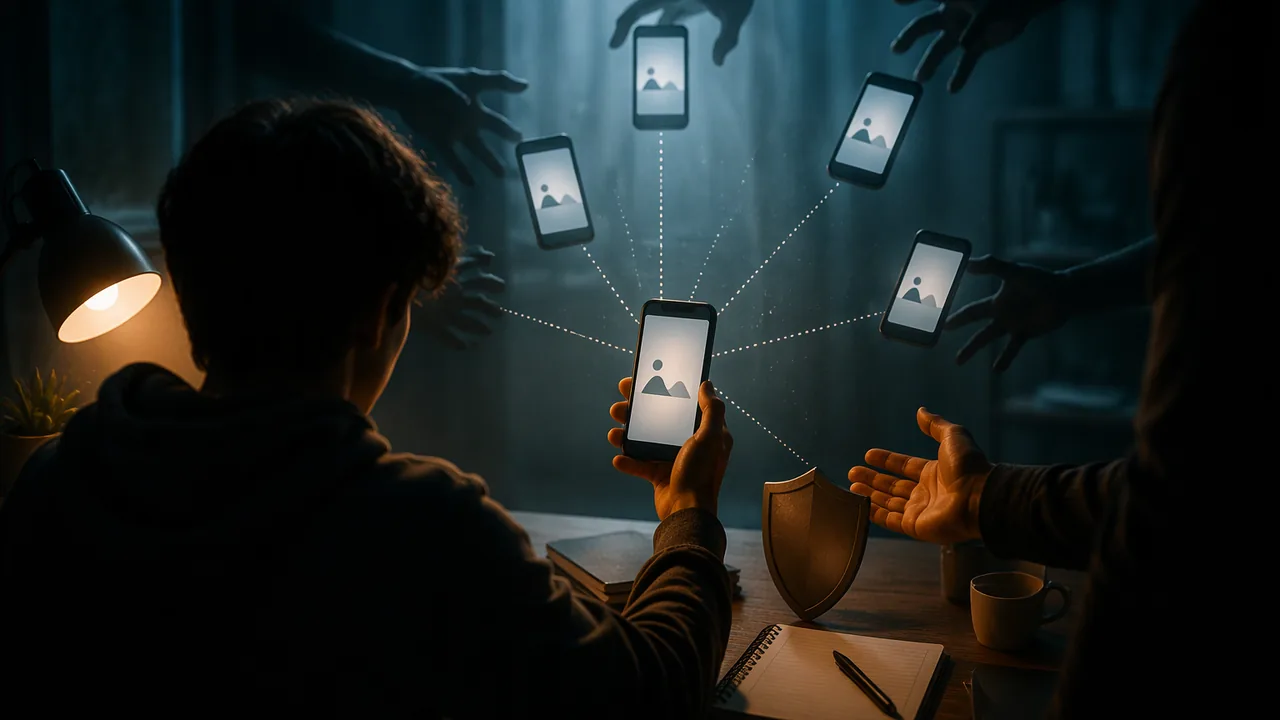
Sending or viewing sexually explicit images: the consequences. A photo or message sent to one person can be screenshotted, saved, forwarded and posted in seconds, and it cannot be taken back. Consequences include embarrassment, bullying, broken trust, damage to reputation, college and job opportunities, anxiety and depression. Images are also the raw material of sextortion: the National Center for Missing & Exploited Children (NCMEC) describes it as threatening to share a young person’s sexual images unless they send more content, sexual activity or money; in recent cases demanding money, teenage boys have been the most common targets. Red flags include someone new who moves fast, asks for photos early, offers to “show you first,” or pushes you to a private app. Viewing explicit media matters too: it often shows behavior without consent, respect or real consequences, which can distort what healthy relationships look like.
Technology and relationships. Phones can bring people closer, but they can also be used to control: demanding passwords or location, checking messages, constant texting, or pressuring for photos as “proof” of love. CDC lists sharing sexual images or sexting without consent as a form of dating violence. A partner who respects you accepts no.
What Missouri law says. In chapter 573, a “minor” is anyone under 18 (RSMo 573.010). Creating sexually explicit images of a minor is sexual exploitation of a minor, a class B felony (RSMo 573.023), and possessing even one such still image is a class D felony (RSMo 573.037). These sections do not make an exception based on the age of the person who takes or keeps the image. Sharing someone’s private sexual image to harass, threaten or coerce them is nonconsensual dissemination, a class D felony, or class C if the person pictured is a minor (RSMo 573.110, the “Evan’s Voice Act”); threatening to share such an image to get something is a class B felony if the image is of a minor (RSMo 573.112). Since August 28, 2026, Missouri also makes it a crime to share or threaten to share a faked (digitally created) intimate image of a real person (RSMo 573.570) and to extort sexual content online through shame or fear (sadistic online exploitation, RSMo 573.575). This is education, not legal advice. If anyone has an image of you or threatens you, you are the victim, not the one in trouble.
If it happens. NCMEC’s advice: the blackmailer is to blame, not you. Do not pay or send more; paying rarely stops it. Report the account on the platform, block it, but do not delete your messages, which help stop the person. Tell a trusted adult. NCMEC’s free Take It Down service (takeitdown.ncmec.org) can help remove images taken when you were under 18 without anyone seeing them, and the CyberTipline takes reports.
Personal information and your safety. Your full name, address, school, schedule, live location, and photos showing your house number, car plate or street sign let a stranger find you. Missouri’s stalking law covers conduct carried out through technology (RSMo 565.225). Posting about other people can endanger them too: never share someone’s location, photos or private information without permission.
Posting and mental health. Comparing yourself to edited highlight reels, counting likes, receiving cruel comments, or regretting a post can feed anxiety, low mood and poor sleep. A post that embarrasses someone else can do the same to them.
Alone or together? Everyday choices such as what to post are individual decisions; use a pause: Would I be fine if my family, a future employer and a stranger saw this? Situations involving threats, sextortion, someone wanting to meet in person or someone in danger call for collaborative decision-making with a parent, guardian or trusted adult.
Alternative activity (equal credit, for excused students). Using the community-health facts reading, evaluate the asthma information it presents: list three signs that a health website is credible, compare two asthma triggers and how to reduce them at home, and write a short plan for checking any health claim you see on social media before sharing it.
📖 Read for this lesson
The reading opens over the lesson; close it to come back to exactly where you were. The checks below draw on it.
Formative check
Work through these before moving on. They are not graded — they tell you whether the standard below has landed yet.
Missouri standard: SH1.12.18, SH1.12.19
Fictional scenario: Taylor, 16, is asked by a new online friend for a revealing photo “that only I will see.” Which statement about the consequences is accurate?
Missouri standard: SH1.12.20
Which is a sign that technology is being used to control a dating relationship?
Missouri standard: SH1.12.19, S5.12.3
Someone threatens to post a teen’s image unless they pay $200 tonight. Following NCMEC’s advice, what should the teen do?
Missouri standard: S1.12.16
Which post puts personal safety most at risk?
Missouri standard: MEH1.12.43
Posting an embarrassing photo of a friend “just as a joke” cannot affect their mental or emotional health.
Missouri standard: CSAP6.1.12, CSAP7.3.12, S1.12.16, MEH1.12.43, S5.12.3
Write your personal social media safety plan (a parent or guardian may review it with you if you choose). Include: (a) three privacy settings you will use; (b) five kinds of personal information you will never post; (c) a pause question you will ask before posting about yourself or anyone else; (d) two habits that protect your mental health, such as time limits; (e) one way you will stay legal and respectful toward others; and (f) which situations you would handle on your own and which you would bring to a trusted adult, and why.
Missouri standard: SH1.12.18, CSAP6.1.12
RSMo 573.010
Tap to revealA minor is anyone under 18
RSMo 573.037
Tap to revealPossessing even one sexual still image of a minor is a class D felony
RSMo 573.110
Tap to revealSharing a private sexual image to harass, threaten or coerce: class D felony, class C if the person is a minor
RSMo 573.570
Tap to revealSharing or threatening to share a faked intimate image of a real person is a crime
Take It Down
Tap to revealNCMEC’s free service to help remove images taken when you were under 18
Missouri standard: CSAP7.3.12
How confident are you that you can explain the consequences of sexting under Missouri law and follow a plan to use social media safely?
Digital Safety File: Missouri’s Sexual-Image Laws, Sextortion Steps, Personal Information and a Model Social Media Safety Plan
SLS original fictional scenarios and model plan. RSMo 573.010, 573.023, 573.037, 573.110, 573.112, 573.570 and 573.575 (versions effective August 28, 2026) and 565.225, revisor.mo.gov; NCMEC Sextortion and Take It Down pages; CDC About Teen Dating Violence (January 14, 2025); CDC YRBS Data Summary & Trends Report 2013-2023. All retrieved 2026-11-06. This is education, not legal advice. · SLS original; statute text and facts from U.S. and Missouri public sources
Why this reading. Lesson 6.3 asks you to analyze the consequences of sexting under Missouri law, respond to sextortion, protect personal information and write a social media safety plan. Here are the laws in summary, NCMEC’s steps, two fictional scenarios with model analysis, and a model plan. All scenarios are SLS original and fictional; nothing here is graphic. If anyone has an image of you or threatens you, you are the victim, not the one in trouble.
1. The numbers
In 2023, 77% of U.S. high school students used social media several times a day and 16% were electronically bullied in the past year (CDC, national YRBS).
2. Missouri law, in summary
| Section | What it covers | Penalty class |
|---|---|---|
| 573.010 | A “minor” is “any person less than eighteen years of age”; child sexual abuse material includes any visual depiction of a minor in sexually explicit conduct, including computer-generated images of an identifiable minor | Definitions |
| 573.023 | Creating such material: sexual exploitation of a minor | Class B felony |
| 573.037 | Possessing it, even one still image | Class D felony; class B for more than 20 images or any video |
| 573.110 | Sharing a private sexual image to harass, threaten or coerce (“Evan’s Voice Act”) | Class D felony; class C if the person is a minor |
| 573.112 | Threatening to share such an image to gain something or coerce someone | Class E felony; class B if the image is of a minor |
| 573.570 | Sharing (class D) or threatening to share (class E) a digitally faked intimate image of a real person | Felony |
| 573.575 | Using shame or fear online to extort sexual content, or using intimate images to demand money | Class E felony |
| 565.225 | Stalking, including through “technological abuse conduct” | Class E felony (first degree) |
The sexual-image sections apply to images of anyone under 18 and do not make an exception based on the age of the person who takes, sends or keeps them. They are serious crimes; the point for you is simple: do not create, ask for, keep or forward sexual images of anyone under 18, and get adult help if one reaches you.
3. Sextortion: red flags and steps (NCMEC)
NCMEC defines sextortion as threatening or blackmailing a young person with sharing nude or sexual images unless they provide more content, sexual activity or money; in recent money-demand cases teenage boys have been the most common targets. Red flags: a new contact who moves fast and asks for images early; “I’ll show you if you show me”; a fake modeling offer; pushing you to a private app. If it happens: the blackmailer is to blame, not you; do not pay or send more (paying rarely stops it); report the account on the platform; block it but keep your profile and messages; tell a trusted adult; use Take It Down (takeitdown.ncmec.org), which creates a digital fingerprint (hash) so participating platforms can remove images taken when you were under 18 without the image leaving your device; report to the CyberTipline (report.cybertip.org or 1-800-843-5678). NCMEC support: gethelp@ncmec.org.
4. Technology and relationships
CDC lists “sharing sexual images or sexting without consent” as sexual violence in dating relationships, and notes dating violence can happen online. Demanding passwords or location, checking a phone, or pressuring for photos as “proof” are control, not love.
5. Two scenarios with model analysis
A. Malik (16) gets a friend request from a stranger with mutual friends who asks for a photo within an hour, then threatens to post an edited image unless Malik pays. Model analysis: classic sextortion; even a faked image is covered by RSMo 573.570; Malik is the victim. This calls for collaborative decision-making: tell a parent, report and block, save messages, CyberTipline, Take It Down.
B. Jess (15) posts a selfie on her porch showing the house number, with live location on and “parents away all weekend.” Later she posts a friend’s embarrassing photo as a joke. Model analysis: the first post reveals where she is and when she is alone; the second can humiliate her friend and invite bullying, harming the friend’s mental health and their trust. These are individual decisions she can fix herself: delete both, turn off location, ask before posting others.
6. Model social media safety plan
- Settings: private account; location off; two-factor sign-in; approve tags before they appear.
- Never post: home address, school or workplace, schedule, phone number, live location, passwords, images of anyone without their permission.
- Pause question: would I be fine if my family, a future employer and a stranger saw this, and would the other person in it agree?
- Mental health: a daily time limit, phones out of the bedroom at night, mute accounts that make me feel worse.
- Legal and respectful: never create, request or forward sexual images; no threats; report cruelty instead of sharing it.
- Alone or together: everyday posting I decide; threats, sextortion, someone wanting to meet, or anyone in danger I bring to a parent, guardian or trusted adult the same day.
7. Help
Missouri Child Abuse and Neglect Hotline 1-800-392-3738 (24/7); NCMEC CyberTipline 1-800-843-5678; 988 for emotional crisis; 911 in immediate danger.
Sources: RSMo 573.010 (revisor.mo.gov); RSMo 573.023 (revisor.mo.gov); RSMo 573.037 (revisor.mo.gov); RSMo 573.110 (revisor.mo.gov); RSMo 573.112 (revisor.mo.gov); RSMo 573.570 (revisor.mo.gov); RSMo 573.575 (revisor.mo.gov); RSMo 565.225 (revisor.mo.gov); NCMEC: Sextortion (missingkids.org); Take It Down (NCMEC) (takeitdown.ncmec.org); CDC: About Teen Dating Violence (cdc.gov); CDC Youth Risk Behavior Survey Data Summary & Trends Report: 2013-2023 (cdc.gov)
Community Health Facts for the Alternative Activities: Germs and Four Diseases, Vaccines Ages 7-18, Sun Safety, Asthma and Dental Care
CDC pages as retrieved 2026-11-06: Strep Throat (updated January 15, 2026); Flu Symptoms (August 26, 2024) and Preventing Flu (September 1, 2026); Ringworm (February 9, 2026); About Head Lice (June 4, 2024); Child and Adolescent Immunization Schedule notes (July 1, 2025); Meningococcal Vaccination for Preteens and Teens (March 30, 2026); HPV Vaccine (August 20, 2024); Reducing Risk for Skin Cancer (June 17, 2026); About Asthma and Controlling Asthma (reviewed August 28, 2026); Oral Health Tips (May 15, 2024). Comparison of two fictional asthma sources is SLS original. · Public domain (U.S. government works); comparison model SLS original
Why this reading. The alternative activities (for students excused under the Unit 4 parent notice, equal credit) ask you to compare four kinds of germs, build a vaccine table, compare sun protection, or evaluate asthma information. Here is what you need, so nothing depends on another website. Everyone may use it. It is general health information, not medical advice.
1. Four kinds of germs, one disease each
Germs that cause disease include bacteria, viruses, fungi and parasites. The table gives one example of each from CDC’s own pages; handwashing with soap and water is a prevention step in several of them.
| Type | Disease and cause | Symptoms | How it spreads | Prevention |
|---|---|---|---|---|
| Bacteria | Strep throat (group A Streptococcus) | Fever; pain when swallowing; red, swollen tonsils; white patches on the tonsils; it usually takes 2 to 5 days after exposure to become ill | Close contact with a sick person is the most common risk; crowded settings raise risk | Wash hands often; do not share cups, utensils or food with a sick person; cover coughs and sneezes; treated with antibiotics. (Only about 3 in 10 children with a sore throat have strep; most sore throats are caused by viruses.) |
| Virus | Influenza (flu viruses) | Fever or chills (not always), cough, sore throat, runny or stuffy nose, muscle or body aches, headaches, fatigue | Contagious respiratory illness | A yearly flu vaccine is “the first and most important action” (everyone 6 months and older); handwashing; covering coughs; staying home when sick. Seek care for trouble breathing, chest pain, confusion or seizures |
| Fungus | Ringworm (caused by fungi, not a worm) | Itchy, scaly, often ring-shaped rash on skin or scalp; red on light skin, gray or brown on darker skin | Skin-to-skin contact with people or animals, shared towels or sheets, surfaces such as locker room or public bathroom floors | Keep skin clean and dry; wear protective footwear in public areas; do not share towels; over-the-counter or prescription antifungal medicine; avoid steroid creams, which can worsen it |
| Parasite | Head lice (Pediculus humanus capitis), parasitic insects that feed on human blood | Itching, which may take four to six weeks to appear the first time; some people have no symptoms | Hair-to-hair contact; they crawl and cannot hop or fly; less often shared hats, combs, brushes or towels | Avoid head-to-head contact and sharing personal items; medicated treatments (over the counter or prescription). Head lice do not transmit any disease |
2. Vaccines, ages 7 to 18 (CDC schedule notes, updated July 1, 2025)
| Vaccine | Disease it prevents | Age on the schedule |
|---|---|---|
| Tdap | Tetanus, diphtheria and whooping cough (pertussis) | 1 dose at 11-12 years (adolescent booster) |
| HPV | Infections from human papillomavirus that can cause several cancers; the vaccine could prevent more than 90% of HPV-caused cancers | Recommended at 11-12 years; can start at age 9; catch-up through age 18 |
| MenACWY | Meningococcal disease | 1st dose at 11-12; 2nd dose at 16 |
| Influenza | Flu | Every year, from 6 months of age |
The schedule is revised periodically; the version above is what the CDC pages showed on 2026-11-06. Use it to build a three-vaccine table. How vaccines work, in brief: they train the immune system to recognize a germ before you meet it.
3. Sun safety and skin cancer prevention (CDC)
| Protection | What CDC says |
|---|---|
| Sunscreen | Use a broad-spectrum sunscreen with SPF 15 or higher on all exposed skin, including ears and the back of the neck |
| Shade | Stay in the shade |
| Protective clothing | Clothing that covers arms and legs; a wide-brimmed hat to shade face, head, ears and neck; wraparound sunglasses that block UVA and UVB |
| Indoor tanning | Avoid tanning beds: indoor tanning exposes users to intense UV rays, a known cause of cancer |
CDC says that if protective clothing and a wide-brimmed hat are not practical, apply plenty of sunscreen (page updated June 17, 2026). A comparison model (SLS original): Shade and clothing block UV before it reaches the skin and do not wear off, but they need to be in place; sunscreen covers exposed skin but has to be applied correctly and reapplied.
4. Asthma
CDC: “Asthma is a disease that affects your lungs” Symptoms include wheezing, breathlessness, chest tightness and coughing at night or early in the morning. It can be controlled with medicines and by avoiding triggers. Medicines are used as reliever therapy (quick relief) or controller therapy (“Controller medicines help you have fewer and milder asthma attacks”); if you need reliever medicine more and more, see your doctor about the plan (CDC, reviewed August 28, 2026).
Common triggers and what CDC advises: tobacco smoke (people should never smoke near someone with asthma); dust mites (allergen-proof mattress and pillow covers, weekly washing of bedding in hot water, keep indoor humidity about 30-50%); outdoor air pollution from factories, cars or smoke (check air quality forecasts); cockroaches and pests (remove food and water sources); mold (dry damp items within 24 to 48 hours, fix leaks, keep humidity under 50%); pets (keep them out of bedrooms; people with asthma are not allergic to fur itself, so trimming fur does not help); infections such as flu, colds and RSV.
Evaluating two sources (SLS original specimens). Source X: a supplement company blog says “Our herbal tonic cures asthma naturally, doctors don’t want you to know.” No author, no date, no references, sells the product. Source Y: the CDC asthma page above, by a federal agency, dated (last reviewed August 28, 2026), lists sources, does not sell anything, and says asthma can be controlled with medicines and by avoiding triggers. Answering the five questions: who (company vs. federal agency); evidence (none vs. cited); current (undated vs. dated); purpose (selling vs. informing); match with other trusted sources (contradicts CDC vs. is CDC). Source Y is trustworthy; Source X is not.
5. Dental health (CDC)
CDC’s tips (page dated May 15, 2024): brush your teeth well twice a day with fluoride toothpaste, floss between your teeth to remove plaque, drink fluoridated tap water, avoid food and drinks with added sugar, visit the dentist at least once a year, and don’t use tobacco products.
6. Verified local places for the asthma or dental version of the task
Use the model list in the Lesson 4.4 workshop reading (Lakeview County, invented) as the form: name, phone, hours, cost, languages and how privacy works, each checked and dated. For a real list, HRSA’s Find a Health Center tool (findahealthcenter.hrsa.gov) can show real clinics; record the date and what it showed.
Sources: CDC, Strep Throat (cdc.gov); CDC, Flu Symptoms (cdc.gov); CDC, Preventing Flu (cdc.gov); CDC, Ringworm (cdc.gov); CDC, About Head Lice (cdc.gov); CDC, Immunization Schedule Notes (cdc.gov); CDC, Meningococcal Vaccines for Preteens and Teens (cdc.gov); CDC, HPV Vaccine (cdc.gov); CDC, Reducing Risk for Skin Cancer (cdc.gov); CDC, About Asthma (cdc.gov); CDC, Controlling Asthma (cdc.gov); CDC, Oral Health Tips (cdc.gov)