read and interpret over-the-counter and prescription medicine labels and describe safe storage and disposal, explain why alcohol or drugs are an unhealthy way to manage stress or weight, build and monitor a personal goal to stay or become tobacco-, alcohol- and drug-free, and commit to and persuade others to avoid impaired driving under Missouri law.
Instruction
Reading a medicine label. Every over-the-counter (OTC) medicine carries an FDA Drug Facts label in a fixed order: Active ingredient (the substance that works, and how much is in each dose), Purpose, Uses, Warnings (the longest section: when not to use it, when to ask a doctor, interactions and side effects, pregnancy cautions, keeping it from children), Directions (how much, how often, how long), Inactive ingredients and Other information, such as storage. FDA advises reading the label every time, because products change and similar brand names can contain different active ingredients. Checking the active ingredient prevents accidental double dosing when two products, such as a cold medicine and a pain reliever, contain the same drug. A prescription label names the patient, the drug and strength, the dose and timing, the prescriber, refills and warning stickers; a prescription is for that patient only, so sharing it is unsafe and illegal.
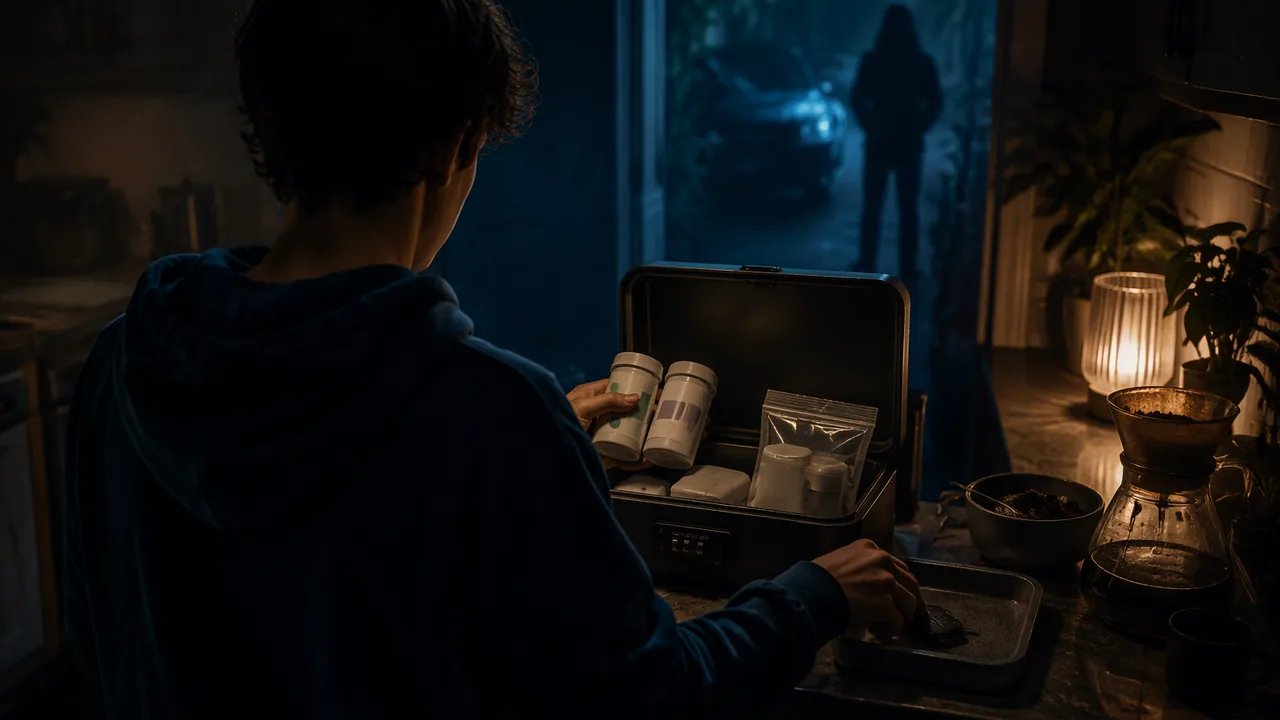
Storing and disposing of medicines. CDC advises keeping medicines where young children cannot reach or see them, checking that the cap is locked, and putting them back right after each use. For medicines that can be misused, such as opioid pain relievers, a locked box is safer. FDA’s disposal guidance puts drug take-back sites, pharmacy kiosks and prepaid mail-back envelopes first. If none is available, most medicines can go in household trash: mix them with something unappealing such as used coffee grounds, dirt or cat litter, seal the mix in a bag or container, and scratch personal information off the empty bottle. Flush a medicine only if it is on FDA’s flush list.
Alcohol and drugs do not fix stress or weight. Drinking to cope backfires: an NIAAA-supported study of young adults found that on days they drank to cope with social anxiety they drank more and had more negative consequences, a cycle of drinking to manage the effects of drinking. For weight, alcohol is the wrong tool: ethanol has 7 calories per gram, so the 14 grams in one standard drink add about 7 × 14 = 98, roughly 100 calories, with little other nutrition, according to the Dietary Guidelines Advisory Committee. Stimulants or nicotine used to suppress appetite bring dependence and heart risks. Sleep, activity, regular meals and talking to someone work better and last.
A personal drug-free goal. Use a SMART goal: specific, measurable, achievable, relevant and time-bound, for example “For the next four weeks I will stay vape-free and log every craving and what I did instead.” Name your barriers (friends who use, stress before tests, boredom, cravings) and plan a strategy for each: a refusal line, a ten-minute walk, deleting a seller’s contact, muting accounts that show vaping. Self-monitoring means tracking each day: did I meet the goal, what triggered a craving, which strategy worked. Review the log weekly with a trusted adult and adjust; a slip is information, not failure.
Impaired driving. NHTSA reports that in 2023, 12,429 people died in U.S. crashes involving a driver with a blood alcohol concentration of 0.08 g/dL or higher, 30% of all traffic deaths, about one every 42 minutes. In Missouri that year, 283 of 991 traffic deaths, 29%, were in alcohol-impaired crashes. Missouri law treats a driver as intoxicated when “under the influence of alcohol, a controlled substance, or drug, or any combination thereof” (RSMo 577.001), so driving high on cannabis or misused pills is driving while intoxicated (RSMo 577.010). For adults the limit is 0.08% (RSMo 577.012). For anyone under 21, Missouri’s zero-tolerance rule lets the state suspend or revoke a license for driving with as little as 0.02% blood alcohol after a traffic stop (RSMo 302.505). Since no one under 21 may legally drink, the only safe and legal number for a teen driver is zero.
Your plan for the ride. Never get in a car with a driver who has been drinking or using drugs. Healthy alternatives: call or text a parent or guardian for a pickup with no lecture that night (agree on this in advance), ride with a sober driver, use a rideshare or taxi with an adult’s account, stay over, or wait. Commit in writing, and use your voice: a friend is more likely to listen to you than to an ad. Persuasion works best when it is specific, respectful and offers a way out: “Give me your keys; I’ll text my mom, and she’ll take us both.”
📖 Read for this lesson
The reading opens over the lesson; close it to come back to exactly where you were. The checks below draw on it.
Formative check
Work through these before moving on. They are not graded — they tell you whether the standard below has landed yet.
Missouri standard: AOD1.12.4
You have a cold and a headache. Your cold medicine and your pain reliever both list acetaminophen under one Drug Facts heading. Which heading is it, and what should you do?
Missouri standard: AOD1.12.5
If no take-back site is available, FDA says most unused medicines can be mixed with something unappealing like used coffee grounds, sealed in a bag and thrown in the household trash.
Missouri standard: AOD1.12.12
A friend says a few drinks before bed help with stress and that skipping meals and drinking instead will help her lose weight. Which response is accurate?
Missouri standard: T6.12.3, AOD6.12.3, T6.12.4, AOD6.12.4, T6.12.5, AOD6.12.5, T6.12.6, AOD6.12.6
Write a four-week SMART goal to stay (or become) tobacco-, vape-, alcohol- or drug-free. (a) State the goal. (b) Name three barriers you are most likely to face. (c) For each barrier, write one specific strategy. (d) Design your self-monitoring log: the columns you will fill in each day. (e) Fill in three sample days, including one where a craving or pressure came up, and write what you will change in week 2 based on the log. Share the plan with a parent, guardian or other trusted adult if you choose.
Missouri standard: AOD7.12.6
Under Missouri’s zero-tolerance rule (RSMo 302.505), a driver under 21 can lose their license for driving with a blood alcohol content of percent or more.
Missouri standard: AOD5.12.8, AOD7.12.5
It is 11:30 p.m. Your ride home, an older friend, has been drinking and says he is “fine to drive, it’s only five minutes.” What is the healthiest choice?
Missouri standard: AOD7.12.6
Under Missouri law, which of these drivers is driving while intoxicated?
Missouri standard: AOD8.12.3, AOD8.12.4, AOD7.12.5, AOD7.12.6
Persuade and commit. (a) Write a 60-90 second message (a script for a short video, voice memo or social post) persuading people your age never to drive impaired and never to ride with an impaired driver. Use at least one figure from the reading (national or Missouri), one Missouri law, and one specific alternative people can use. (b) Write a two-sentence personal commitment: what you will never do, and what you will do instead. You may share it with a family member and ask them to agree to a no-questions-tonight pickup.
Medicines, a Drug-Free Goal and Impaired Driving: The Drug Facts Label, Safe Disposal, a Goal Log, and Missouri’s Impaired-Driving Laws and Data
FDA, The Over-the-Counter Drug Facts Label (current as of September 2, 2026); FDA, Where and How to Dispose of Unused Medicines (current as of April 16, 2025); CDC, Medication Safety (November 18, 2024); NIAAA research update (May 9, 2023); 2020 Dietary Guidelines Advisory Committee, Part D Chapter 11; NHTSA, Alcohol-Impaired Driving: 2023 Data, DOT HS 813 713 (May 2025); RSMo 302.505, 577.001, 577.010 and 577.012, revisor.mo.gov. The sample label, goal log and message model are SLS original. Retrieved 2026-11-06. · Public domain (U.S. and Missouri government works); sample label, goal log and message model SLS original
Why this reading. You will annotate a Drug Facts label, design a goal log, and write an impaired-driving message with real numbers and Missouri law. Everything you need is here.
1. The Drug Facts label, section by section (FDA)
| Section | What it tells you |
|---|---|
| Active ingredient(s) | The substance that causes the intended effect, and the amount in each dose |
| Purpose(s) | What the product does (its category of action) |
| Use(s) | Symptoms or conditions it treats or prevents |
| Warning(s) | When not to use it, when to ask a doctor first, interactions and side effects, when to stop, pregnancy or breastfeeding cautions, keep away from children |
| Directions | How much, how, how often and for how long |
| Inactive ingredients | Binders, colors, flavorings |
| Other information | Storage, and some ingredient amounts such as sodium |
FDA advice: read the label every time; similar brand names can contain different active ingredients; ask a doctor or pharmacist about anything unclear.
Sample label to annotate (SLS original, simplified): Active ingredient (in each tablet): acetaminophen 325 mg. Purpose: pain reliever/fever reducer. Uses: temporarily relieves minor aches and headache. Warnings: liver warning; do not use with any other drug containing acetaminophen; ask a doctor before use if you have liver disease. Directions: adults and children 12 and over: 2 tablets every 4 to 6 hours as needed; do not exceed the maximum stated on the package. Find: which section prevents a double dose if you also take a cold medicine? (Active ingredient plus the Warning.)
Prescription labels show the patient’s name, the drug and strength, how and when to take it, the prescriber, refills and warning stickers. A prescription is for that patient only.
2. Storing and disposing of medicines
- Store (CDC): where young children cannot reach or see; check that the cap is locked; put medicines back right after each use. Lock up medicines that can be misused, such as opioid pain relievers.
- Dispose (FDA), best first: a drug take-back site or event, a pharmacy drop-off kiosk, or a prepaid mail-back envelope.
- If none is available: mix medicines (not on the flush list) with used coffee grounds, dirt or cat litter; seal in a bag or container; put in household trash; scratch out personal information on the empty package. Flush only medicines on FDA’s flush list.
3. Why alcohol and drugs fail for stress and weight
- Stress: in an NIAAA-supported study of 257 people aged 18-25, on days they used alcohol to cope with social anxiety they drank more and had more negative consequences, suggesting a cycle of drinking to manage the effects of drinking.
- Weight: a U.S. standard drink holds 14 grams of ethanol (12 fl oz of 5% beer, 5 fl oz of 12% wine or 1.5 fl oz of 40% spirits); ethanol has 7 calories per gram, so 14 × 7 = 98, about 100 calories, before mixers, with little other nutrition (2020 Dietary Guidelines Advisory Committee).
4. A drug-free goal and a self-monitoring log (SLS original model)
Goal: “For the next four weeks I will stay vape-free and log every craving or offer and what I did instead.”
| Barrier | Strategy |
|---|---|
| Friends vape at lunch meetups | Refusal line ready; suggest a walk; sit with non-users |
| Stress before tests | Ten-minute walk or slow breathing; study plan |
| Feeds show vape content | Mute or unfollow accounts; delete seller contacts |
| Day | Goal met? | Trigger | Strength (1-5) | Strategy used | Worked? |
|---|---|---|---|---|---|
| Mon | Yes | None | – | – | – |
| Tue | Yes | Friend offered at the park | 4 | Refusal line, left early | Yes |
| Wed | Yes | Stress after practice test | 3 | Walk with the dog | Mostly |
Review weekly with a trusted adult; if one strategy is not working, change it. A slip is information about a barrier, not a reason to quit the goal.
5. Impaired driving: national and Missouri data (NHTSA, 2023)
| Measure | United States | Missouri |
|---|---|---|
| Total traffic deaths | 40,901 | 991 |
| Deaths in alcohol-impaired crashes (a driver at BAC 0.08+) | 12,429 (30%) | 283 (29%) |
| How often | one about every 42 minutes | about 5 a week (283 ÷ 52 ≈ 5.4) |
Other NHTSA findings for 2023: drivers aged 21-24 had the highest percentage (28%) of alcohol-impaired drivers in fatal crashes; 67% of alcohol-impaired-driving deaths involved a driver at BAC 0.15 or higher; of the 1,019 traffic deaths among children 14 and younger, 253 (25%) were in alcohol-impaired-driving crashes. NHTSA estimates BAC when test results are missing, so these figures include estimates. Check: 283 ÷ 991 = 28.6%, which NHTSA rounds to 29%; 525,600 minutes in a year ÷ 12,429 ≈ 42.
6. What Missouri law says
- Intoxicated condition (RSMo 577.001): “under the influence of alcohol, a controlled substance, or drug, or any combination thereof.” Driving high on cannabis or misused medicine counts.
- Driving while intoxicated (RSMo 577.010): operating a vehicle in an intoxicated condition is an offense; penalties rise for repeat offenders, for having a child under 17 in the vehicle, and for injuring or killing someone.
- Excessive blood alcohol (RSMo 577.012): driving with 0.08% or more (0.04% for a commercial vehicle).
- Zero tolerance under 21 (RSMo 302.505): the state shall suspend or revoke the license of a driver under 21 stopped for a traffic offense with a blood alcohol content of 0.02% or more.
7. A persuasive message model (SLS original)
“Five times a week, on average, someone in Missouri dies in a crash with a drunk driver. In Missouri, if you’re under 21, 0.02% is enough to lose your license, and driving high counts as driving while intoxicated. So here’s the deal: if you’ve been drinking or using, hand me your keys. If your driver has been, don’t get in. Text me, text your parents, call a sober adult. Nobody is too cool to get home alive.” Notice the structure: a local fact, the law, a specific alternative, and a respectful close.
Sources: FDA, The Over-the-Counter Drug Facts Label (content current as of September 2, 2026) (fda.gov); FDA, Where and How to Dispose of Unused Medicines (content current as of April 16, 2025) (fda.gov); CDC, Medication Safety (November 18, 2024) (cdc.gov); NIAAA, Alcohol and Other Substance Use To Cope With Social Anxiety (May 9, 2023) (niaaa.nih.gov); 2020 Dietary Guidelines Advisory Committee, Part D, Chapter 11: Alcoholic Beverages (dietaryguidelines.gov); NHTSA, Alcohol-Impaired Driving: 2023 Data (DOT HS 813 713, May 2025) (crashstats.nhtsa.dot.gov); RSMo 302.505, license suspension or revocation (0.02% for drivers under 21) (revisor.mo.gov); RSMo 577.001, definitions (intoxicated condition) (revisor.mo.gov); RSMo 577.010, driving while intoxicated (revisor.mo.gov); RSMo 577.012, driving with excessive blood alcohol content (revisor.mo.gov)