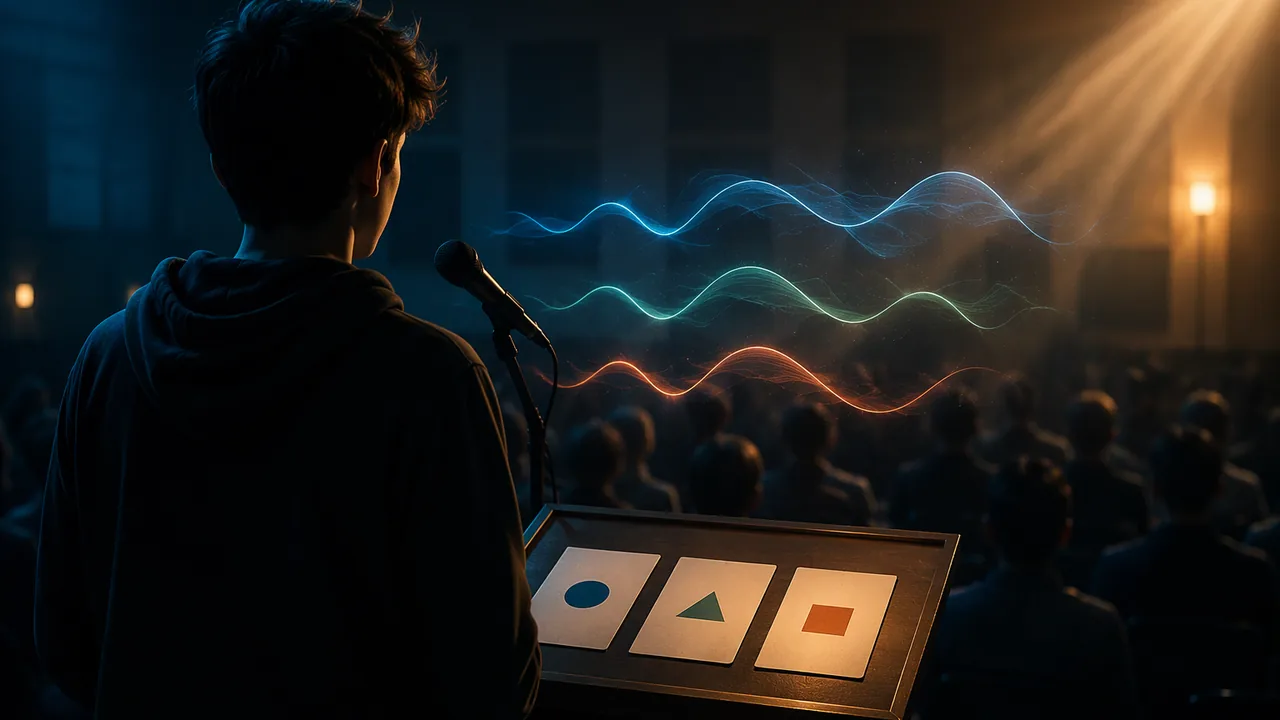
plan and draft a persuasive speech for a named audience and occasion, choosing structure, syntax and devices that work when heard once.
Instruction
Aristotle defined rhetoric as “the faculty of observing in any given case the available means of persuasion” (Rhetoric, trans. W. Rhys Roberts). The phrase that matters is in any given case. Your speech is for one audience, at one occasion. Start there, not with your topic.
Step 1 — Audience and occasion. Name a real audience that could act on your claim: the city council during public comment, the school board, a student assembly, a community meeting. Find out the constraints: public comment at many local meetings is limited to a few minutes per speaker. Ask what the audience already knows, what it values, and what it fears. 11-12.W.2.A asks for writing whose development, organization and style fit task, purpose and audience.
Step 2 — The three appeals. Aristotle names three modes of persuasion: the speaker’s character (ethos), the audience’s emotions (pathos) and the argument itself (logos). Plan all three. Ethos: why should this audience listen to you — as a student, a resident, someone affected? Logos: the claim, reasons and evidence. Pathos: one concrete case or image that makes the stakes felt. A speech with only pathos is manipulation; with only logos it is a report.
Step 3 — Structure for listeners. Readers can look back; listeners cannot. So: tell the audience where you are going; use numbered or clearly signposted reasons (“First … The second reason …”); summarize before you close. Put your strongest reason last or first, never in the middle. State the counterclaim fairly and answer it.
Step 4 — Syntax for the ear (11-12.W.3.A.d). Shorter sentences than in an essay, with deliberate exceptions. Balanced antitheses that the ear can catch (“not … but …”). One instance of anaphora at a climax. Concrete nouns and active verbs. Read every sentence aloud; if you run out of breath, split it.
Step 5 — Devices with a purpose. Choose at least three devices from the unit — antithesis, anaphora, metaphor, rhetorical question, a key term you redefine, accumulation — and know why each is where it is. A device you cannot justify should be cut.
Step 6 — Draft, record, revise (11-12.W.3.A). Draft the speech, then record a rehearsal. Listen back once as your audience would: where did you lose track? Where did a sentence sound written rather than spoken? Your peer reviewer will listen to the recording, not only read the script.
Routine writing (11-12.W.2.A). Speechwriters revise in many short passes. Keep a log of each pass and what changed; it is part of your Stage 2 submission.
Care in choosing a topic. Choose a public question, not a private one. You are never required to disclose personal experiences; you may speak for a group or from evidence.
Reading: Writing for the ear: Aristotle, two mentors and a model speech
Edmund Burke, Speech on Conciliation with America (House of Commons, 22 March 1775), Wikisource transcription of a 1918 school edition, footnote reference numbers removed; William Jennings Bryan, Speech at the Democratic National Convention (“Cross of Gold”), Chicago, 9 July 1896, Wikisource transcription; Mary Church Terrell, “What It Means to Be Colored in the Capital of the United States,” The Independent (New York), vol. 62, 24 January 1907, pp. 181-186, Internet Archive scan sim_independent_1907-01-24_62_3034, OCR text with line-break hyphens joined; retrieved 26 September 2026; Aristotle, Rhetoric, tr. W. Rhys Roberts (Oxford, 1924), Internet Classics Archive; sources fetched: Burke, Speech on Conciliation (Wikisource), https://en.wikisource.org/wiki/Burke%27s_Speech_on_Conciliation_with_America/Speech; Bryan, Cross of Gold (Wikisource), https://en.wikisource.org/wiki/Cross_of_Gold_Speech; Terrell (Internet Archive), https://archive.org/stream/sim_independent_1907-01-24_62_3034/sim_independent_1907-01-24_62_3034_djvu.txt; Aristotle, Rhetoric, tr. Roberts (Internet Classics Archive), https://classics.mit.edu/Aristotle/rhetoric.mb.txt · SLS original student model, revision and criteria; quoted passages are public domain (Aristotle, tr. Roberts, 1924; Burke, 1775; Bryan, 1896)
The model speech is invented for teaching and makes no claim about any real place. Plan yours for a real audience and occasion.
Aristotle wrote for people who had to persuade a crowd that could not stop the speaker and look back. Burke, Bryan and Terrell wrote under the same condition. Here are the definition you plan from, three mentor structures, a student model, and a revision.
The definition and the three modes
Aristotle, Rhetoric, Book I, chapter 2 (translated by W. Rhys Roberts, Oxford, 1924).
Rhetoric may be defined as the faculty of observing in any given case the available means of persuasion.
Of the modes of persuasion furnished by the spoken word there are three kinds. The first kind depends on the personal character of the speaker; the second on putting the audience into a certain frame of mind; the third on the proof, or apparent proof, provided by the words of the speech itself.
Mentor 1: signposts a listener can follow (Burke, 1775)
Burke is arguing against a House that wants force. Notice the words that tell the ear where it is: First, My next objection, A further objection. You can lose the thread of a written argument and find it again; a listener cannot.
First, Sir, permit me to observe that the use of force alone is but temporary. It may subdue for a moment, but it does not remove the necessity of subduing again; and a nation is not governed which is perpetually to be conquered.
My next objection is its uncertainty. Terror is not always the effect of force, and an armament is not a victory. If you do not succeed, you are without resource; for, conciliation failing, force remains; but, force failing, no further hope of reconciliation is left. Power and authority are sometimes bought by kindness; but they can never be begged as alms by an impoverished and defeated violence.
A further objection to force is, that you impair the object by your very endeavors to preserve it. The thing you fought for is not the thing which you recover; but depreciated, sunk, wasted, and consumed in the contest. Nothing less will content me than WHOLE AMERICA. I do not choose to consume its strength along with our own, because in all parts it is the British strength that I consume.
Mentor 2: one device at the climax (Bryan, 1896)
Bryan uses balanced pairs and repeats them until the last clause breaks the pattern: We beg no longer; we entreat no more; we petition no more. We defy them! The change of verb at the end is the point of the pattern.
We have petitioned, and our petitions have been scorned; we have entreated, and our entreaties have been disregarded; we have begged, and they have mocked when our calamity came. We beg no longer; we entreat no more; we petition no more. We defy them!
A student model, for the ear (SLS original)
Audience and occasion: a city council, public comment, three minutes. Claim: the council should keep the branch library open on Saturdays. This is an invented model; it makes no claim about any real city.
Good evening, members of the council. My name is [your name], and I have used the branch library every Saturday since I was eleven. I want to give you three reasons to keep it open, and then answer the reason you have been given to close it.
First, Saturday is the one day the branch is open when families are not at work. Second, the students who use it do not have a quiet room at home. Third, the cost is small: two staff, one day.
Some of you will say we can save money by opening it only on weekdays. That is a fair concern, and I share it. But a library that is open only when its readers are at work or at school is a building, not a service.
So the choice is not between saving money and spending it. It is between a library people can use and one they can only walk past. Please keep it open. Thank you.
Annotations (SLS original): ethos is the opening line (a resident and a user); logos is the three numbered reasons and the answer to the objection; pathos is the one image of a child without a quiet room; the signposts are First, Second, Third; the device is the antithesis “a library people can use and one they can only walk past.”
Before and after: writing for the ear (SLS original)
Before (written for the eye): Although some have argued that limiting hours would result in cost savings, it should be noted that such savings would be offset by the reduced access experienced by those who are unable to visit during the week.
After (for the ear): Some of you will say that shorter hours save money. They do. But they save it by closing the library on the one day working families can come.
The revision has short sentences, one signposted concession (They do.), a concrete noun (working families) and a verb the listener can hear (closing). Read both aloud to hear the difference.
Criteria for Stage 1 (SLS original)
- Audience and occasion are named, with the real constraint (time limit, room, who will act).
- One claim, three reasons with evidence, and a counterclaim answered fairly.
- Ethos, logos and pathos are each planned: one line for each.
- Signposts are audible (First, Second, Finally) and the speech is summarized before the close.
- Three devices, each with a purpose you can state in a sentence.
- A rehearsal recording, with a note of one place where a listener would get lost.
Formative check
Work through these before moving on. They are not graded — they tell you whether the standard below has landed yet.
Which choice best adapts a written argument for listeners?
A persuasive speech should rely mainly on emotional appeal, because audiences remember feelings.
Submit Stage 1: audience and occasion with its constraints; claim; three reasons with evidence; counterclaim and response; one ethos move, one concrete pathos image; three devices with their purposes. Then upload a first draft and a rehearsal recording, with a note on one place a listener would get lost.
How confident are you that you can plan and draft a speech that works when heard once by a particular audience?