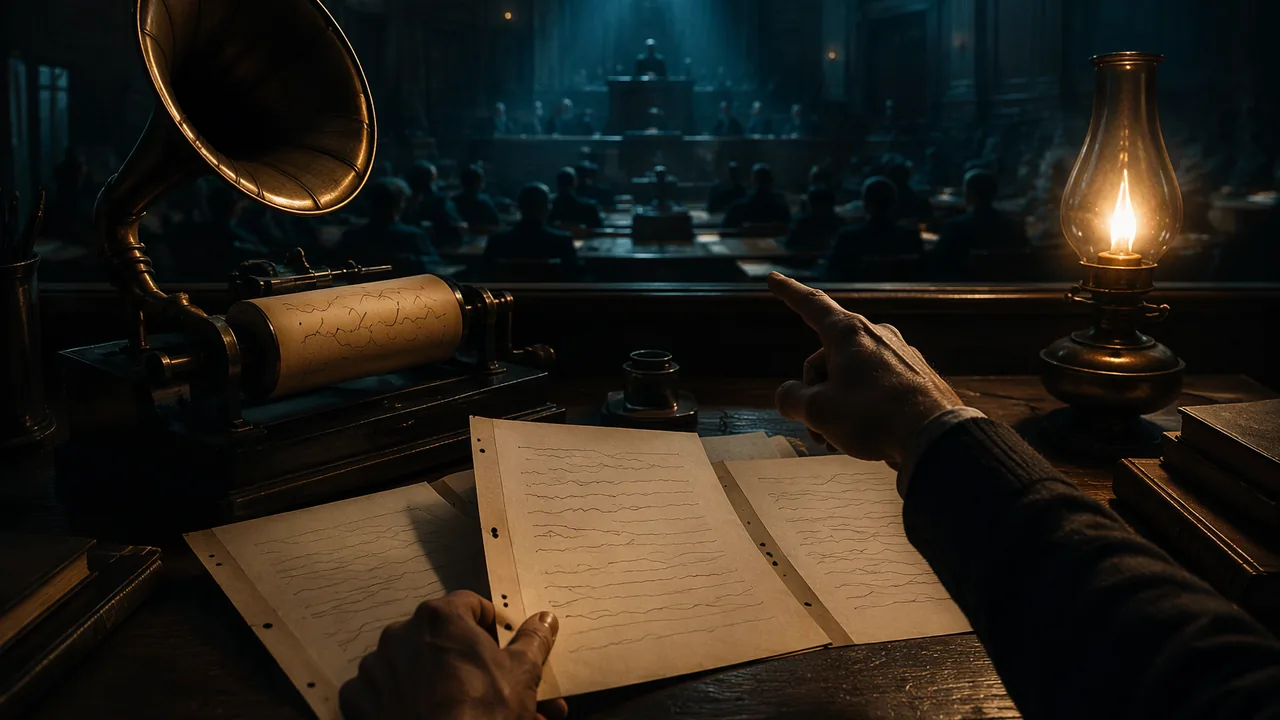
integrate a printed speech, a performance of it and a record of its occasion, and evaluate how the speaker adapts language and delivery to audience and setting.
Instruction
A printed speech is a transcript of something that happened once, in a room, with a crowd. To evaluate it you have to rebuild the event. This lab asks you to integrate three kinds of source (11-12.SL.1.C): the text, a performance, and a record of the occasion, and to notice what each reveals and hides.
Source 1: the printed text. What you read is not always what was said. Speeches were often revised before printing. Burke’s speech was published in 1775 in a version prepared for print, as parliamentary speeches of the time usually were. Bryan’s reached most Americans through newspaper reports, and printed versions of long speeches from this period often differ in small ways. Terrell’s address was printed in a magazine the following year. Treat the printed text as a version and ask who prepared it.
Source 2: a performance. Listen to a recorded reading of one speech — a classmate’s, a family member’s, or an archival or public-domain recording if you can find one. Note what the voice adds: where it pauses, what it stresses, where it speeds up. Then read the same passage aloud yourself and compare. Two performances of the same words can make different arguments.
Source 3: a record of the occasion. Find a short account of the occasion in a public-domain source — a newspaper report of the 1896 convention, the parliamentary record of the vote on Burke’s motion, or a description of Washington in 1906 — for example through the Library of Congress’s Chronicling America newspaper archive. How did the audience respond? What happened next? A speech that wins the room can lose the vote, as Burke’s did.
Evaluating adaptation (11-12.SL.2.A / 11-12.SL.2.B). The standard asks speakers to adapt speech to context and task. Evaluate each speaker’s adaptation: Burke speaks to a chamber of legislators, so he builds long chains of reasoning and concedes their premises before turning them. Bryan speaks to a convention hall before amplification, so he uses short, strongly balanced sentences that carry and applause lines that let the crowd answer. Terrell speaks to an audience of women in a club, so she uses first-person testimony that her listeners could not easily dismiss.
Evaluating reasoning (11-12.SL.1.B). Delivery can hide weak reasoning. Ask of each speech: what is the stance, what are the premises, and are the links between ideas sound? Bryan’s crowd cheered the crown of thorns; the image does not by itself prove that free silver would help farmers. Evaluate the rhetoric and the reasoning separately.
Come prepared (11-12.SL.1.A). Before the lab, read your chosen speech twice and mark three passages you want to hear aloud.
The lab. Complete a three-source comparison log for one speech: what the text shows, what the performance adds or changes, what the occasion record reveals. Then record a two-minute evaluation: how well did the speaker adapt to the audience and occasion, and where does the rhetoric outrun the reasoning? Reply to one classmate who chose a different speech.
Reading: Text, performance and occasion: passages and records
Edmund Burke, Speech on Conciliation with America (House of Commons, 22 March 1775), Wikisource transcription of a 1918 school edition, footnote reference numbers removed; William Jennings Bryan, Speech at the Democratic National Convention (“Cross of Gold”), Chicago, 9 July 1896, Wikisource transcription; Mary Church Terrell, “What It Means to Be Colored in the Capital of the United States,” The Independent (New York), vol. 62, 24 January 1907, pp. 181-186, Internet Archive scan sim_independent_1907-01-24_62_3034, OCR text with line-break hyphens joined; retrieved 26 September 2026; Encyclopaedia Britannica, 11th ed. (1911), “Bryan, William Jennings” and “Burke, Edmund”, Wikisource transcriptions; sources fetched: Burke, Speech on Conciliation (Wikisource), https://en.wikisource.org/wiki/Burke%27s_Speech_on_Conciliation_with_America/Speech; Bryan, Cross of Gold (Wikisource), https://en.wikisource.org/wiki/Cross_of_Gold_Speech; Terrell (Internet Archive), https://archive.org/stream/sim_independent_1907-01-24_62_3034/sim_independent_1907-01-24_62_3034_djvu.txt; Britannica 1911 “Bryan, William Jennings” (Wikisource), https://en.wikisource.org/wiki/1911_Encyclop%C3%A6dia_Britannica/Bryan,_William_Jennings; Britannica 1911 “Burke, Edmund” (Wikisource), https://en.wikisource.org/wiki/1911_Encyclop%C3%A6dia_Britannica/Burke,_Edmund · SLS original method, template and model; quoted passages are public domain (Burke, 1775; Bryan, 1896; Terrell, 1907; Encyclopaedia Britannica, 1911)
Use one speech for your log. The worked entries show the three kinds of evidence, each with what it cannot show.
A printed speech is a version of an event. This page gives you, for the three speeches, the printed text of a passage to perform, and for two of them a public-domain record of the occasion or of how the text was made. Your log compares them.
Source 1: the printed text, and what it preserves of the room
Bryan, 1896. The printed text carries stage directions in square brackets, so it records something of delivery. Find them in the passage below and in your copy of the full speech.
I would be presumptuous, indeed, to present myself against the distinguished gentlemen to whom you have listened if this were a mere measuring of abilities; but this is not a contest between persons. The humblest citizen in all the land, when clad in the armor of a righteous cause, is stronger than all the hosts of error. I come to speak to you in defence of a cause as holy as the cause of liberty—the cause of humanity.
Ah, my friends, we say not one word against those who live upon the Atlantic coast, but the hardy pioneers who have braved all the dangers of the wilderness, who have made the desert to blossom as the rose—the pioneers away out there [pointing to the West], who rear their children near to Nature’s heart, where they can mingle their voices with the voices of the birds—out there where they have erected schoolhouses for the education of their young, churches where they praise their Creator, and cemeteries where rest the ashes of their dead—these people, we say, are as deserving of the consideration of our party as any people in this country. It is for these that we speak. We do not come as aggressors. Our war is not a war of conquest; we are fighting in the defence of our homes, our families, and posterity. We have petitioned, and our petitions have been scorned; we have entreated, and our entreaties have been disregarded; we have begged, and they have mocked when our calamity came. We beg no longer; we entreat no more; we petition no more. We defy them!
Burke, 1775. A passage for the performance test: read it once as a statement of fact and once as advice to a House that will not want it.
First, Sir, permit me to observe that the use of force alone is but temporary. It may subdue for a moment, but it does not remove the necessity of subduing again; and a nation is not governed which is perpetually to be conquered.
My next objection is its uncertainty. Terror is not always the effect of force, and an armament is not a victory. If you do not succeed, you are without resource; for, conciliation failing, force remains; but, force failing, no further hope of reconciliation is left. Power and authority are sometimes bought by kindness; but they can never be begged as alms by an impoverished and defeated violence.
Terrell, 1907. A passage in which the repeated opening carries the delivery. Where would a speaker pause?
As a colored woman I might enter Washington any night, a stranger in a strange land, and walk miles without finding a place to lay my head. Unless I happened to know colored people who live here or ran across a chance acquaintance who could recommend a colored boarding-house to me, I should be obliged to spend the entire night wandering about. Indians, Chinamen, Filipinos, Japanese and representatives of any other dark race can find hotel accommodations, if they can pay for them. The colored man alone is thrust out of the hotels of the national capital like a leper.
Source 2: a performance you make (SLS original method)
- Read your chosen passage aloud once without preparing. Note where you ran out of breath.
- Mark the text: a slash for a short pause, a double slash for a long one, an underline under the two or three words you will stress, and an arrow up or down at the end of a sentence for pitch.
- Read it again from the marks and record it. If you find another reader’s recording, such as a classmate’s or an archival one, compare where the other voice paused with where you marked.
- Write one sentence: what argument did the second reading make that the first did not? For example, pausing before like a leper in Terrell makes the simile a separate act of accusation.
Source 3: records of the occasion, from public-domain reference works
The 1896 convention (Encyclopaedia Britannica, 1911).
In the Democratic national convention at Chicago in 1896, during a long and heated debate with regard to the party platform, Bryan, in advocating the “plank” declaring for the free coinage of silver, of which he was the author, delivered a celebrated speech containing the passage, “You shall not press down upon the brow of labour this crown of thorns; you shall not crucify mankind upon a cross of gold.” This speech made him the idol of the “silver” majority of the convention and brought him the Democratic nomination for the presidency on the following day.
How Burke’s printed speech was made (Encyclopaedia Britannica, 1911).
It is true that his manuscripts were blotted and smeared, and that he made so many alterations in the proofs that the printer found it worth while to have the whole set up in type afresh.
The 1911 entry does not report the vote on Burke’s motion or the response of the House on the night. If you need it, find it in a parliamentary record or a newspaper archive, and cite the source. The three-source log asks what a record can and cannot show, and this gap is an example of the second.
Log template and a worked entry (SLS original)
- What the printed text shows: Bryan’s bracketed direction pointing to the West shows that the speaker used a gesture at this line, and that whoever prepared the printed version chose to keep it.
- What a performance adds or changes: the run of we have petitioned … we beg no longer … we defy them is read faster as it goes, and the final words can be stopped short. A slow reading turns the passage into a complaint; a fast one turns it into a threat.
- What the record of the occasion reveals: Britannica says the speech made Bryan the idol of the silver majority and brought him the nomination on the following day, so the room, at least, was persuaded. That does not show that the reasoning was sound; the next entry asks about that.
A model two-minute evaluation (SLS original)
Bryan adapted his speech to a convention that was already divided on the currency, and he did it by turning a platform debate into a matter of principle. He tells the delegates that the debate is not “a mere measuring of abilities” but a cause, and he speaks for “the people for whom we speak,” not for himself. His delivery gestures, like pointing to the West, make the imagined farmer present in the hall. The occasion rewarded him: according to the Britannica, the speech won him the nomination the next day. But persuasion in the room is not proof. When he says that if cities burn they will “spring up again as if by magic,” while a ruined farm leaves grass in the streets, the sentence is vivid and unproved. It is antithesis carrying an assumption, and the applause it earned tells me nothing about whether cities depend on farms in the way he says. So the rhetoric was excellent for the room and the reasoning was thinner than the rhetoric.
Formative check
Work through these before moving on. They are not graded — they tell you whether the standard below has landed yet.
Why should you treat the printed text of a historical speech as “a version”?
A speech that moves its audience powerfully has necessarily used sound reasoning.
Complete the three-source log for one speech: what the printed text shows; what a performance adds or changes; what a record of the occasion reveals. Then draft your two-minute evaluation of how the speaker adapted to audience and occasion, and where the rhetoric outruns the reasoning.
How confident are you that you can integrate text, performance and occasion to evaluate a speech?