define play and game using the formal elements, place a game in the long history of human play, and explain why the Supreme Court treated video games as expression.
Instruction
Everyone has played, but few people can say precisely what a game is. Designers need that precision, because you cannot improve something you cannot name. This lesson gives you three tools: a definition of play, a list of the formal elements every game has, and a sense of where today’s games came from.
Play comes first. The Dutch historian Johan Huizinga argued in Homo Ludens (1938) that play is older than culture: animals play, children play before they can speak, and play is voluntary, set apart from ordinary life and governed by its own rules. The French sociologist Roger Caillois later sorted play into four kinds: agon (competition, as in chess or a race), alea (chance, as in dice), mimicry (pretending, as in make-believe or role-play) and ilinx (vertigo, the dizzy thrill of a swing or a spinning ride). Most video games mix several. A racing game is agon and ilinx; a card battler adds alea. Play also teaches: children learn turn-taking, fairness and strategy through games long before school names those skills.
A game is play with structure. Game designers commonly break any game into formal elements: players (how many, and in what relationship), objectives (what counts as winning or succeeding), procedures (the actions you take), rules (what is allowed and what follows), resources (what is scarce: lives, time, cards, coins), conflict (what stands in your way), boundaries (where the game stops and ordinary life starts) and outcome (how it ends). Try it on tic-tac-toe: two players; objective, three in a row; procedure, place one mark per turn; rule, you cannot mark a filled square; resource, empty squares; conflict, your opponent blocks you; boundary, the grid; outcome, win, lose or draw. If you can fill in all eight for a game, you understand its skeleton.
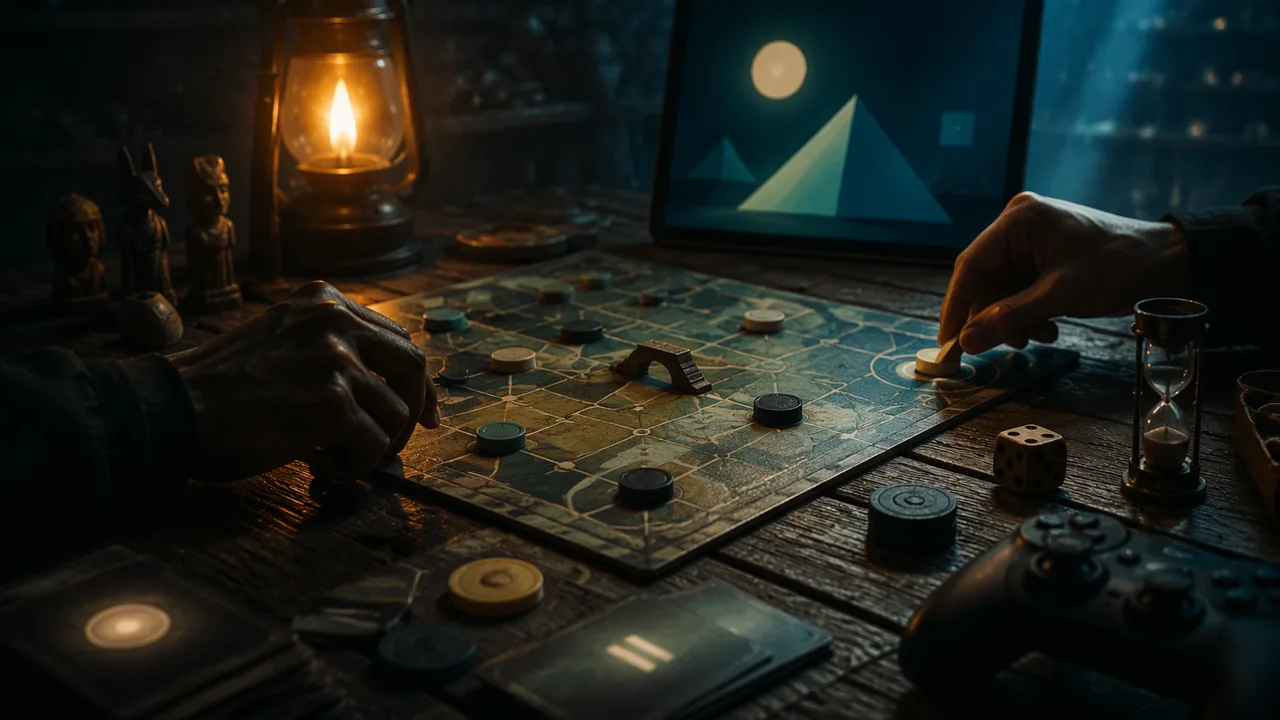
Games are ancient and global. The Royal Game of Ur was played in Mesopotamia more than four thousand years ago, and Senet in ancient Egypt. Mancala games, in which seeds move around rows of pits, have been played across Africa for centuries. Go comes from ancient China; chess descends from the Indian game chaturanga; the Aztec game patolli was a race game played with beans as dice. Many Native nations of North America play hand games, in which teams hide marked pieces and guess while singing. These are not a prelude to “real” games: they are designs so good they have lasted for millennia.
Then came computers. In 1958 physicist William Higinbotham built Tennis for Two on an oscilloscope for visitors to Brookhaven National Laboratory. In 1962 students at MIT created Spacewar! on a PDP-1 computer. In 1972 the Magnavox Odyssey, designed by Ralph Baer, brought games to home televisions, and Atari released Pong. In 1976 the Fairchild Channel F, developed by a team led by engineer Jerry Lawson, pioneered interchangeable programmable game cartridges. Game technology has since spread into other fields: flight and driving simulators, surgical training and serious games for education all use the same techniques.
Why it matters. The Supreme Court case in today’s reading began with a state law restricting the sale of violent video games to minors. The Court held that video games communicate ideas through familiar devices and through the player’s own interaction. That last phrase is the designer’s territory: in a game, meaning comes from what the player does, not only from what the player sees.
📖 Read for this lesson
The reading opens over the lesson; close it to come back to exactly where you were. The checks below draw on it.
Reading: Video games as expression
Brown v. Entertainment Merchants Association, 564 U.S. 786 (2011), opinion of the Court delivered by Justice Scalia · Public domain (U.S. government work)
A state law restricted the sale or rental of violent video games to minors. The Court struck it down, 7-2; Justices Thomas and Breyer dissented. Underline the two kinds of features the Court says games use to communicate.
Like the protected books, plays, and movies that preceded them, video games communicate ideas—and even social messages—through many familiar literary devices (such as characters, dialogue, plot, and music) and through features distinctive to the medium (such as the player’s interaction with the virtual world). That suffices to confer First Amendment protection.
Formative check
Work through these before moving on. They are not graded — they tell you whether the standard below has landed yet.
Objective
Tap to revealWhat counts as winning or succeeding
Procedure
Tap to revealAn action a player can take, such as rolling or jumping
Resource
Tap to revealSomething scarce that players manage: lives, time, cards, coins
Boundary
Tap to revealWhere the game stops and ordinary life starts
Alea
Tap to revealPlay based on chance
Ilinx
Tap to revealPlay based on vertigo or physical thrill
In a game of musical chairs, which formal element are the chairs?
The Supreme Court held in Brown v. Entertainment Merchants Association that video games are not protected speech because players interact with them.
Break one non-digital game you know well into all eight formal elements. Then name the kind or kinds of play (agon, alea, mimicry, ilinx) it offers, and one thing a child learns by playing it.
How confident are you that you can define play and game with the formal elements and place a game in the history of play?
Practice
Work these on paper or in your notebook, then open Check your answer. Aim for all of Fluency and Application; try at least one Challenge.
Printable version: this unit’s practice workbook (PDF)
Fluency
Build speed and accuracy with the core skill.
- List the eight formal elements that every game has.
Check your answer
Answer: Players, objectives, procedures, rules, resources, conflict, boundaries and outcome.If you can fill in all eight for a game, you understand its skeleton. A memory aid: who plays, what they want, what they do, what is allowed, what is scarce, what is in the way, where it stops, how it ends. - Name Caillois’s kind of play for each: (a) a foot race; (b) rolling dice to see who goes first; (c) playing make-believe pirates; (d) the dizzy thrill of a spinning ride.
Check your answer
Answer: (a) agon; (b) alea; (c) mimicry; (d) ilinx.Agon is competition, alea is chance, mimicry is pretending and ilinx is vertigo. - Put these early digital games and machines in order and give the year of each: Pong, Tennis for Two, Fairchild Channel F, Spacewar!
Check your answer
Answer: Tennis for Two (1958), Spacewar! (1962), Pong (1972), Fairchild Channel F (1976).Tennis for Two ran on an oscilloscope at Brookhaven; Spacewar! was made by MIT students on a PDP-1; Pong came from Atari the same year as the Magnavox Odyssey; the Channel F, developed by a team led by Jerry Lawson, pioneered interchangeable programmable cartridges.
Application
Use the skill in context. Show your reasoning.
- Break hide-and-seek into all eight formal elements.
Check your answer
Answer: Players: one seeker against several hiders. Objective: hiders stay unfound (or reach base); the seeker finds everyone. Procedures: the seeker counts, hiders hide, the seeker searches. Rules: no peeking while counting; hiders stay inside the agreed area. Resources: hiding places and time. Conflict: the seeker hunting the hiders. Boundaries: the agreed play area. Outcome: everyone found (seeker wins) or someone stays hidden.Any reasonable version is fine if all eight are filled in and each fits its definition. The resource is what is scarce: good hiding spots and the counting time. - A kart-racing game has players race each other, take sharp turns at high speed and grab random item boxes. Which kinds of play does it mix? Give the feature that supplies each.
Check your answer
Answer: Agon (racing against other players), ilinx (the thrill of speed and sharp turns) and alea (random item boxes).The lesson notes that most video games mix several kinds of play; a racing game is agon and ilinx, and random items add alea. - In Brown v. Entertainment Merchants Association (2011), the Court said video games communicate in two kinds of ways. Name both and explain why the second one is called the designer’s territory.
Check your answer
Answer: (1) Familiar literary devices such as characters, dialogue, plot and music; (2) features distinctive to the medium, such as the player’s interaction with the virtual world. The second is the designer’s territory because in a game, meaning comes from what the player does, which the designer shapes through rules and mechanics.A strong answer names both kinds and connects interaction to design decisions, not only to visuals or story. - Someone says the Royal Game of Ur, Senet and mancala were just a warm-up before “real” games were invented. Use the lesson to answer them in two or three sentences.
Check your answer
Answer: Model answer: These games were played thousands of years ago (Ur more than four thousand years ago in Mesopotamia), and mancala games have been played across Africa for centuries. Designs that have lasted for millennia are not a prelude; they are very good designs, with the same formal elements as any video game.Must include a fact about their age or spread from the lesson and the point that lasting so long shows design quality.
Challenge
Stretch problems. Expect to think before you write.
- Change exactly one formal element of tic-tac-toe (for example, its boundary or its objective). State the change, then predict how the game would play differently.
Check your answer
Answer: Model answer: Boundary changed from a 3 × 3 grid to a 4 × 4 grid while the objective stays three in a row. With more empty squares (more resources) and more possible lines, it is easier to build two threats at once, so draws become rarer.Any change works if exactly one element changes and the prediction follows from it. Strong answers name the element and say what happens to the others.
Review
Keep earlier skills sharp.
- Warm-up recall: define play as Huizinga describes it, and give one thing children learn through games before school names the skill.
Check your answer
Answer: Play is voluntary, set apart from ordinary life, governed by its own rules and done for its own sake. Children learn turn-taking, fairness or strategy.Huizinga argued in Homo Ludens (1938) that play is older than culture: animals and very young children play.
Eight Formal Elements, Worked on Nim, Mancala and Spacewar!
SLS original worked breakdown; rules of Nim and mancala are traditional and public domain; Spacewar! facts summarized from a public reference, read 2026-09-26 · SLS original; game rules public domain
Why this reading. The lesson asks for a formal-elements breakdown of one non-digital and one digital game, and a response to the Brown excerpt. This reading breaks down three games in full so you can see what a finished breakdown looks like, and it supplies the rules of each so you can check my table against the game. The game descriptions are SLS original wording of public-domain rules; the Spacewar! facts are summarized from a public reference read on Sept. 26, 2026.
Three rule sets
Nim (13 stones). Two players share one pile of 13 stones. On your turn you take 1, 2 or 3 stones. Whoever takes the last stone wins.
Mancala (a common two-row variant). The board has two rows of six pits and a store at each end; each pit starts with 4 seeds, 48 in all. On your turn, pick up every seed in one pit on your side and sow them one per pit, counterclockwise, including your own store and skipping your opponent’s. If your last seed lands in your own store, take another turn. When one side is empty, the other player keeps the seeds left on their side. The bigger store wins. Many mancala games exist across Africa and Asia; this is one common rule set.
Spacewar! (1962). Made at MIT for the DEC PDP-1 computer, it was for exactly two players. Each controls a ship, nicknamed the needle and the wedge. Ships rotate clockwise or counterclockwise, thrust forward, fire torpedoes and can jump to hyperspace, which is a random teleport that grows riskier each use. A star in the middle pulls on both ships. Ammunition and fuel are limited, and a ship leaving one edge of the screen comes back on the opposite edge. A ship is destroyed by a torpedo, the star or a collision.
The eight elements, side by side
| Element | Nim | Mancala | Spacewar! |
|---|---|---|---|
| Players | Two, taking turns | Two, taking turns | Two, at the same time |
| Objective | Take the last stone | Finish with more seeds in your store | Destroy the other ship |
| Procedures | Take 1, 2 or 3 stones | Pick up a pit and sow its seeds one at a time | Rotate, thrust, fire a torpedo, jump to hyperspace |
| Rules | You must take at least 1 and at most 3; no passing | Sow counterclockwise, skip the opponent’s store; last seed in your own store earns another turn | A central star pulls on both ships; anything leaving one screen edge returns on the opposite edge |
| Resources | Stones left in the pile | Seeds in each pit; extra turns | Torpedoes and fuel, which are limited |
| Conflict | The opponent is trying to leave you a losing count | The opponent’s captures and your own crowded pits | The opponent’s torpedoes, and the star |
| Boundaries | The pile is all there is | The board: two rows of six pits and two stores | The screen, which wraps around instead of ending |
| Outcome | The player who takes the last stone wins; no draws | The bigger store wins; a draw is possible | The last ship flying wins |
Something the table reveals
Nim looks like a game of chance, but it is not. Count what is left after your move. If you leave 12, 8, 4 or 0 stones, your opponent cannot escape: whatever they take (1, 2 or 3), you take the number that brings that round’s total to 4. With 13 stones the first player takes 1, leaves 12 and can always win. A designer would say Nim has a dominant strategy, so it stops being a game once both players know it. Check it by playing a few rounds against a friend or by drawing the tree of moves on paper.
Kinds of play
Nim is agon (competition). Mancala is agon with a little mimicry if you call the seeds a harvest. Spacewar! is agon plus ilinx: the thrill of falling toward the star and slingshotting away.
Responding to Brown
Your two paragraphs have two jobs. Paragraph one: name the two kinds of features the Court says games use (familiar literary devices such as characters, dialogue, plot and music, and features distinctive to the medium such as the player’s interaction with the virtual world). Paragraph two: apply the second kind to your digital game. In Spacewar!, for example, the meaning is in what the player does: the pull of the star makes every turn a choice between risk and safety. Say what your game means through its rules and actions, not only its pictures.
Sources: Spacewar! (Wikipedia, facts only) (en.wikipedia.org)