compare how games tell stories through embedded narrative, environment and player action, and outline a character and world that serve a core mechanic.
Instruction
Film and novels tell stories to an audience. Games tell stories with a player, who makes choices, fails, retries and wanders off. That changes every tool a storyteller uses.
Two kinds of narrative. Embedded narrative is the story the designers wrote in advance: cut-scenes, dialogue, a letter found in a drawer. Emergent narrative is the story that happens because of the rules: the time your last soldier held the bridge, or a friend’s farm flooded the night before the harvest festival. Strategy and simulation games lean on emergent stories; adventure games lean on embedded ones; most games mix both.
Structure still helps. Many games use a familiar three-act shape: a setup that establishes the world and the want, a confrontation in which obstacles escalate, and a resolution. Games often map acts to worlds or chapters, and escalate difficulty with the stakes, so the hardest challenge arrives with the emotional climax. Branching stories let players choose, but every branch costs content, so designers often use branches that rejoin, or choices that change tone and characters’ attitudes rather than the whole plot.
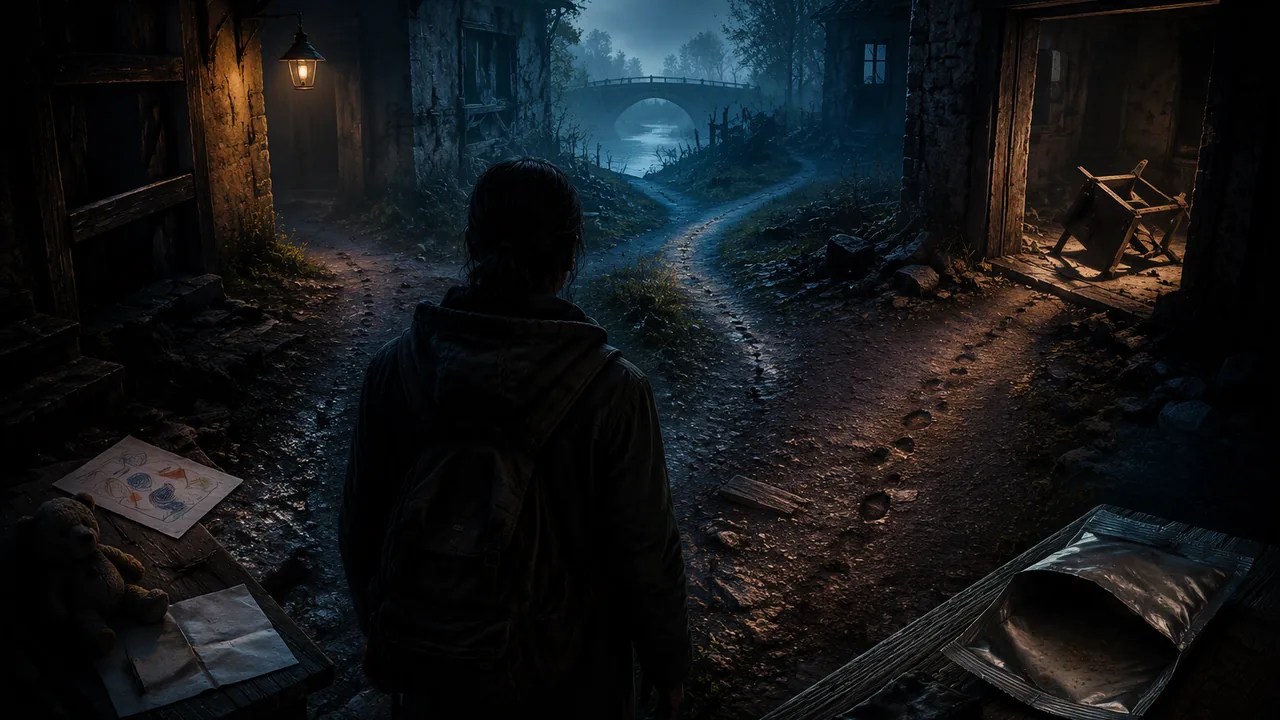
Environmental storytelling. A world can tell a story without a word: an overturned table and a trail of footprints, a village with boarded windows, a child’s drawing on a wall. Players who discover a story feel ownership of it. The best environmental storytelling also guides play: the trail of footprints leads somewhere.
Story and mechanics should agree. When a story says a character is desperate and hunted, but the mechanics let the player stroll around collecting flowers with no danger, players feel the gap. Designers sometimes call this ludonarrative dissonance. When they agree, each strengthens the other: in a survival story, a scarce-food mechanic makes the player feel the hunger the story describes.
Characters. A strong game character has a clear want (what they pursue), a need (what they must learn or face) and an obstacle. Visually, a readable silhouette lets players recognize a character in a fraction of a second, even small and in motion. Give characters verbs: a character defined by what the player can do as them is more memorable than one defined only by backstory.
Perspective. First person puts the camera in the character’s eyes, which is immersive but hides the character’s body and face. Third person shows the character from behind or above, so players see animation and personality. Second person (“you”) is rare in games; it appears in text adventures and in games that show the player’s character through another’s eyes. A top-down or side-on view is a kind of third person that trades intimacy for clarity.
World-building means deciding a world’s rules, history, cultures and conflicts, and keeping them consistent. Represent people with care. If your world draws on a real culture, research it from sources written by members of that culture, avoid stereotypes, and consider who is shown as heroic, who as monstrous and who is missing. A world that includes many kinds of people is more interesting and reaches more players.
Immersion grows when story, world and mechanics agree and when nothing reminds players that they are “just” playing. Your character and world sheet today should name the core mechanic and show how the story makes it matter.
📖 Read for this lesson
The reading opens over the lesson; close it to come back to exactly where you were. The checks below draw on it.
Formative check
Work through these before moving on. They are not graded — they tell you whether the standard below has landed yet.
In a city-building game, a player remembers “the year the fire spread because I never built a fire station”. What kind of narrative is this?
A designer wants players to see their character’s animations and expressions during combat. Which perspective best supports that?
Draft your character and world sheet: the character’s want, need and obstacle; three verbs the player can do as them; the world’s one most important rule; and one sentence explaining how the story makes your core mechanic matter.
How confident are you that you can compare narrative techniques and outline a character and world that serve a mechanic?
Practice
Work these on paper or in your notebook, then open Check your answer. Aim for all of Fluency and Application; try at least one Challenge.
Printable version: this unit’s practice workbook (PDF)
Fluency
Build speed and accuracy with the core skill.
- Embedded or emergent narrative? (a) a cut-scene where the hero leaves home; (b) the time your last soldier held the bridge; (c) a letter found in a drawer; (d) a friend’s farm flooded the night before the harvest festival.
Check your answer
Answer: (a) embedded; (b) emergent; (c) embedded; (d) emergent.Embedded narrative is written in advance; emergent narrative happens because of the rules and players’ choices. - Name the three acts of the familiar story shape and say how games often map them onto play.
Check your answer
Answer: Setup (establishes the world and the want), confrontation (obstacles escalate), resolution. Games often map acts to worlds or chapters and escalate difficulty with the stakes, so the hardest challenge arrives with the emotional climax.Structure still helps even when the player is making choices. - Give one strength and one limit of first-person and of third-person perspective.
Check your answer
Answer: First person: immersive, but hides the character’s body and face. Third person: players see animation and personality, but it is less intimate; top-down or side-on views trade intimacy for clarity.Second person (“you”) is rare and appears in text adventures.
Application
Use the skill in context. Show your reasoning.
- A story says the hero is starving and hunted, but the player can stroll around picking flowers with no danger. Name the problem and suggest one mechanic that would fix it.
Check your answer
Answer: Ludonarrative dissonance: story and mechanics disagree. Fix: a scarce-food mechanic (or a pursuing enemy) so the player feels the hunger or danger the story describes.When story and mechanics agree, each strengthens the other. - A character is a lighthouse keeper who wants to keep ships safe, needs to accept help from the villagers and is blocked by a storm that knocks out the lamp. Label the want, need and obstacle, and give three verbs the player could do as her.
Check your answer
Answer: Want: keep ships safe. Need: accept help from the villagers. Obstacle: the storm that knocks out the lamp. Model verbs: climb, repair, signal (other fitting verbs are fine).A character defined by what the player can do as them is more memorable than one defined only by backstory. - Design one piece of environmental storytelling for an abandoned school level that also guides the player where to go.
Check your answer
Answer: Model answer: chairs knocked over in a line leading out of a classroom and a trail of dropped papers running toward the gym doors, suggesting everyone left in a hurry and pointing the way.Strong answers tell a story without words and lead somewhere, as the lesson’s trail of footprints does. - A story has three choice points, and each choice splits into 2 branches that never rejoin. How many different paths are there? How does the lesson suggest controlling that cost?
Check your answer
Answer: 8 paths. Use branches that rejoin, or choices that change tone and characters’ attitudes rather than the whole plot.2 × 2 × 2 = 8. Every branch costs content. - Your world draws on a real culture. List three things the lesson says to do.
Check your answer
Answer: Research it from sources written by members of that culture; avoid stereotypes; consider who is shown as heroic, who as monstrous and who is missing.A world that includes many kinds of people is more interesting and reaches more players.
Review
Keep earlier skills sharp.
- Review (Lesson 2.4): what is the “intended experience” line in a one-page design document, and how does it connect to today’s lesson?
Check your answer
Answer: The aesthetic you want (such as tension or discovery) and the mechanic you expect to produce it. Story and world should support that same mechanic.Today’s character and world sheet must show how the story makes the core mechanic matter.
Story in Games: The Immortal Game as Emergent Narrative, and a Model Character and World Sheet
SLS original analysis; chess game record is historical and public domain (moves checked for legality in python-chess); game facts read 2026-09-26 · SLS original; chess record public domain
Why this reading. The lesson asks you to analyze the story structure of one game and to draft a character and world sheet. You may pick your own game; this reading shows a complete analysis of a game whose record is public domain, the “Immortal Game” of chess, and a complete character and world sheet for an invented game, so you have a pattern for both. The chess record is historical; the analysis and the sheet are SLS original.
Emergent narrative in a game nobody scripted
In 1851, in London, Adolf Anderssen (White) beat Lionel Kieseritzky (Black) in a friendly game played during a break in the London tournament (the exact venue is uncertain). Chess has no plot, yet this game is retold as a story. Its 23 moves, which I checked move by move for legality and for the final checkmate with a chess program:
1. e4 e5 2. f4 exf4 3. Bc4 Qh4+ 4. Kf1 b5 5. Bxb5 Nf6 6. Nf3 Qh6 7. d3 Nh5 8. Nh4 Qg5 9. Nf5 c6 10. g4 Nf6 11. Rg1 cxb5 12. h4 Qg6 13. h5 Qg5 14. Qf3 Ng8 15. Bxf4 Qf6 16. Nc3 Bc5 17. Nd5 Qxb2 18. Bd6 Bxg1 19. e5 Qxa1+ 20. Ke2 Na6 21. Nxg7+ Kd8 22. Qf6+ Nxf6 23. Be7#
Structure, with moves as evidence
- Setup (moves 1 to 4). White offers a pawn (2. f4) and gives up castling by moving the king (4. Kf1). The want: attack at any cost.
- Confrontation (moves 5 to 17). Both sides trade threats. Black’s queen raids White’s side (17 … Qxb2) and wins material.
- Escalation (moves 18 to 22). White gives up a rook (Black takes it on move 18), the other rook (move 19) and the queen (22. Qf6+, captured by the knight). By the usual 9-5-3-3-1 point count, at the end White has 15 points of pieces and pawns and Black has 36.
- Resolution (move 23). Be7 is checkmate. White wins with a bishop and two knights while Black still holds a queen, two rooks and two bishops.
Notice what makes it a story: the stakes rise as the sacrifices grow, the reversal is a surprise, and the ending recasts every move. The rules did not write it; the players’ choices did. That is emergent narrative. A letter found in a drawer in an adventure game is embedded narrative.
Character and world sheet for an invented game (SLS original): Dam Break
| Part | Entry |
|---|---|
| Character | Ines, a seed keeper in a river-bottom farm town on the Missouri River (an invented town) |
| Want | Get her neighbors’ seed to the far bank before the dam breaks |
| Need | To accept that she cannot save everything, and to trust the town to help |
| Obstacle | The river, and her own wish to carry too much |
| Verbs the player does as Ines | Load seeds, row, choose how much to risk |
| The world’s most important rule | When the water reaches 4, the dam breaks, and anything still on the river is lost |
| Perspective | Top-down, so the boat, the seeds and the water can all be seen |
| Why the story makes the mechanic matter | Each seed is a family’s crop, so choosing to load a third seed means choosing to gamble a neighbor’s harvest |
The pattern to copy: name the want, need and obstacle; give the character verbs that come from the mechanic; state one world rule; and say in one sentence why the story makes the core mechanic matter.
Sources: The Immortal Game (Wikipedia, facts and move list) (en.wikipedia.org)