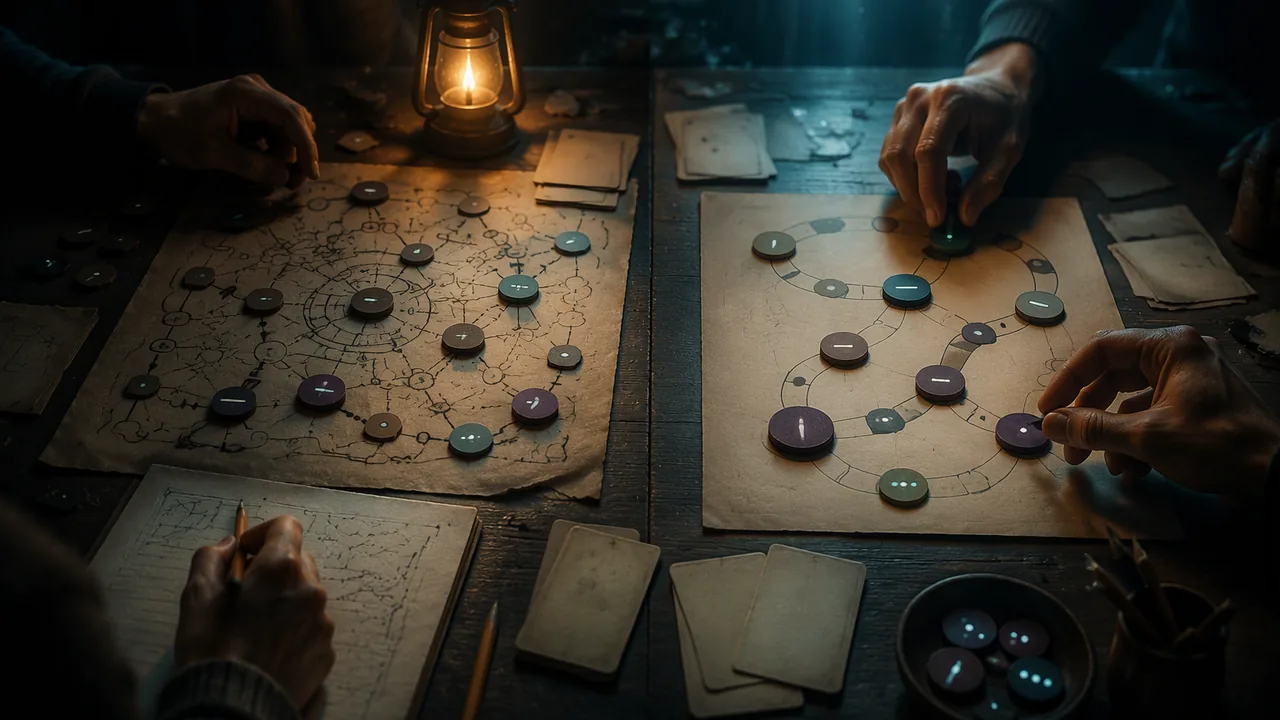
playtest my paper game in two sessions with family players (or a structured self-playtest), change rules based on evidence, and present the revised game with a design document, process flowchart and iteration log in a recording.
Instruction
This project is where you practice the habit that separates designers from people with ideas: changing your game because of what players actually did.
Who plays. Your playtesters are family members, or other adults or siblings you know, playing in person at home. Never recruit strangers online. Before you start, read a short consent script: “I’m testing a game I designed for my game design course. I’ll take notes on what you do and say, not on how well you play. You can stop at any time. Is that OK?” Take written notes; do not record video or audio of anyone under 18 without a parent’s OK. If no one is available for a session, run a structured self-playtest: set the game aside for at least a day, play both sides strictly from the written rules, and log every pause, guess and dead turn as if a stranger had made it.
Running the playtest. Explain the goal of the game in two sentences, hand over the rules and then stay quiet. Watch and write. Record what players did (“both players ignored the trade rule”), what they said (“wait, can I move twice?”) and when they looked bored or excited. Resist explaining: every time you want to explain, a rule is unclear, so write that down instead. After the game, ask three open questions: What was the most interesting decision you made? When were you bored or confused? If you could change one rule, which would it be?
From observations to changes. Sort your notes into three piles: clarity (players misunderstood a rule), balance (a strategy was too strong, a player was knocked out early, one side always won) and experience (the game felt different from what you intended). Choose at least two changes, and for each one write the evidence, the change and your prediction. Then test the revised game in a second session, with a different player if you can, and check whether your prediction came true. A change that made things worse is still a success if you can explain why; that is what the iteration log is for.
Change one thing at a time where you can. If you change four rules at once and the game improves, you will not know which change helped. Professional designers often test one change per session for exactly this reason.
The iteration log (400-600 words) covers: the original rule set in brief; what you observed in test 1; each change, with the evidence and prediction; what happened in test 2; and one challenge you expect in future iteration, such as a rule that still feels fragile. Write it as technical prose, not a diary: precise, past tense, evidence first.
The process flowchart shows the process you actually followed, not the ideal one, with the backward arrows labeled by the evidence that sent you back.
The presentation is recorded: five minutes to explain your design goal, your process and what changed and why, then a demonstration round, played with a family member or played by you while you narrate both sides. If a family member appears on camera, get a parent’s OK first; pointing the camera at the table so only hands and pieces show works well. Finish with a short written self-critique against the rubric.
📖 Read for this lesson
The reading opens over the lesson; close it to come back to exactly where you were. The checks below draw on it.
Formative check
Work through these before moving on. They are not graded — they tell you whether the standard below has landed yet.
In test 1, three of four players never used the trading rule. What is the best next step?
Write the evidence, change and prediction for your first rule change, in three sentences.
How confident are you that you can change a game’s rules based on playtest evidence and explain each change?
Unit 2 checkpoint
Do this before you start the task. It covers the whole unit and tells you what to review first.
All content is in the game and the team is mainly fixing bugs. Which milestone?
A vertical slice is a rough prototype that tests one design question.
In a process flowchart, what shape stands for a decision such as “Is it fun?”
Which node detects the player entering it without blocking them?
The text “Final score: %d” % 9 displays Final score: . When the Timer runs out it emits the signal.
Changing the sprite in Coin.tscn updates every Coin instance in Main.tscn.
In a strategy game, the player with the most farms earns the most food, which buys more farms. This is…
With two six-sided dice, a sum of 8 happens ways out of 36, and a sum of 2 happens way.
Which is a useful target audience for a design document?
In a design document, it is better to use a different typeface for each section so readers can tell them apart.
A silent set-up tester asks, “Who goes first?” What does that tell you?
Submit: Paper prototype + design document + flowchart + iteration log (400-600 words) + presentation
Task: Playtest your paper game in two sessions, make at least two evidence-based rule changes, and present the revised game, its one-page design document, your process flowchart and your iteration log in a recording.
Submission workflow
- Stage 1 — Plan. Design document draft, prototype ready to play, and a playtest plan with your consent script and the three questions you will ask.
- Stage 2 — Self-reviewed draft. After test 1, set your observation notes aside for a day, then check each proposed change against the self-check sheet in the reading and strike any change that has no evidence behind it.
- Stage 3 — Revised final. Revised prototype and design document, results of test 2, the process flowchart and the 400-600 word iteration log.
- Stage 4 — Presentation. Five-minute recorded explanation and a recorded demonstration round (with a family player or narrated solo), plus a written self-critique against the rubric.
How it is scored
| Criterion | What proficient looks like |
|---|---|
| Design documents (AME.D6.7) | One-page design document complete and specific; mechanics and their interaction clearly explained. |
| Paper prototype (AME.D2.8) | Playable from the written rules alone; three or more interacting mechanics. |
| Iteration from evidence (AME.D6.2) | At least two changes, each tied to observed evidence with a tested prediction. |
| Technical writing (WHST.9-10.2) | Iteration log is precise, organized and evidence-first. |
| Process flowchart (AME.D6.1) | Shows the actual process with labeled iteration loops. |
| Presentation and critique (SL.9-10.4) | Clear explanation of goal, process and changes; demonstration round runs from the rules; honest self-critique against the rubric. |
Playtest, Iterate, Present: Criteria, a Model Playtest and Iteration Log, and the Self-Check Sheet
SLS original; playtest log invented; simulation figures computed by SLS · SLS original
Why this reading. The project needs a rubric, a model playtest log and iteration log, and a self-check sheet. This reading gives them, built from the Dam Break game (Reading 2.4). The players, results and notes are invented for teaching; no real players are described.
Criteria (four levels)
| Beginning | Developing | Proficient | Advanced | |
|---|---|---|---|---|
| Evidence | Tests not recorded | Notes without counts | Two tests with counts of what players did and said | Counts compared against arithmetic or simulation |
| Changes | Changes without reasons | Reasons vague | At least two changes, each with evidence, change and prediction | One change at a time; predictions checked |
| Document and flowchart | Missing parts | Partly clear | One page; flowchart shows the real process | Strangers can play from the page alone |
| Presentation | Unclear | Understandable | Goal, process and changes in 5 minutes | Demonstration round runs smoothly from the rules alone |
Playtest 1 log (invented; four family players at home)
| Player | What they did | What they said | Observed |
|---|---|---|---|
| A | Loaded 2 seeds, rolled 2 (moved 1) | “Wait, does the water rise before or after I move?” | Stopped play to ask |
| B | Loaded 1 seed, delivered in round 4 | “Too easy.” | Bored in rounds 3 and 4 |
| C | Loaded 3 seeds | “That was unfair.” | Dam broke in round 4; boat at 7 |
| D | Loaded 3 seeds | — | Dam broke in round 4; boat at 8 |
The three piles
Clarity: A asked about the order of water and movement. Balance: both 3-seed boats (C and D) failed; the 1-seed boat won easily. Experience: B was bored, so the game did not feel tense for the safe player.
Caution with counts. Two failures in two tries is weak evidence. If 3 seeds delivers 47.7 percent of the time (Reading 2.4), the chance that two separate 3-seed boats both fail is 0.523 × 0.523 = 0.274, about 27 percent. It could be bad luck. Run more tests before drastic changes.
Changes: evidence, change, prediction
- Clarity. Evidence: player A asked about order. Change: number steps (a) to (d) on the track sheet. Prediction: no player asks about the order in test 2.
- Balance. Evidence: two of two 3-seed boats failed. Change: dam breaks at 5 instead of 4. Prediction: 3-seed delivery rises from 47.7 percent to about 72 percent (simulation, 200,000 runs), and 1-seed delivery from 83.5 to about 95 percent, so players will take 2 or 3 seeds more often.
Test 2 result and iteration log excerpt (invented)
In test 2, no one asked about the order (prediction confirmed). Of four boats, two loaded 3 seeds and one delivered; two loaded 2 seeds and both delivered. The 1-seed choice disappeared, which is not what I wanted: the change made risk too cheap. Still an open challenge: the 1-seed choice is now rarely worth making. Next test: dam at 5, but a Surge card adds 3.
Write your log in this order: original rules in brief; test 1 observations; each change with evidence and prediction; test 2 result; one open challenge. Use past tense, evidence first, 400 to 600 words.
Self-check sheet (after a day away)
- What did the designer’s evidence show, in counts?
- Does each change follow from its evidence?
- Was each prediction checkable? Was it checked?
- Could a stranger play from the rules alone? Which step would they question?
- One thing that worked, one to change, one question.