identify the critical elements of a chosen sport skill, record and analyze your own technique against a checklist, detect the error that matters most, and show improvement on a second recording.
Instruction
Critical elements
Every skill has a few critical elements: the parts of the movement that must be right for the skill to work. They are not every detail; they are the handful that separate a good attempt from a poor one. Physical educators usually group them into three phases: preparation (stance, grip, eyes), execution (the action itself) and follow-through (how the movement finishes). Here are checklists for four common skills.
| Skill | Preparation | Execution | Follow-through |
|---|---|---|---|
| Basketball set shot | Feet shoulder-width, knees bent, eyes on the rim | Ball on fingertips, elbow under the ball, legs and arm extend together | Wrist snaps, fingers point at the rim (“hand in the cookie jar”) |
| Two-hand chest pass | Ball at chest, elbows out, eyes on the target | Step toward the target, push with both arms | Arms fully extended, thumbs turned down |
| Soccer inside-foot pass | Plant foot beside the ball, toe pointing at the target | Ankle locked, strike the middle of the ball with the inside of the foot | Kicking leg swings through toward the target |
| Underhand volleyball serve | Opposite foot forward, ball held low in front of the hitting shoulder | Swing the arm like a pendulum and contact the ball with the heel of the hand | Weight shifts to the front foot; arm finishes toward the target |
Your camera is your mirror
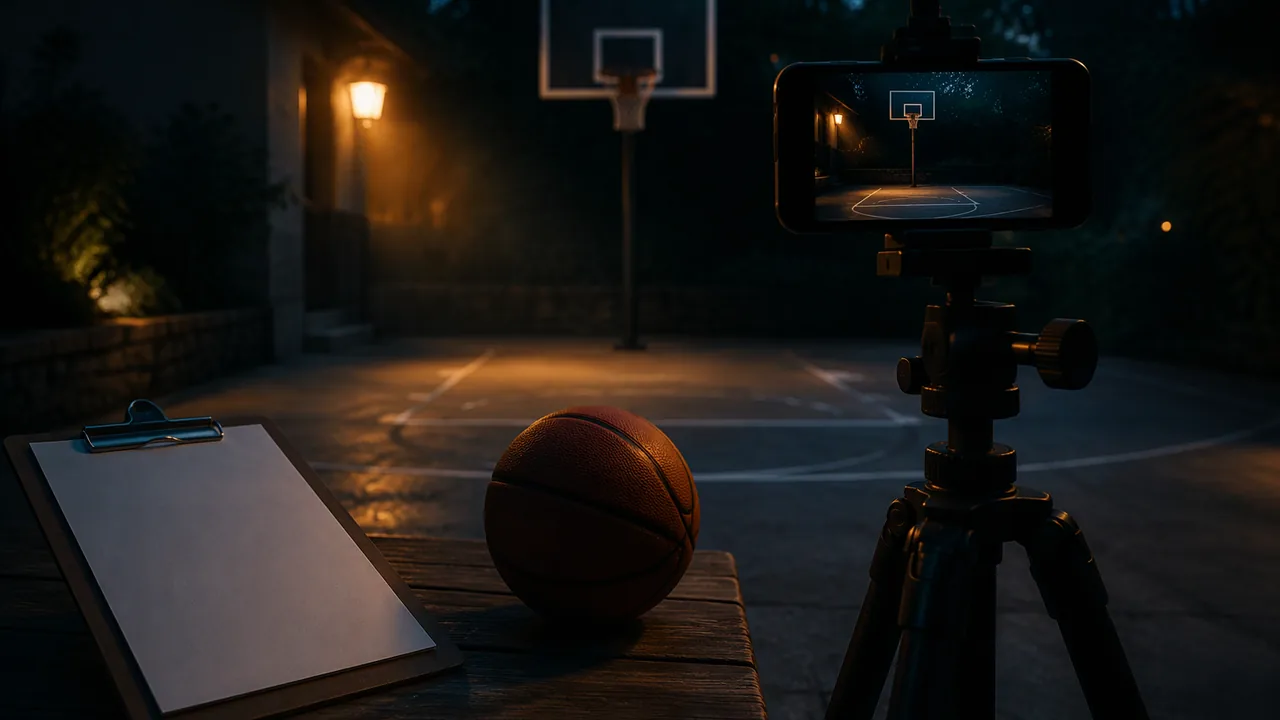
Athletes at every level use video because the body cannot see itself. In this course the camera replaces the second pair of eyes. A good recording follows three rules. Angle: film once from the side (to see arm and leg angles and weight shift) and once from the front or behind (to see whether the movement lines up with the target). Distance: about 10-15 feet, so your whole body and the ball are in the frame. Speed: use slow motion or pause frame by frame; most errors happen in a fraction of a second. Prop the phone on a shelf, chair or stack of books, or have a family member hold it if they want to help.
Detecting the error that matters
When you watch your video you will probably notice several problems. Do not fix them all at once. Look for the root error — usually the earliest one in the movement, because errors in preparation cause errors later. A chest pass that sails high may look like a follow-through problem, but if the video shows you are not stepping toward the target, the missing step is the root: without it, the arms push upward to make up the distance. Fixing the step often fixes the follow-through for free.
Correcting it
Turn the error into a short cue — three or four words you can think during the movement, such as “step, then push” or “lock the ankle.” Cues that point at an outcome outside the body (“push the ball through the target”) often work better than cues about body parts. Then practice 3 sets of 10 with that one cue, record again from the same angle, and compare. Two kinds of feedback help you judge: knowledge of results (did the ball hit the target? — your success rate) and knowledge of performance (did the movement match the checklist? — your video). You want both to improve.
Worked example
A student’s first set-shot video shows the elbow flaring out to the side and the ball landing left of the rim on 6 of 10 attempts. Cue: “elbow under the ball.” After 30 practice shots, the second video shows the elbow lined up under the ball on 8 of 10 frames, and misses to the left drop to 2. That is improvement in both performance and results — exactly the evidence the portfolio asks for.
Privacy: your recordings are yours. Keep them on your device or in the course submission only, and never post them online.
Formative check
Work through these before moving on. They are not graded — they tell you whether the standard below has landed yet.
Which is a critical element of the execution phase of a soccer inside-foot pass?
A video shows a chest pass that sails high, a weak follow-through and no step toward the target. Which error should you correct first?
Filming from only one angle is enough to see every error in a skill.
For your focus skill, list its critical elements in three phases. Describe what your first recording showed for each element, name the root error and your cue, and describe what changed on the second recording, using both your video and your success rate as evidence.
How confident are you that you can analyze my own recorded technique against critical elements, find the root error and show a correction?
Practice
Work these on paper or in your notebook, then open Check your answer. Aim for all of Fluency and Application; try at least one Challenge.
Printable version: this unit’s practice workbook (PDF)
Fluency
Build speed and accuracy with the core skill.
- Name the three phases physical educators use to group critical elements.
Check your answer
Answer: Preparation (stance, grip, eyes), execution (the action itself) and follow-through (how the movement finishes).Critical elements are the handful of parts that separate a good attempt from a poor one. - Give the follow-through critical element for (a) the basketball set shot and (b) the two-hand chest pass.
Check your answer
Answer: (a) The wrist snaps and fingers point at the rim (“hand in the cookie jar”). (b) Arms fully extended, thumbs turned down.From the lesson’s checklist table. - Define knowledge of results and knowledge of performance.
Check your answer
Answer: Knowledge of results is feedback about the outcome (did the ball hit the target? your success rate). Knowledge of performance is feedback about how the movement was done (did it match the checklist? your video).You want both to improve.
Application
Use the skill in context. Show your reasoning.
- State the three recording rules (angle, distance, speed) for video self-analysis.
Check your answer
Answer: Angle: film once from the side and once from the front or behind. Distance: about 10-15 feet, so your whole body and the ball are in the frame. Speed: use slow motion or pause frame by frame.Side shows arm and leg angles and weight shift; front or behind shows alignment with the target. - An example student’s soccer passes keep popping up off the ground. His video shows the plant foot well behind the ball and a floppy ankle at contact. Which is the root error, and what cue could he use?
Check your answer
Answer: The plant foot position is the root error because it comes first (preparation); the plant foot should be beside the ball with the toe pointing at the target. A cue such as “plant beside the ball” fixes that first, then “lock the ankle” if needed.Errors in preparation cause errors later, so fix the earliest one first. - An example student’s underhand serves often go into the wall below the line. Her video shows her same-side foot forward and her weight staying on the back foot. List the correct preparation and follow-through elements.
Check your answer
Answer: Preparation: opposite foot forward, ball held low in front of the hitting shoulder. Follow-through: weight shifts to the front foot; arm finishes toward the target. (Execution: pendulum swing, contact with the heel of the hand.)Fix the preparation error (foot position) first. - Why do cues that point at an outcome outside the body often work better than body-part cues? Give one example of each kind.
Check your answer
Answer: The lesson notes that outcome cues often work better because attention goes to the target, not the body part. Outside-the-body example: “push the ball through the target.” Body-part example: “lock the ankle.”Cues are three or four words you can think during the movement.
Challenge
Stretch problems. Expect to think before you write.
- An example student’s set-shot video showed the elbow under the ball on 3 of 10 frames before his cue and 8 of 10 after; his makes went from 4/10 to 6/10. Calculate both changes in percentage points and explain why the portfolio wants both kinds of evidence.
Check your answer
Answer: Performance (elbow position): 30% to 80%, up 50 percentage points. Results (makes): 40% to 60%, up 20 percentage points. Both are wanted because knowledge of performance shows the movement changed, and knowledge of results shows the change paid off.3 ÷ 10 = 30%, 8 ÷ 10 = 80%, 80 − 30 = 50. 4 ÷ 10 = 40%, 6 ÷ 10 = 60%, 60 − 40 = 20.
Review
Keep earlier skills sharp.
- Review (Lesson 1.2): after correcting with a cue, the student practices 3 sets of 10. Why must she keep the same distance and target when she records again?
Check your answer
Answer: So the comparison is fair: if the task gets easier (for example, moving closer), a higher score would not show that her technique improved.Same distance, same target, same ball.