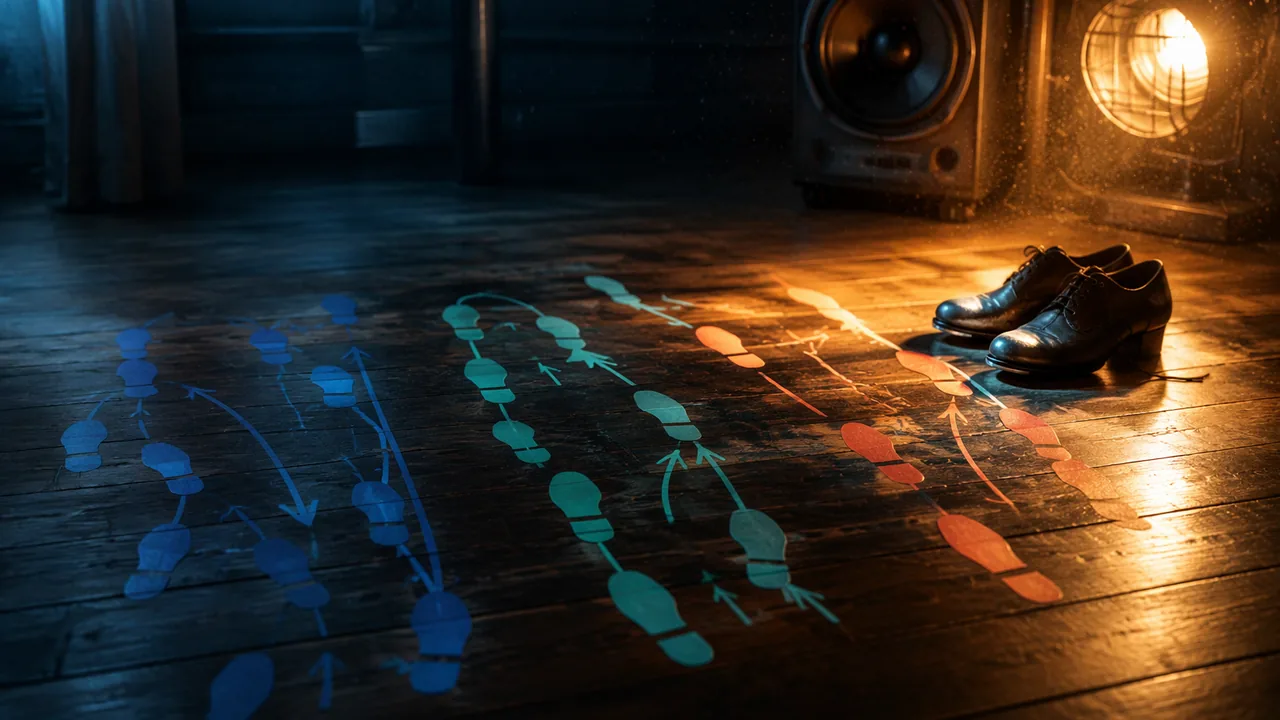
perform and record the basic steps of at least three dance forms with different cultural origins, explain each form’s etiquette, and correct one technique error in each from video self-analysis.
Instruction
Learning a dance respectfully
When you learn a dance from a culture that is not your own, you are a guest in that tradition. Respect looks like this: learn the dance’s correct name and where it comes from; learn what occasions it belongs to; do the steps sincerely rather than as a joke; never wear costumes as a caricature; and remember that the basics you learn here are a starting point, not the whole tradition. The four forms below are social and folk dances that their communities share publicly and teach widely. Each description gives practice steps in words and counts. These are basic patterns, not anyone’s full choreography. Practice with any music you choose at a comfortable tempo.
1. Square dance (United States; Missouri’s official American folk dance)
Origins: English country dance and the French quadrille, with calling developed in America (Missouri Secretary of State; Wikipedia, cross-checked). Practice alone: tape a small X where you stand and imagine the dancer beside you and your corner on the other side. Honor: bow or curtsy to the side, 2 counts each way. Circle left: 8 smooth walking steps to the left, one per beat, then 8 back to the right. Do-si-do (8 counts): walk forward past an imagined dancer’s right shoulder (counts 1-2), slide sideways to the right, back to back (3-4), walk backward past the left shoulder (5-6) and back to your place (7-8). Promenade: walk 16 counts around the square counterclockwise. Etiquette: listen to the caller, honor the dancers at the start and end, finish the whole dance and help newcomers.
2. Hora (Southeast Europe and Jewish communities)
Origins: a circle dance found in Romania, Moldova, Bulgaria, North Macedonia, Greece and Turkey, with versions among Ashkenazi and Sephardic Jews and the Roma; it is a centerpiece of weddings and festivals, and in Israel it became a symbol of the pioneer settlement movement (Wikipedia, “Hora,” cross-checked). Practice step (Romanian horă pattern): the circle travels with three steps forward and one step back. Face slightly right with arms held at shoulder height as if joining hands. Counts 1-3: step right, left, right, traveling counterclockwise; count 4: step back on the left. Repeat 8 times. Etiquette: join where there is space, keep the same step as the circle so no one is pulled, and let anyone join.
3. Bhangra (Punjab, South Asia)
Origins: a folk dance of Punjabi farmers tied to Vaisakhi, the spring harvest festival, driven by the dhol, a double-headed drum (Wikipedia, “Bhangra (dance),” cross-checked). Movement features are energetic kicks, hops and raised arms with shoulder bounces. Practice step: arms raised in a wide V. Counts 1-2: hop on the left foot while the right foot lifts forward, knees soft; counts 3-4: hop on the right while the left lifts. Add a shoulder bounce on every count. Then 4 counts of bouncing in place with the arms pushing up twice. Etiquette: dance with full energy and joy, which is the spirit of the form, and keep the circle open.
4. Zapateado footwork from the jarabe tapatío (Jalisco, Mexico)
Origins: the jarabe tapatío began as a courtship dance in Guadalajara, Jalisco, became a symbol of Mexican national identity after independence and is usually played by mariachi (Wikipedia, “Jarabe Tapatío,” cross-checked). Its English nickname, “Mexican Hat Dance,” reduces a national dance to a prop, so use its real name. Practice drill (zapateado means rhythmic footwork): stamp the right foot flat (1), the left (2), the right (3), hold (4); repeat starting left (5-8). Then a heel-toe: right heel taps forward (1), right toe taps beside you (2), repeat on the left (3-4). Stay light and upright with the weight over the balls of the feet. Etiquette: stand tall and proud; the dance is performed with dignity.
Self-analysis
For each form you choose, record 30-60 seconds, then watch with a checklist: on the beat? correct foot pattern? posture tall? arms as described? Find one error, practice the correction 5 times, and record again. A family member may watch or join you, but you can do it all alone. Keep recordings private.
Formative check
Work through these before moving on. They are not graded — they tell you whether the standard below has landed yet.
In the 8-count do-si-do described in the studio, what happens on counts 3-4?
Square dance etiquette
Tap to revealListen to the caller, honor at the start and end, finish the dance, help newcomers
Hora etiquette
Tap to revealJoin where there is space, keep the circle’s step, let anyone join
Bhangra spirit
Tap to revealFull energy and joy, raised arms, open circle
Jarabe tapatío
Tap to revealUse the real name, dance with dignity, no costume caricature
Wearing an exaggerated costume as a joke is an acceptable way to learn a folk dance from another culture.
For each of your three recorded dance forms, name the form and its origin, describe one error you saw in your first recording (timing, foot pattern, posture or arms), the correction you practiced and what changed in the second recording.
How confident are you that you can perform basic steps from three dance forms with their etiquette and correct my own errors from video?
Practice
Work these on paper or in your notebook, then open Check your answer. Aim for all of Fluency and Application; try at least one Challenge.
Printable version: this unit’s practice workbook (PDF)
Fluency
Build speed and accuracy with the core skill.
- Write the counts for the 8-count do-si-do.
Check your answer
Answer: Counts 1-2: walk forward past the dancer’s right shoulder. Counts 3-4: slide sideways to the right, back to back. Counts 5-6: walk backward past the left shoulder. Counts 7-8: back to your place.Practiced alone by imagining the other dancer. - Match each dance to its place of origin and one feature: hora, bhangra, jarabe tapatío.
Check your answer
Answer: Hora: Southeast Europe and Jewish communities; a circle dance central to weddings and festivals. Bhangra: Punjab, South Asia; a farmers’ folk dance tied to Vaisakhi and the dhol drum, with kicks, hops and raised arms. Jarabe tapatío: Guadalajara, Jalisco, Mexico; a courtship dance with zapateado footwork, usually played by mariachi.Use each dance’s real name. - List four ways to learn a dance from another culture respectfully.
Check your answer
Answer: Learn the dance’s correct name and where it comes from; learn what occasions it belongs to; do the steps sincerely, not as a joke; never wear costumes as a caricature; remember the basics are a starting point, not the whole tradition (any four).You are a guest in that tradition.
Application
Use the skill in context. Show your reasoning.
- In the Romanian horă practice pattern, the circle travels three steps forward and one step back per 4 counts, repeated 8 times. (a) How many counts is that? (b) How many steps forward and back in total? (c) What is the net number of steps forward?
Check your answer
Answer: (a) 32 counts; (b) 24 steps forward and 8 steps back; (c) 16 steps forward.4 × 8 = 32 counts. 3 × 8 = 24 forward; 1 × 8 = 8 back. 24 − 8 = 16 net. - Write the zapateado drill from the lesson in counts, and name the posture cue.
Check your answer
Answer: Stamp right (1), left (2), right (3), hold (4); repeat starting left (5-8). Then heel-toe: right heel taps forward (1), right toe taps beside you (2), repeat on the left (3-4). Posture: stay light and upright with the weight over the balls of the feet; stand tall and proud.Zapateado means rhythmic footwork. - An example student’s recording of the bhangra step shows her landing flat-footed with stiff knees and her arms drooping to shoulder height. Using the lesson’s checklist, name the errors and the corrections.
Check your answer
Answer: Knees should be soft on each hop; arms should be raised in a wide V with a shoulder bounce on every count. Correction: practice the hop with soft knees and the arms held high 5 times, then record again.Checklist: on the beat? correct foot pattern? posture tall? arms as described? Fix one error at a time. - Give the etiquette for each: hora circle; bhangra; jarabe tapatío.
Check your answer
Answer: Hora: join where there is space, keep the same step as the circle so no one is pulled, let anyone join. Bhangra: dance with full energy and joy, keep the circle open. Jarabe tapatío: stand tall and proud, perform with dignity, use the real name rather than “Mexican Hat Dance.”Etiquette is part of the skill.
Challenge
Stretch problems. Expect to think before you write.
- Explain why the lesson asks you to use the name “jarabe tapatío” instead of its English nickname, and connect this to the idea of cultural appropriation.
Check your answer
Answer: The nickname “Mexican Hat Dance” reduces a national dance to a prop. Using the real name, learning its origin and dancing with dignity is respectful learning; taking a dance or costume without understanding or credit, or as a joke, is cultural appropriation.A strong answer names the reduction-to-a-prop problem and defines appropriation.
Review
Keep earlier skills sharp.
- Review (Lesson 3.1): which square-dance figure moves all dancers counterclockwise around the square, and how many counts does the studio give it?
Check your answer
Answer: The promenade: 16 counts walking side by side counterclockwise.Other figures: honor, circle left (8 steps each way), do-si-do (8 counts).