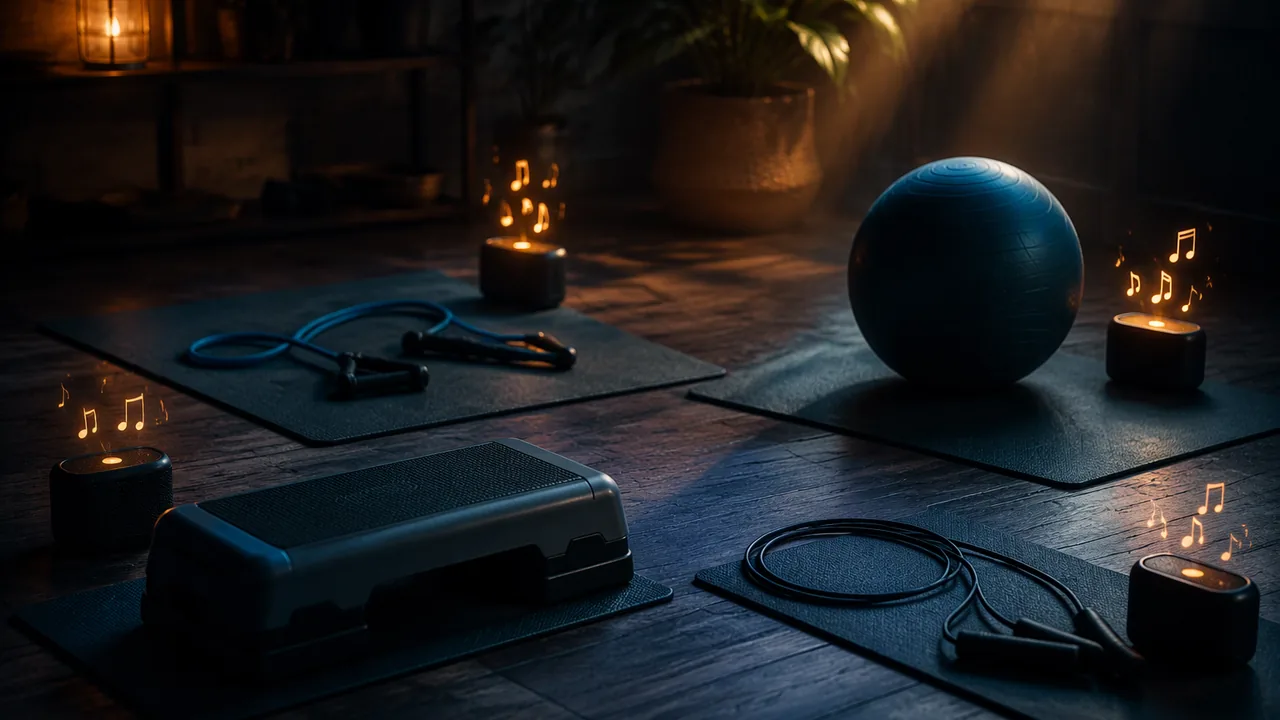
perform rhythmic eight-count patterns with four pieces of simple equipment, measure heart rate and perceived exertion after each, and compare the fitness components each station develops.
Instruction
Rhythm turns exercise into a skill
Rhythmic activity is exercise organized by a beat. Most popular music is built on groups of four beats, and dancers and fitness instructors count in eight-counts: two groups of four, spoken “1, 2, 3, 4, 5, 6, 7, 8.” A routine is a string of eight-count phrases. Counting does two jobs. It makes a movement repeatable, because you can check whether a step lands on the beat, and it lets you control intensity, because the tempo (beats per minute, or BPM) sets how fast you move. A walking-pace song may sit near 100 BPM; a brisk workout song is often 120-130 BPM. You can find any song’s tempo by counting beats for 15 seconds and multiplying by 4, exactly the way you count a pulse. Choose any music you like for this lab; the lab gives the counts, not songs.
One beat, four kinds of fitness
Missouri’s expectations ask you to demonstrate rhythmic activities that use a variety of equipment to develop different components of fitness, and to compare the benefits of different activities. Each station in today’s lab targets something different:
| Station | Main fitness components | Why |
|---|---|---|
| Step (bottom stair or a sturdy low step) | Cardiorespiratory endurance, leg muscular endurance | Repeatedly lifting your body weight raises heart rate |
| Resistance band | Muscular strength and endurance | The band adds load to rows, presses and curls done on the beat |
| Jump rope | Cardiorespiratory endurance, coordination, bone strength | Repeated landings load the bones; timing the rope takes coordination |
| Ball | Coordination, agility, reaction time | Bouncing, passing hand to hand and catching on the beat are skill-related |
The Physical Activity Guidelines for Americans (HHS, 2018) ask ages 6-17 for 60 minutes or more of moderate-to-vigorous activity daily, with vigorous activity, muscle-strengthening and bone-strengthening activity each on at least 3 days a week. Jumping activities such as rope jumping put impact on the bones, which is what bone-strengthening means. A rhythmic circuit can hit several of these targets in one session.
Measuring intensity
You will measure intensity three ways. Heart rate: find your pulse at the wrist or the side of the neck, count for 15 seconds and multiply by 4. A common estimate of maximum heart rate is 220 minus your age (CDC, Target Heart Rate), so for a 15-year-old about 205 beats per minute; moderate activity is roughly 64-76% of that and vigorous activity roughly 77-93% (CDC, Target Heart Rate). Perceived exertion: rate effort from 0 (resting) to 10 (all-out); 5-6 is moderate, 7-8 vigorous. Talk test: during moderate activity you can talk but not sing; during vigorous activity you can say only a few words before pausing for breath.
Worked example
Ana (a fictional student) records a resting pulse of 18 beats in 15 seconds (72 bpm). After three minutes of step patterns at about 120 BPM she counts 36 in 15 seconds: 144 bpm, which is 70% of her estimated 205 maximum, so moderate. After rope she counts 42: 168 bpm, 82%, vigorous. After the ball station she counts 27: 108 bpm. Her conclusion: rope and step trained her heart and lungs most; the ball station trained coordination and let her recover. That is the comparison you will make with your own numbers. Results compare to health standards, not to anyone else.
Safety at home
Use a clear floor at least 2 by 2 meters with nothing overhead for the rope, athletic shoes, and a step no higher than a normal stair. In Missouri’s hot, humid summer months, do the lab indoors or in the cool of the morning, and drink water before, during and after.
Activity: A four-station rhythmic fitness circuit with heart-rate checks
Question. Which piece of simple equipment, used to the same beat, raises heart rate most, and which fitness component does each station develop?
Materials
- A bottom stair or a sturdy low step (no higher than a normal stair) that will not slide
- A resistance band (or two filled water bottles as light hand weights)
- A jump rope (or an imaginary rope: the same footwork without the rope)
- A ball that bounces, such as a basketball or playground ball
- A phone or clock with a second hand, music you choose at about 115-130 BPM, water and athletic shoes
- This lesson’s data table (copy it onto paper)
- Complete the readiness check from PE A before you begin. If any readiness answer has changed, talk with a parent or guardian and your doctor before doing this lab.
- Clear a floor space at least 2 by 2 meters with nothing overhead or breakable nearby; jump rope only where the rope cannot hit a ceiling fan, light or person.
- Anchor the band under your feet or around a sturdy post, never a door that someone could open, and check it for tears before each use.
- Keep the step against a wall so it cannot slide, step up with your whole foot on the step, and step down with control.
- Drink water before, during and after; in hot weather do the lab indoors or in the early morning.
- Stop at once and tell a parent or guardian if you feel chest pain or pressure, dizziness or light-headedness, unusual shortness of breath, or sharp or joint pain; call 911 for an emergency such as fainting, chest pain that does not go away or trouble breathing.
Procedure
- Sit quietly for 2 minutes, then take your resting pulse for 15 seconds and multiply by 4. Record it and work out your estimated maximum (220 minus your age) and your moderate (64-76%) and vigorous (77-93%) zones.
- Warm up for 5 minutes to your music: march in place 2 eight-counts, step-touch side to side 4 eight-counts, arm circles 2 eight-counts, then repeat, getting bigger each time.
- Find your music’s tempo: count beats for 15 seconds and multiply by 4. Record the BPM.
- Station 1, step (3 minutes): basic step on counts 1-4 (right foot up, left foot up, right foot down, left foot down), then switch the lead foot every 4 eight-counts. At the end, take your 15-second pulse at once, rate exertion 0-10 and do the talk test. Rest 1 minute walking.
- Station 2, band (3 minutes): standing row for 2 eight-counts (pull on 1-2, return on 3-4), overhead or chest press for 2 eight-counts, biceps curl for 2 eight-counts; repeat. Pulse, exertion and talk test, then rest 1 minute.
- Station 3, rope (3 minutes): basic two-foot bounce, one jump per beat, in sets of 4 eight-counts with 1 eight-count of marching between sets. Land softly on the balls of your feet. Pulse, exertion and talk test, then rest 1 minute.
- Station 4, ball (3 minutes): bounce and catch on 1-2, pass hand to hand around your waist on 3-8; then bounce with the right hand 1 eight-count and the left hand 1 eight-count. Pulse, exertion and talk test.
- Cool down for 5 minutes: slow marching, then hold calf, quadriceps, hamstring and shoulder stretches for 20-30 seconds each. Take a final pulse 2 minutes after you stop and record how far it has dropped.
- Session 2: repeat the circuit with the station you found easiest made harder (faster tempo, a heavier band, or one more set), and record the new numbers.
Data
| Station | Pulse (15 s) × 4 | % of est. max | Zone | Exertion 0-10 | Talk test |
|---|---|---|---|---|---|
| Resting | |||||
| Step | |||||
| Band | |||||
| Rope | |||||
| Ball | |||||
| 2 min after cool-down |
Analysis
- Rank the four stations by heart rate. Which put you in the vigorous zone, and do your exertion ratings and talk-test results agree with your pulse?
- For each station, name the main health-related or skill-related fitness component it developed and give one piece of evidence from your data or your experience.
- Compare the benefits: which station would you choose for heart-and-lung fitness, which for muscular strength, and which for coordination? Which one could become a lifetime activity for you, and why?
- How did the tempo of your music change your intensity? Use your Session 2 numbers to explain one way to adjust a rhythmic routine to make it harder or easier.
If you cannot do this activity in person: Low-impact or seated version for the same credit: do every station seated in a sturdy chair or standing without impact. Step station: seated alternating knee lifts and heel taps on the beat. Band: the same rows, presses and curls seated. Rope: turn the wrists as if holding a rope while tapping the feet or marching in place, with no jumping. Ball: seated bounce-and-catch and hand-to-hand passes. Keep the same counts, pulse checks, exertion ratings and data table.
Formative check
Work through these before moving on. They are not graded — they tell you whether the standard below has landed yet.
To find a song’s tempo, count its beats for 15 seconds and multiply by .
A student’s pulse after the rope station is 42 beats in 15 seconds and her estimated maximum is 205 bpm. Which conclusion is correct?
You repeat the step station with music at 130 BPM instead of 115 BPM, keeping one step per beat. What will most likely happen?
Using your lab data, compare the health, skill and fitness benefits of the four stations. Recommend two stations for a person whose goal is heart-and-lung fitness and one for a person whose goal is coordination, and support each recommendation with your numbers.
How confident are you that you can use rhythm and simple equipment to train different fitness components and measure the intensity?
Practice
Work these on paper or in your notebook, then open Check your answer. Aim for all of Fluency and Application; try at least one Challenge.
Printable version: this unit’s practice workbook (PDF)
Fluency
Build speed and accuracy with the core skill.
- What is an eight-count, and how many beats are in 4 eight-counts?
Check your answer
Answer: A phrase of eight beats, two groups of four, counted “1 to 8.” Four eight-counts contain 32 beats.4 × 8 = 32. A routine is a string of eight-count phrases. - You count 31 beats of a song in 15 seconds. What is its tempo? Is it closer to a walking-pace song or a brisk workout song?
Check your answer
Answer: 124 BPM, a brisk workout song (120-130 BPM).31 × 4 = 124. A walking-pace song is near 100 BPM. - Match each lab station to its main fitness components: step, band, rope, ball.
Check your answer
Answer: Step: cardiorespiratory endurance, leg muscular endurance. Band: muscular strength and endurance. Rope: cardiorespiratory endurance, coordination, bone strength. Ball: coordination, agility, reaction time.From the lesson’s station table.
Application
Use the skill in context. Show your reasoning.
- An example 17-year-old, Leo, counts 37 beats in 15 seconds after the step station, 44 after rope and 25 after the ball station. For each, find bpm, the percentage of his estimated maximum (to the nearest whole percent) and the zone.
Check your answer
Answer: Step: 148 bpm, about 73%, moderate. Rope: 176 bpm, about 87%, vigorous. Ball: 100 bpm, about 49%, below moderate.Maximum 220 − 17 = 203. 37 × 4 = 148; 148 ÷ 203 = 0.729. 44 × 4 = 176; 176 ÷ 203 = 0.867. 25 × 4 = 100; 100 ÷ 203 = 0.493. Moderate is 64-76%, vigorous 77-93%. - At 120 BPM with one step per beat, how many steps are taken in a 3-minute station, and how many eight-counts is that? How many steps would a 130 BPM song give in the same time?
Check your answer
Answer: 360 steps, which is 45 eight-counts. At 130 BPM: 390 steps.120 × 3 = 360; 360 ÷ 8 = 45. 130 × 3 = 390, so 30 more steps and more work. - Explain why rope jumping counts as bone-strengthening activity but the band station does not in the same way.
Check your answer
Answer: Bone-strengthening means activity that produces impact or force on the bones; repeated rope landings put impact on the bones. The band station adds muscular load to rows, presses and curls but without repeated impact.The guidelines ask for bone-strengthening on at least 3 days a week. - Give three ways to make a rhythmic station harder for Session 2, drawn from the lab.
Check your answer
Answer: A faster tempo, a heavier band, or one more set.Change one thing at a time so the new numbers show its effect.
Challenge
Stretch problems. Expect to think before you write.
- An example student wants one 15-minute rhythmic routine that trains her heart and lungs and also counts as bone-strengthening, plus one station for coordination. Design it in eight-counts with the stations from the lab and justify each choice.
Check your answer
Answer: Model: warm-up march and step-touch (4 eight-counts); step station 4 minutes (cardiorespiratory endurance); rope station 4 minutes in sets of 4 eight-counts with 1 eight-count of marching between (cardiorespiratory endurance plus bone-strengthening from landings); ball station 3 minutes (coordination, and active recovery); cool-down. Music near 120-130 BPM to keep step and rope in the moderate-to-vigorous range.A strong plan matches each station to its component and uses tempo to control intensity.
Review
Keep earlier skills sharp.
- Review (PE A, Lesson 2.3): list the three ways the lab measures intensity and what vigorous looks like on each.
Check your answer
Answer: Heart rate (77-93% of 220 minus age); perceived exertion (7-8 on the 0-10 scale); talk test (only a few words before pausing for breath).Results compare to health standards, not to anyone else.