complete a four-station sport skill circuit (dribbling, wall passing, serving or tossing, footwork), record ten-attempt success rates in two rounds, and use the numbers to judge consistency and pick one skill to improve.
Instruction
What “skill competency” means
Doing a skill once proves very little. Anyone can make one lucky shot. Competency means performing a skill correctly consistently — most of the time, under ordinary conditions. That is why this lab measures every skill as a success rate: the number of successful attempts out of ten, written as a fraction or a percentage. If you hit a wall target 6 times in 10 tries, your rate is 6/10 = 60%. For this course, a rate of 8 out of 10 (80%) or better on two different days is the working definition of “consistent.” Two days matter because a single good session can be luck, fresh legs or an easy setup.
How skills are learned
Motor-learning researchers describe three broad stages of learning a skill. In the cognitive stage you think about every part (“step, then push, then follow through”), errors are large and results jump around. In the associative stage the movement starts to hang together, errors get smaller and you begin to notice your own mistakes. In the autonomous stage the skill runs almost automatically, so your attention can move to the game — where a defender is, where the open space is. Most people are in different stages for different skills. Your circuit data will show you which.
Practice that works
- Count, don’t guess. Write the result of every attempt. Memory flatters us; numbers do not.
- Keep conditions the same between rounds. Same distance (mark it with tape or chalk), same target, same ball. Otherwise you cannot tell whether you improved or the task got easier.
- Short rest between sets. Fatigue ruins technique. Thirty to sixty seconds of rest keeps attempts honest.
- Blocked, then varied. Repeating one skill ten times (blocked practice) builds the pattern early. Once your rate climbs, mixing skills or distances (varied practice) makes the skill hold up better in a real game.
The circuit
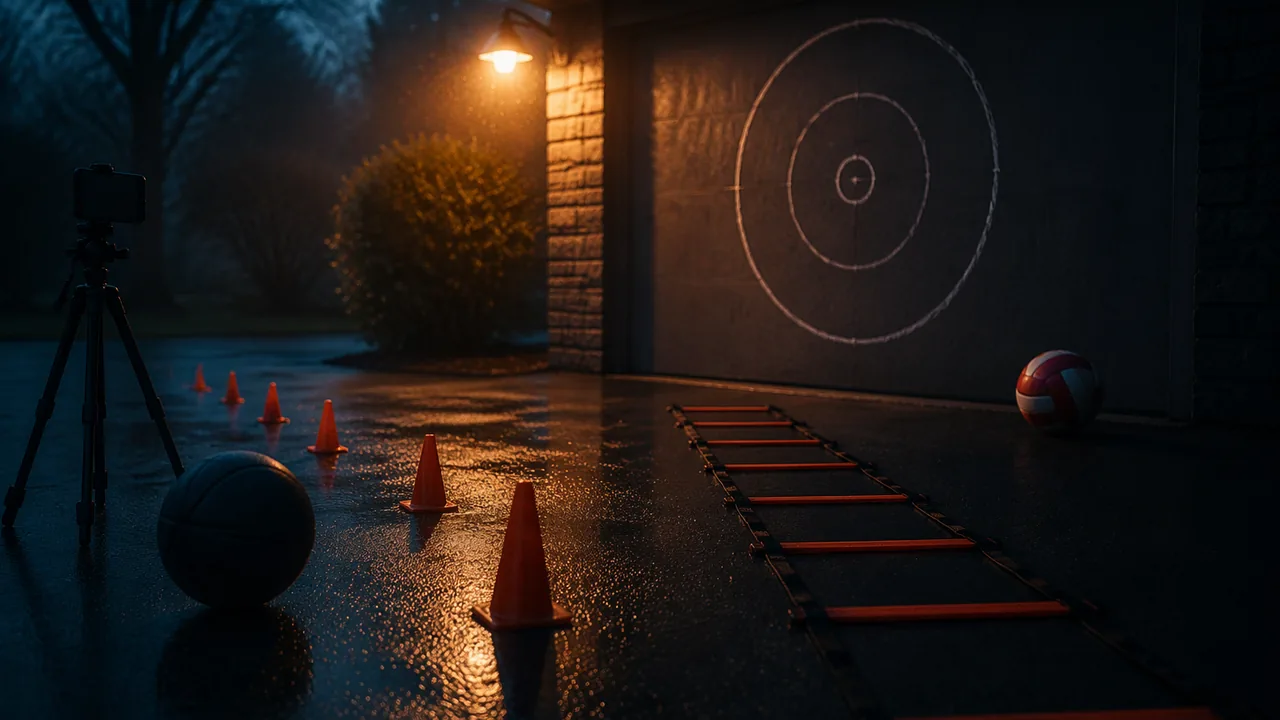
The four stations sample the main skill families in individual, dual and team sports: ball control (dribbling a basketball with your hands or a soccer ball with your feet), sending to a target (a chest pass or inside-foot pass to a wall target), serving or tossing (an underhand volleyball-style serve to a wall zone, or a tennis-style toss that rises and falls into a hoop or box), and footwork (quick steps through a chalk or tape ladder). Each station takes about five minutes per round. You can do it in a garage, a driveway (away from the street, with an adult knowing where you are), a basement with a high ceiling, or a park with an adult.
Worked example
A student records wall passes from 10 feet: round 1 = 5/10, 6/10, 6/10 (mean 5.7, or 57%). After a two-minute break she notices most misses go high and focuses on stepping toward the target. Round 2 = 7/10, 7/10, 8/10 (mean 7.3, or 73%). She has improved by 16 percentage points but is not yet consistent at the 80% line, so passing becomes her focus skill for the technique studio in the next lesson.
Heart rate during skill work
Skill circuits are usually moderate activity, not all-out effort. You will count your pulse for 15 seconds and multiply by 4 at rest, after the warm-up and after each round. The CDC estimates maximum heart rate as 220 minus your age and describes moderate intensity as 64-76% of that maximum and vigorous intensity as 77-93%. For a 15-year-old, that is about 131-156 beats per minute for moderate and 158-191 for vigorous. Footwork drills often push you into the vigorous range; dribbling and passing usually sit in the moderate range. Both count toward your daily 60 minutes.
Activity: Four-station sport skill circuit: dribble, wall pass, serve or toss, footwork
Question. How consistent am I at four basic sport skills, measured as a success rate over ten attempts, and does a second round after brief practice change the rate?
Materials
- A ball that bounces (basketball, playground ball or soccer ball)
- A solid outside wall, garage door or basement wall with no windows nearby
- Painter’s tape or sidewalk chalk to mark a wall target (about 2 ft by 2 ft) and a throwing line 10 ft away
- Chalk, tape or a rope laid out as a 10-rung ladder (rungs about 18 in apart) for footwork
- A hoop, laundry basket or chalk box (about 3 ft across) for the toss station
- A phone or timer, a water bottle, athletic shoes and the data table below
- Complete the readiness check from enrollment; if any answer was yes, do this lab only after a doctor’s clearance, or use the seated alternative.
- Clear a space at least 6 ft around you; keep the ball away from windows, cars, the street and younger children or pets. In a driveway, stay well back from the street and tell an adult where you are; at a park, an adult must be with you.
- Wear athletic shoes on a dry, flat surface; stop and wipe up or move if the surface is wet or uneven.
- Drink water before, during and after. In Missouri summer heat, practice in the morning or evening, not at midday, and move into shade or indoors if you feel hot and weak.
- Stop signs: stop at once and tell a parent or guardian if you feel chest pain or pressure, dizziness or light-headedness, unusual shortness of breath, or joint pain (not ordinary muscle effort). Call 911 for an emergency, such as someone who collapses, cannot breathe or will not wake up.
Procedure
- Set up (5 min): mark the wall target and the 10-ft line, lay out the ladder and place the hoop or box 10 ft from the toss line. Count your resting pulse for 15 seconds, multiply by 4 and record it.
- Warm up (5 min): 1 minute of easy marching or jogging in place, then 10 arm circles each way, 10 leg swings each leg, 10 walking lunges and 30 seconds of easy dribbling. Record your pulse again.
- Station 1 — Dribbling (5 min): dribble in place for 30 seconds, counting controlled bounces (or soccer touches) without losing the ball; then dribble around two markers 10 ft apart and back, ten times. Record the 30-second count and how many of the ten laps were completed without losing control.
- Station 2 — Wall pass (5 min): from the 10-ft line, make 3 sets of 10 chest passes (or inside-foot passes for soccer) at the target, resting 30 seconds between sets. A pass that hits inside the target counts as a success. Record each set’s score out of 10.
- Station 3 — Serve or toss (5 min): make 3 sets of 10 underhand serves that hit the wall above a 6-ft chalk line, or 3 sets of 10 tosses that land in the hoop from 10 ft. Record each set out of 10.
- Station 4 — Footwork (5 min): move through the ladder with one foot in each rung, then two feet in each rung, then sideways; do each pattern 3 times. Count rungs touched by mistake (lower is better) and record your time for the last pass through. Record your pulse right after the station.
- Rest 3 minutes and drink water. Look at your round-1 numbers and choose one cue for your weakest skill (for example, “step toward the target”).
- Round 2 (20 min): repeat Stations 1-4 exactly as before, same distances and targets, and record the new numbers and your pulse after Station 4.
- Cool down (5 min): walk slowly for 2 minutes, then hold calf, quadriceps, hamstring and shoulder stretches for 20-30 seconds each. Record your pulse at the end. Log the session’s minutes and intensity in your weekly activity log.
Data
| Measure | Round 1 | Round 2 |
|---|---|---|
| Resting pulse (bpm) | — | |
| Pulse after warm-up (bpm) | — | |
| Dribble: 30-second count | ||
| Dribble: laps without losing control (/10) | ||
| Wall pass: sets 1, 2, 3 (/10 each) | ||
| Serve or toss: sets 1, 2, 3 (/10 each) | ||
| Footwork: rungs missed / last-pass time (s) | ||
| Pulse right after Station 4 (bpm) | ||
| Pulse after cool-down (bpm) | — |
Analysis
- Convert each passing and serving result into a mean success rate (%) for each round. Which skills reached the 80% line? Which improved most between rounds, and by how many percentage points?
- Using the three stages of learning, decide which stage you are in for each of the four skills, and give one piece of evidence from your data for each decision.
- Compare your pulse after Station 4 with the CDC moderate (64-76%) and vigorous (77-93%) ranges for your age. Which stations raised your heart rate most, and why?
- Name one condition you kept the same between rounds and one you could not fully control (for example, wind or tiredness). How might it have affected your results?
- Choose your focus skill for the next lesson’s video studio and write the one cue you will test first.
If you cannot do this activity in person: Seated or low-impact version (same credit): sit on a sturdy chair without wheels, about 6 ft from a wall. Station 1: dribble a ball beside the chair with one hand, then the other, for 30 seconds each. Station 2: make 3 sets of 10 two-hand chest passes to a 2-ft wall target, catching the rebound. Station 3: make 3 sets of 10 underhand tosses into a basket placed 6 ft away. Station 4: seated footwork — tap a chalk or tape ladder on the floor in front of you with alternating feet as quickly as you can control for 20 seconds, 3 times (or, without leg use, do 3 rounds of 20 seconds of fast alternating hand taps on your knees). Record the same success rates and pulse checks.
Formative check
Work through these before moving on. They are not graded — they tell you whether the standard below has landed yet.
A student scores 9/10 on wall passes in one session but has never tested again. Has she shown consistent competency?
A student makes 7 of 10 serves in each of three sets. Her success rate is percent.
Between rounds, which change makes the comparison of round 1 and round 2 unfair?
Report your round 1 and round 2 success rates for passing and serving or tossing. Name your weakest skill, describe the most common error you noticed in your misses (where did they go?), and write the cue you will test in the next lesson.
How confident are you that you can measure my skill competency as a success rate and use the results to choose a skill to correct?
Practice
Work these on paper or in your notebook, then open Check your answer. Aim for all of Fluency and Application; try at least one Challenge.
Printable version: this unit’s practice workbook (PDF)
Fluency
Build speed and accuracy with the core skill.
- Convert each to a success rate: (a) 6 of 10; (b) 21 of 30; (c) 17 of 20.
Check your answer
Answer: (a) 60%; (b) 70%; (c) 85%.Successes ÷ attempts: 6 ÷ 10 = 0.6; 21 ÷ 30 = 0.7; 17 ÷ 20 = 0.85. - What is this course’s working definition of a “consistent” skill, and why are two days required?
Check your answer
Answer: A success rate of 8 out of 10 (80%) or better on two different days. One good session can be luck, fresh legs or an easy setup.Competency means performing correctly most of the time under ordinary conditions. - Name the three stages of learning and one sign of each.
Check your answer
Answer: Cognitive: you think about every part; errors are large and results jump around. Associative: the movement hangs together, errors get smaller and you notice your own mistakes. Autonomous: the skill runs almost automatically, so attention moves to the game.Most people are in different stages for different skills.
Application
Use the skill in context. Show your reasoning.
- An example student, Andre, records serves. Round 1: 4/10, 5/10, 6/10. Round 2: 7/10, 8/10, 8/10. (a) Find each round’s mean success rate. (b) By how many percentage points did he improve? (c) Has he shown consistency?
Check your answer
Answer: (a) Round 1: 50%; Round 2: about 76.7%. (b) About 26.7 percentage points. (c) Not yet: he is just below the 80% line and has only one day of data.Round 1: 4 + 5 + 6 = 15 of 30 = 50%. Round 2: 7 + 8 + 8 = 23 of 30 ≈ 76.7%. 76.7 − 50 = 26.7. - Explain the difference between blocked and varied practice and when the lesson recommends each.
Check your answer
Answer: Blocked practice repeats one skill many times in a row; it builds the pattern early. Varied practice mixes skills, distances or targets; once your rate climbs, it makes the skill hold up better in a real game.Blocked first, then varied. - An example 16-year-old’s pulse after the footwork station is 41 beats in 15 seconds. (a) What is the heart rate? (b) Using the CDC formula, is that moderate or vigorous for her age?
Check your answer
Answer: (a) 164 bpm. (b) Vigorous: her vigorous range is about 157 to 190 bpm.41 × 4 = 164. Maximum 220 − 16 = 204. Moderate 204 × 0.64 ≈ 131 to 204 × 0.76 ≈ 155; vigorous 204 × 0.77 ≈ 157 to 204 × 0.93 ≈ 190. Footwork drills often push into the vigorous range. - List four practice rules from the lesson that make your circuit data trustworthy.
Check your answer
Answer: Count, don’t guess (write every attempt); keep conditions the same between rounds (same distance, target, ball); short rest between sets (30 to 60 seconds); blocked, then varied practice.Memory flatters us; numbers do not.
Challenge
Stretch problems. Expect to think before you write.
- An example student’s dribble data are 30-second counts of 38 and 52 on two attempts with many lost balls, while her wall pass rate is a steady 8/10 on two days. Which stage of learning is she probably in for each skill? Give evidence.
Check your answer
Answer: Dribbling: cognitive stage, since results jump around (38 to 52) and errors (lost balls) are large. Passing: associative to autonomous, since she meets the 80% line consistently on two days.Use the data pattern (spread and error size) as the evidence.
Review
Keep earlier skills sharp.
- Review (Lesson 1.1): the circuit samples skills from individual, dual and team sports. Name one sport from each family that uses a skill in the circuit and say which skill.
Check your answer
Answer: Model: team, basketball (dribbling, chest pass); team, soccer (inside-foot pass); team or dual, volleyball or tennis (serve or toss); individual, track and field (footwork). Any correct family and skill pairing earns credit.Volleyball is a team sport; tennis is a dual sport.