explain basic offensive and defensive strategies in team, dual and individual sports, identify how specific rules of play shape those strategies, and apply both by analyzing 20 minutes of a broadcast game.
Instruction
Strategy and tactics
A strategy is a plan for winning that is decided before or between plays: “we will pressure the ball” or “I will serve to my opponent’s backhand.” A tactic is a choice made in the moment to carry out the plan: cutting to the basket when a defender turns her head. Strategy is never separate from the rules, because the rules decide what is possible. You cannot plan to stall in basketball when a shot clock forces a shot; you cannot plan to leave an attacker behind the defense in soccer when the offside rule makes that position illegal.
Principles that cross sports
Many team sports share the same invasion-game principles, because the goal is the same: move an object into the other side’s territory and score.
| When your side has the ball (offense) | When the other side has it (defense) |
|---|---|
| Create space: spread wide and deep so defenders must cover more ground | Deny space: stay compact between the ball and your goal |
| Move without the ball: cut, screen or run into open space | Mark: man-to-man (each defender guards a player) or zone (each guards an area) |
| Attack weaknesses: a slower defender, a tired opponent, an empty side | Pressure the ball: force hurried, low-percentage choices |
| Transition fast: score before the defense is set | Recover fast: sprint back after losing the ball |
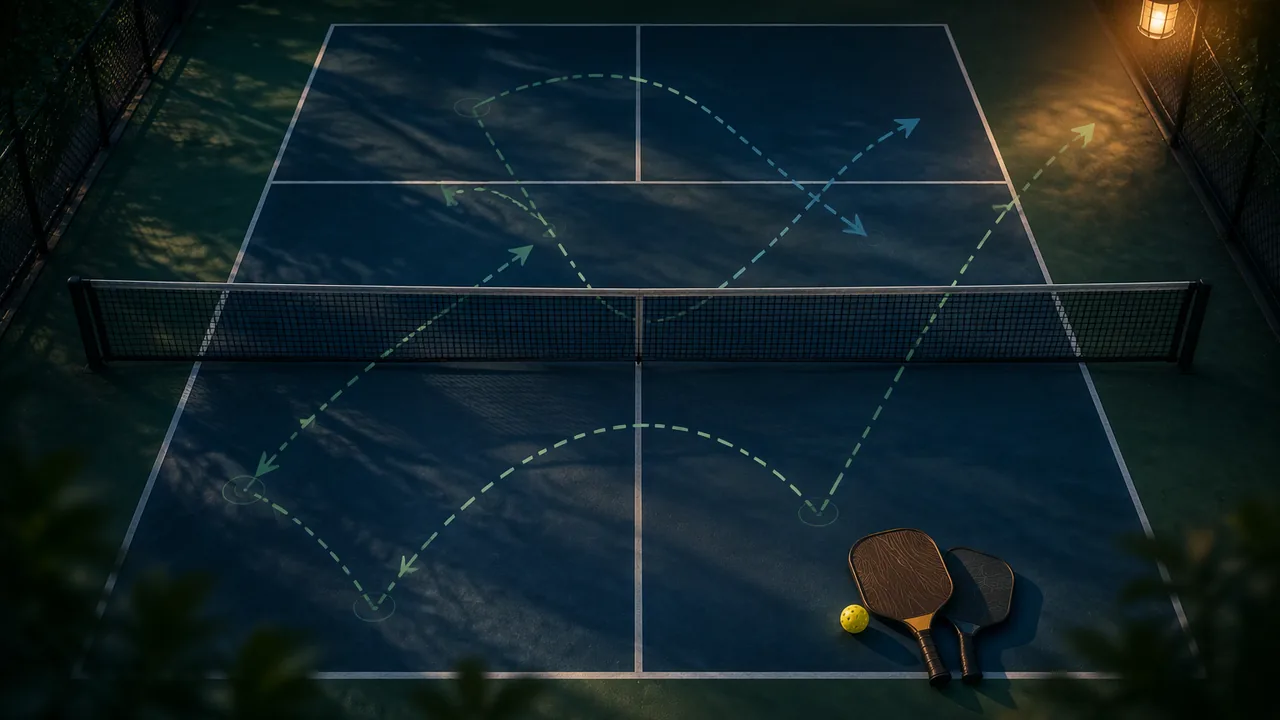
Net and wall games (volleyball, tennis, pickleball, badminton) follow different principles: hit to open space, make the opponent move, play to a weakness, and recover to a balanced “base” position after each shot. In pickleball, the rule that the ball must bounce once on each side before anyone may volley (the two-bounce rule) creates a well-known strategy: the serving side often plays a soft third shot that drops near the net so it can move forward safely. Target games such as golf and bowling are mostly strategy against the course or lane: choosing a safe target, managing risk and staying consistent.
How rules shape strategy: three examples
- Basketball’s three-point line rewards shots from farther away with 50% more points, so teams spread out to take them — which in turn opens driving lanes to the basket. A team shooting 33% from three scores about 1 point per attempt, the same as a team shooting 50% from two.
- Soccer’s offside rule stops attackers from waiting behind the defense, so defenders can step up together to “catch” an attacker offside — and attackers time their runs to stay level.
- Volleyball’s rally scoring means every serve is worth a point to someone, so a missed serve gives the other side a free point. Players balance aggressive serves against the risk of errors.
Watching like an analyst
A broadcast game — on television or a league’s free online replay — is a free film session. Watch 20 minutes with a tally sheet, not just as a fan. Decide what you will count before you start: shots by type (two-point, three-point, free throw), how possessions end (score, turnover, miss), whether the defense is man-to-man or zone, fouls and the rules they broke, or for tennis the share of points won at the net versus the baseline. Pause after each scoring play and ask: what rule mattered here, and what choice did the scorer or defender make? Then look for one pattern the numbers reveal and one strategic adjustment a team or player made during the 20 minutes.
Worked example
During 20 minutes of a college basketball game, a student tallies 14 three-point attempts by one side (5 made) and 10 two-point attempts (6 made). Points per attempt: threes 15 ÷ 14 ≈ 1.07; twos 12 ÷ 10 = 1.2. Late in the period the other side switches to a zone and the threes increase, because a zone leaves the perimeter more open. The student concludes that the rule (the three-point line) and the defensive choice (zone) together pushed the offense outside, even though inside shots were paying slightly better.
Formative check
Work through these before moving on. They are not graded — they tell you whether the standard below has landed yet.
A basketball team shoots 35% on three-point attempts and 50% on two-point attempts. Which earns more points per attempt?
In pickleball, the ball must bounce once on each side before anyone may volley. What does the serving side usually try to do with its first shot after the return?
In volleyball’s rally scoring, only the serving team can win a point.
Watch 20 minutes of a broadcast game in any sport. Report your tally (what you counted and the numbers), name two rules of play that shaped what happened, identify one offensive and one defensive strategy you saw, and describe one adjustment a team or player made. Use at least one calculation from your tally as evidence.
How confident are you that you can explain how rules of play shape strategy and apply that analysis to a real game?
Practice
Work these on paper or in your notebook, then open Check your answer. Aim for all of Fluency and Application; try at least one Challenge.
Printable version: this unit’s practice workbook (PDF)
Fluency
Build speed and accuracy with the core skill.
- Define strategy and tactic and give one example of each.
Check your answer
Answer: A strategy is a plan for competing decided before or between plays (“we will pressure the ball”; “serve to the opponent’s backhand”). A tactic is a choice made during play to carry out the plan (cutting to the basket when a defender turns her head).Strategy is never separate from the rules. - List the four offensive and four defensive invasion-game principles from the lesson.
Check your answer
Answer: Offense: create space; move without the ball; attack weaknesses; transition fast. Defense: deny space; mark (man-to-man or zone); pressure the ball; recover fast.They are shared because invasion games have the same goal: move an object into the other side’s territory and score. - Explain the difference between man-to-man and zone defense.
Check your answer
Answer: Man-to-man: each defender guards one opposing player. Zone: each defender guards an area of the court or field.A zone can leave the perimeter more open, as in the worked example.
Application
Use the skill in context. Show your reasoning.
- A team shoots 40% on threes and 55% on twos. Calculate points per attempt for each and say which shot pays better.
Check your answer
Answer: Threes: 1.2 points per attempt. Twos: 1.1 points per attempt. Threes pay slightly better.0.40 × 3 = 1.2; 0.55 × 2 = 1.1. - In 20 minutes of a broadcast, an example student tallies one side’s 8 three-point attempts (3 made) and 12 two-point attempts (7 made). Find points per attempt for each type, to the nearest hundredth.
Check your answer
Answer: Threes: about 1.13 points per attempt. Twos: about 1.17 points per attempt.Threes: 3 × 3 = 9 points ÷ 8 = 1.125 ≈ 1.13. Twos: 7 × 2 = 14 points ÷ 12 = 1.167 ≈ 1.17. Inside shots paid slightly better here. - Explain how each rule shapes strategy: (a) soccer’s offside rule; (b) volleyball’s rally scoring.
Check your answer
Answer: (a) Attackers cannot wait behind the defense, so defenders can step up together to catch an attacker offside, and attackers time their runs to stay level. (b) Every serve is worth a point to someone, so a missed serve gives a free point; players balance aggressive serves against the risk of errors.Rules decide what is possible, so they shape plans. - List the strategic principles of net and wall games, and explain the pickleball “third shot” strategy.
Check your answer
Answer: Hit to open space, make the opponent move, play to a weakness, and recover to a balanced base position after each shot. In pickleball the two-bounce rule keeps the serving side back at first, so it often plays a soft third shot that drops near the net, giving time to move forward safely.Target games (golf, bowling) are mostly strategy against the course or lane.
Challenge
Stretch problems. Expect to think before you write.
- The lesson says a team shooting 33% from three scores about the same per attempt as a team shooting 50% from two. Check the claim with arithmetic, and explain how the three-point line also helps a team’s inside game.
Check your answer
Answer: 0.33 × 3 = 0.99 ≈ 1 point; 0.50 × 2 = 1.0 point, so they are about equal. Because teams spread out to take threes, defenders must cover more ground, which opens driving lanes to the basket.Threes are worth 50% more points (3 versus 2), so a lower percentage can still pay the same.
Review
Keep earlier skills sharp.
- Review (Lesson 1.1): classify tennis, pickleball, golf and soccer by sport family, and say which type of game each is in this lesson (invasion, net and wall, target).
Check your answer
Answer: Tennis: dual, net and wall. Pickleball: dual (or pairs), net and wall. Golf: individual, target. Soccer: team, invasion.Family is about how many compete on a side; game type is about how the game is won. - Review (Lesson 1.2): a player makes 14 of 20 free throws in practice. What is the success rate, and is it at the course’s consistency line?
Check your answer
Answer: 70%; no, it is below the 80% line.14 ÷ 20 = 0.70.