explain why logarithmic scales are used for quantities that span many powers of ten, convert differences on a logarithmic scale into ratios and back, and solve problems with earthquake magnitude, decibels and pH.
Instruction
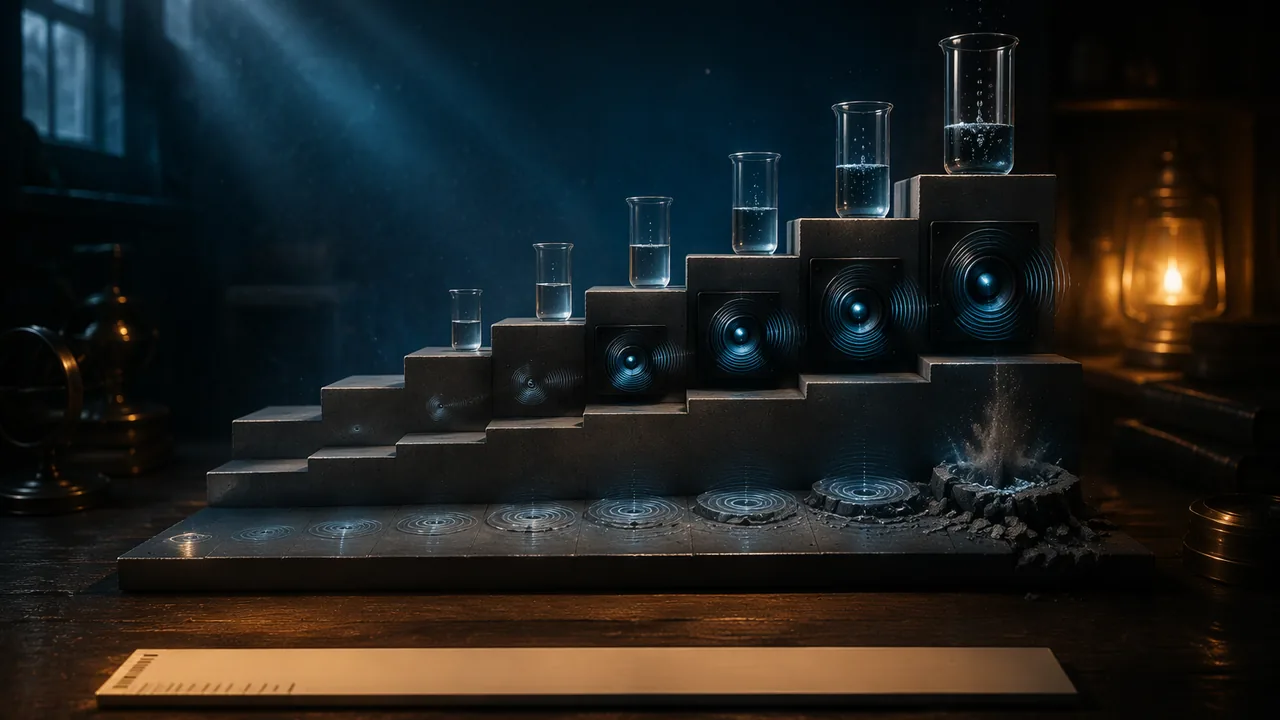
Some quantities refuse to fit on an ordinary number line. The ground motion of the largest earthquake ever felt in Missouri was hundreds of times that of a small one; the loudest sound a person can stand is about a trillion times as intense as the faintest one they can hear. Put such values on an evenly spaced axis and every small value is crushed against zero. A logarithmic scale solves this by recording the exponent instead of the number: it spaces 1, 10, 100 and 1,000 evenly, because each is ten times the one before. On such a scale, equal steps mean equal ratios, not equal differences. That one idea, from Unit 1, is the whole lesson: log(a/b) = log a − log b, so a difference on the scale is a ratio in the world.
1. Earthquake magnitude. On the magnitude scale each whole step means 10 times the amplitude of ground motion and about 32 times the energy released (101.5 ≈ 31.6). The U.S. Geological Survey lists the February 7, 1812 New Madrid earthquake at about magnitude 7.5 and the October 31, 1895 Charleston, Missouri earthquake at 5.8. The difference is 1.7, so the 1812 shaking had about 101.7 ≈ 50 times the amplitude, and it released about 101.5 × 1.7 = 102.55 ≈ 355 times the energy. A gap that looks small on the scale is a large ratio in the ground. To go the other way, take a logarithm: a quake with 200 times the amplitude of another is log 200 ≈ 2.3 magnitude units larger.
2. Sound level in decibels. Sound level is L = 10 log(I/I0), where I is intensity in watts per square meter and I0 = 10−12 W/m2 is a reference near the threshold of hearing. The factor 10 means each 10 dB is one power of ten: +10 dB is 10 times the intensity, +20 dB is 100 times, +30 dB is 1,000 times. Typical levels (approximate) are about 60 dB for ordinary conversation and about 90 dB for a gas lawn mower at the operator, so the mower is about 103 = 1,000 times as intense. Doubling the intensity adds only 10 log 2 ≈ 3 dB. That is why two identical mowers are not twice as many decibels as one.
3. Acidity: pH. pH = −log[H+], where [H+] is the hydrogen-ion concentration in moles per liter. The minus sign makes most pH values positive and means a lower pH is more acidic. Pure water at room temperature has pH 7; a solution at pH 4 has 107 − 4 = 1,000 times the hydrogen-ion concentration. From a concentration, compute directly: [H+] = 3.2 × 10⁻⁸ gives pH = −log(3.2 × 10⁻⁸) ≈ 7.49.
Why use these scales at all? Three reasons. They fit an enormous range on a short scale (pH runs roughly 0 to 14 while concentration spans fourteen powers of ten). They turn the comparisons people actually make, “how many times stronger?”, into subtraction. And they match how some effects are perceived: listeners judge loudness much more by ratios of intensity than by differences. The cost is that the scale hides how large the steps are. A reader who sees 5.8 and 7.5 and thinks “not that different” has forgotten that the scale is logarithmic. Your job on the comparison sheet is to say each result both ways.
📖 Read for this lesson
The reading opens over the lesson; close it to come back to exactly where you were. The checks below draw on it.
Formative check
Work through these before moving on. They are not graded — they tell you whether the standard below has landed yet.
Missouri standard: A2.SSE.A.4
The 1812 New Madrid earthquake was about magnitude 7.5 and the 1895 Charleston, Missouri earthquake was 5.8. About how many times the amplitude of ground motion did the 1812 earthquake have?
Missouri standard: A2.SSE.A.4
An increase of 20 decibels multiplies sound intensity by , and an increase of 30 decibels multiplies it by .
Missouri standard: A2.SSE.A.4
A solution with pH 4 has how many times the hydrogen-ion concentration of a solution with pH 7?
Missouri standard: A2.SSE.A.4
On a logarithmic axis, the distance from 1 to 10 equals the distance from 10 to 100.
Missouri standard: A2.SSE.A.4
A second identical lawn mower starts next to the first, doubling the sound intensity. About how much does the sound level rise?
How confident are you that you can explain why logarithmic scales are used and convert between differences on the scale and ratios in the world?
Practice
Work these on paper or in your notebook, then open Check your answer. Aim for all of Fluency and Application; try at least one Challenge.
Printable version: this unit’s practice workbook (PDF)
Fluency
Build speed and accuracy with the core skill.
- Earthquake A is magnitude 6.2 and earthquake B is 4.2. How many times the amplitude does A have?
Check your answer
Answer: 100 times106.2 − 4.2 = 102. - One earthquake has 1,000 times the amplitude of another. How many magnitude units larger is it?
Check your answer
Answer: 3log 1,000 = 3. - A sound has intensity 10−5 W/m2. Find its level in decibels.
Check your answer
Answer: 70 dB10 log(10−5/10−12) = 10 · 7. - Find the pH of a solution with [H+] = 10−3 mol/L.
Check your answer
Answer: 3 - How many times more acidic (in hydrogen-ion concentration) is pH 5 than pH 6.5?
Check your answer
Answer: About 31.6 times101.5 ≈ 31.6. - A sound level rises from 70 dB to 76 dB. By what factor does the intensity grow?
Check your answer
Answer: About 4100.6 ≈ 3.98.
Application
Use the skill in context. Show your reasoning.
- Using the USGS magnitudes 7.5 (February 1812, New Madrid) and 5.8 (1895, Charleston, Missouri), find the energy ratio, using about 101.5 times the energy per magnitude unit.
Check your answer
Answer: About 355 times101.5 × 1.7 = 102.55 ≈ 354.8. - A friend says a magnitude 6 earthquake is “only 20% bigger” than a magnitude 5 because 6 is 20% more than 5. Write a two-sentence correction.
Check your answer
Answer: Magnitude is logarithmic, so the 1-unit difference means 10 times the amplitude and about 32 times the energy. Comparing the scale numbers as if they were the quantities themselves ignores the logarithm. - Four identical speakers each produce 75 dB alone. What level do all four produce together (intensities add)?
Check your answer
Answer: About 81 dB75 + 10 log 4 ≈ 75 + 6.0.
Challenge
Stretch problems. Expect to think before you write.
- Explain why the energy ratio for a 2-unit magnitude difference is 1,000 when each unit is about 32 times the energy.
Check your answer
Answer: Two units are (101.5)2 = 103 = 1,000; 32 × 32 = 1,024 only looks different because 32 rounds 31.62.
Review
Keep earlier skills sharp.
- Evaluate: log2 (1/2)
Check your answer
Answer: −1Ask: 2 to what power gives 1/2? - Solve for x: 5x = 1000. Give an exact answer using logarithms and a decimal to the nearest thousandth.
Check your answer
Answer: x = log 1000 / log 5 ≈ 4.292Take the logarithm of both sides and use the power property.
Three Logarithmic Scales Side by Side: Magnitude, Decibels and pH
Earthquake magnitudes from the USGS event pages for the February 7, 1812 New Madrid earthquake and the October 31, 1895 Charleston, Missouri earthquake (retrieved November 5, 2026); decibel and pH definitions are standard; sound levels are typical approximate values · SLS original, with U.S. Geological Survey data (public domain)
Why this reading. The comparison sheet asks for one earthquake, one sound and one acidity comparison, each written two ways. This card puts the three scales next to each other so the common pattern is visible, works one comparison on each, and gives the values you need.
The three scales
| Scale | Formula | One step on the scale | Reference point |
|---|---|---|---|
| Earthquake magnitude | M2 − M1 = log(A2/A1) | 1 unit = 10× amplitude, about 32× energy | defined by instrument calibration |
| Sound level | L = 10 log(I/I0) | 10 dB = 10× intensity; 3 dB ≈ 2× | I0 = 10−12 W/m2 (0 dB) |
| Acidity | pH = −log[H+] | 1 unit lower = 10× [H+] | pure water ≈ pH 7 |
Worked comparisons
- Earthquakes (USGS). February 7, 1812, New Madrid: magnitude about 7.5. October 31, 1895, Charleston, Missouri: 5.8. Difference 1.7. Amplitude ratio 101.7 ≈ 50.1; energy ratio 102.55 ≈ 355. Magnitudes before seismographs are estimates from damage and felt reports, and USGS notes that studies of the 1812 earthquake range from about 7.2 to 8.0; say so if you use it.
- Sound (typical values). Conversation about 60 dB, gas lawn mower at the operator about 90 dB. Difference 30 dB, so intensity ratio 103 = 1,000. The mower’s intensity is I = 10−12 · 109 = 10−3 W/m2.
- Acidity. pH 4 against pH 7: ratio of hydrogen-ion concentrations 103 = 1,000. From a concentration: [H+] = 3.2 × 10⁻⁸ mol/L gives pH = 8 − log 3.2 ≈ 8 − 0.505 = 7.49.
Going back from a ratio to the scale
| Ratio | Magnitude difference (amplitude) | Decibel difference (intensity) | pH difference |
|---|---|---|---|
| 2 | 0.30 | 3.0 | 0.30 |
| 10 | 1 | 10 | 1 |
| 200 | 2.30 | 23.0 | 2.30 |
| 1,000 | 3 | 30 | 3 |
Every column is the same calculation, log(ratio), with the decibel column multiplied by 10. That is the sense in which the three scales are one idea.
On your sheet. For each comparison write the difference on the scale, the ratio it stands for, and one sentence on why someone reading only the scale might misjudge the size of the difference.
Sources: USGS Earthquake Hazards Program (earthquake.usgs.gov)