define radian measure as arc length on the unit circle, convert between degrees and radians, and use the unit circle to define sine and cosine for any real number.
Instruction
In Geometry, sine and cosine were ratios of sides in a right triangle, so they only made sense for angles between 0° and 90°. To model tides, seasons and sound, we need them for any angle and, better yet, for any real number. The unit circle makes that possible.
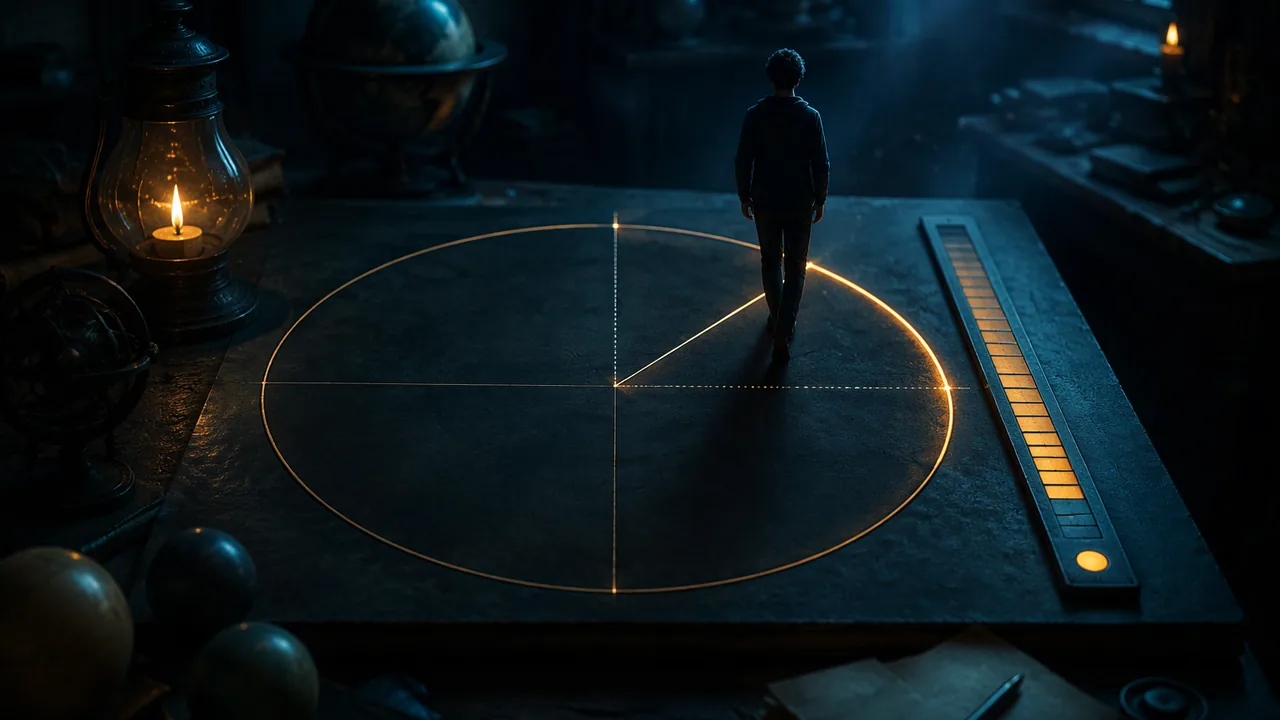
Radians. Draw a circle of radius 1 centered at the origin, the unit circle. Start at (1, 0) and walk counterclockwise along the circle. The radian measure of the angle you have turned is the length of the arc you walked. A full turn is the whole circumference, 2π ≈ 6.283, so
360° = 2π radians, 180° = π radians, 1 radian = 180°/π ≈ 57.2958°.
To convert degrees to radians, multiply by π/180: 150° = 150π/180 = 5π/6. To convert back, multiply by 180/π. On a circle of radius r, the same angle cuts an arc r times as long, so arc length is s = rθ with θ in radians. A bicycle wheel of radius 0.35 m turning through 4 radians rolls 1.4 m. Radians are not a unit invented for convenience; they measure an angle by a length, which is why they are the natural input for functions of real numbers.
Sine and cosine on the circle. After turning θ radians, you stand at a point (x, y) on the unit circle. Define
cos θ = x, sin θ = y, tan θ = y/x (when x ≠ 0).
For an angle between 0 and π/2, the point, the origin and the foot of the perpendicular to the x-axis form a right triangle with hypotenuse 1, so these match the Geometry definitions: the adjacent side is x = cos θ, and the opposite side is y = sin θ. The new definition agrees with the old one where both apply, and extends it everywhere else (enrichment).
Known values. From the 30-60-90 triangle, the point at π/3 (60°) is (1/2, √3/2), so cos(π/3) = 1/2 and sin(π/3) = √3/2 ≈ 0.866. Reflect that point to other quadrants and only the signs change: at 2π/3 the point is (−1/2, √3/2), and at 5π/6 (150°) the point is (−√3/2, 1/2), so cos(5π/6) = −√3/2. At 7π/6 (210°) the point is (−√3/2, −1/2), so sin(7π/6) = −1/2. The quarter-turn points are exact: (1, 0) at 0, (0, 1) at π/2, (−1, 0) at π and (0, −1) at 3π/2.
Any real number. Walking more than a full turn just goes around again, so sin(θ + 2π) = sin θ: for example sin(13π/6) = sin(π/6) = 1/2. Walking clockwise gives negative angles: −π/2 lands at (0, −1), so sin(−π/2) = −1. Every real number is now an angle, and sine and cosine are functions whose domain is all real numbers. Because the point on the circle repeats every 2π, both functions are periodic.
Precision (MP.6). Set your calculator to radian mode for this unit. sin(30) in degree mode is 0.5; in radian mode it is about −0.988, the sine of 30 radians. Most wrong answers in this unit come from the wrong mode.
📖 Read for this lesson
The reading opens over the lesson; close it to come back to exactly where you were. The checks below draw on it.
Formative check
Work through these before moving on. They are not graded — they tell you whether the standard below has landed yet.
150° = radians, and 1 radian is about degrees.
Simulation & tools
Walking the unit circle
Switch the angle units to radians and turn on the special angles. Drag the point to π/3 and record cos and sin as shown. Then drag to 2π/3, 4π/3 and 5π/3 and record the values each time. Finally, keep dragging counterclockwise past 2π to 7π/3 and record sin. Question: which values stayed the same and which changed sign across the four angles, and why does sin(7π/3) equal sin(π/3)? Explain using the point’s coordinates. No device: draw a unit circle, mark the four angles using the 30-60-90 triangle, and read the coordinates with signs from the quadrants.
Open in a new tab ↗ · PhET Interactive Simulations, University of Colorado Boulder · CC BY 4.0
What is sin(7π/6)?
Explain in your own words why an angle of 1 radian is the same size on every circle, even though the arc it cuts is longer on bigger circles. Then explain how the unit circle lets sine take the input 10 (radians), and estimate the sign of sin 10 by deciding which quadrant the angle lands in.
How confident are you that you can use radians and the unit circle to evaluate sine and cosine for any real number?
Practice
Work these on paper or in your notebook, then open Check your answer. Aim for all of Fluency and Application; try at least one Challenge.
Printable version: this unit’s practice workbook (PDF)
Fluency
Build speed and accuracy with the core skill.
- Convert 150° to radians.
Check your answer
Answer: 5π/6Multiply by π/180. - Convert 75° to radians.
Check your answer
Answer: 5π/12Multiply by π/180. - Convert 5π/6 radians to degrees.
Check your answer
Answer: 150°Multiply by 180/π. - Convert 2π/9 radians to degrees.
Check your answer
Answer: 40°Multiply by 180/π. - Convert 400° to radians.
Check your answer
Answer: 20π/9Multiply by π/180. - Find the exact value of tan(2π).
Check your answer
Answer: 0Use the reference angle and the sign of the function in that quadrant. - Find the exact value of cos(5π/6).
Check your answer
Answer: −√3/2Use the reference angle and the sign of the function in that quadrant. - Find the exact value of tan(5π/4).
Check your answer
Answer: 1Use the reference angle and the sign of the function in that quadrant. - Find the exact value of sin(4π/3).
Check your answer
Answer: −√3/2Use the reference angle and the sign of the function in that quadrant. - Find the exact value of cos(3π/4).
Check your answer
Answer: −√2/2Use the reference angle and the sign of the function in that quadrant.
Application
Use the skill in context. Show your reasoning.
- A bicycle wheel of radius 0.35 m turns through 4 radians. How far does the bike roll?
Check your answer
Answer: 1.4 ms = rθ. - A Ferris wheel of radius 20 m turns through 3π/4 radians. How far does a rider travel along the arc?
Check your answer
Answer: 15π ≈ 47.12 m - A clock’s minute hand is 12 cm long. How far does its tip travel in 20 minutes? Give the angle in radians too.
Check your answer
Answer: 2π/3 radians; 8π ≈ 25.13 cm
Challenge
Stretch problems. Expect to think before you write.
- Without a calculator, decide the sign of sin 10 (radians). Then check.
Check your answer
Answer: Negative: 10 − 2π ≈ 3.717, between π and 3π/2 (Quadrant III); sin 10 ≈ -0.5440
Review
Keep earlier skills sharp.
- Solve for x: 2x = 100. Give an exact answer using logarithms and a decimal to the nearest thousandth.
Check your answer
Answer: x = log 100 / log 2 ≈ 6.644Take the logarithm of both sides and use the power property. - Solve and graph: |x − 6| ≥ 3
Check your answer
Answer: x ≤ 3 or x ≥ 9Distance from 6 is at least 3: x − 6 ≤ −3 or x − 6 ≥ 3.
Radians on a Real Sphere: Latitude, Arc Length and Nine Missouri Cities
U.S. Census Bureau, 2020 Gazetteer Files, national place file (internal-point latitude, INTPTLAT, for nine Missouri incorporated places), and the IUGG mean Earth radius of 6,371.0088 km; retrieved Nov. 5, 2026 · Public domain (works of the United States government)
Why this reading. The lesson gives one arc-length example, a bicycle wheel, and then asks you to explain why one radian is the same size on every circle. That argument is much easier to make when you have a circle you cannot see all of and a set of measured points on it. Latitude is an angle. Distance north–south is an arc. The coordinates below are the U.S. Census Bureau’s own, published in its 2020 Gazetteer of places, so the arithmetic is a real measurement problem and not a textbook one.
Why latitude is a radian problem
Latitude measures the angle at the Earth’s center between a place and the equatorial plane. Two places on the same meridian, at latitudes φ1 and φ2, are separated by a central angle θ = φ2 − φ1, and the distance between them along the surface is the arc s = Rθ — with θ in radians. Using degrees gives an answer 57 times too large, and no amount of unit labeling will save it, because s = Rθ is only true when the angle is measured as arc length on a unit circle in the first place. For two places that are not on the same meridian, the same formula gives their north–south separation, which is what the last column of Table 1 measures.
With R = 6,371.0088 km (the mean Earth radius adopted by the International Union of Geodesy and Geophysics), one degree of latitude is 6,371.0088 × (π/180) = 111.2 km, and one radian is 6,371 km — the radius itself, which is what “one radian” means.
Table 1. Nine Missouri places, north to south
Latitudes are the Census Bureau’s “internal point” for each incorporated city (a point inside the city limits, near its center), from the 2020 Gazetteer place file. Lancaster sits a few miles south of the Iowa line; Thayer sits just north of the Arkansas line.
| City | Latitude °N | Latitude in radians | Arc north of Thayer (km) |
|---|---|---|---|
| Lancaster (near the Iowa line) | 40.52632 | 0.70732 | 445.2 |
| Kirksville | 40.19817 | 0.70159 | 408.7 |
| Hannibal | 39.71021 | 0.69307 | 354.5 |
| Kansas City | 39.12236 | 0.68281 | 289.1 |
| Columbia | 38.94729 | 0.67976 | 269.6 |
| St. Louis | 38.63570 | 0.67432 | 235.0 |
| Cape Girardeau | 37.31009 | 0.65118 | 87.6 |
| Springfield | 37.19415 | 0.64916 | 74.7 |
| Thayer (near the Arkansas line) | 36.52236 | 0.63744 | 0.0 |
Read the last two columns together. Thayer to Lancaster spans 40.52632 − 36.52236 = 4.00396°, which is 0.06988 radians, and 6,371.0088 × 0.06988 = 445.2 km. Every other row is the same calculation. The middle column exists to make one point: the numbers in it are pure — 0.06988 is a length divided by a length — and that is why multiplying by R in kilometers gives kilometers with nothing left over.
Why one radian is the same angle on every circle
On a circle of radius r, the arc cut by an angle of one radian has length r. On a bigger circle that arc is longer — 0.35 m on a bicycle wheel, 6,371 km on the Earth — but it is longer in exactly the same proportion as the radius. The angle is the ratio s/r, and a ratio of two lengths has no units and does not care how big the circle is. That is the whole of the argument, and you can check it here: 0.06988 radians of latitude is 445.2 km on the Earth and would be 0.02446 m on the bicycle wheel, and 445.2/6,371.0 = 0.02446/0.35 = 0.0699.
Table 2. Conversions you will use all unit
| Degrees | 0° | 30° | 45° | 60° | 90° | 120° | 135° | 150° | 180° | 270° | 360° |
|---|---|---|---|---|---|---|---|---|---|---|---|
| Radians | 0 | π/6 | π/4 | π/3 | π/2 | 2π/3 | 3π/4 | 5π/6 | π | 3π/2 | 2π |
| Decimal | 0 | 0.5236 | 0.7854 | 1.0472 | 1.5708 | 2.0944 | 2.3562 | 2.6180 | 3.1416 | 4.7124 | 6.2832 |
Two checks worth doing by hand. 150° × π/180 = 5π/6, and 5π/6 = 2.6180, which the table confirms. And 1 radian × 180/π = 57.2958°, so the latitude span from Thayer to Lancaster, 0.06988 radians, is 0.06988 × 57.2958 = 4.0038° — back where we started, to within the rounding of 0.06988, which is what a conversion is supposed to do.
A caution the data forces on you
Latitude arcs are clean because they run along a meridian, a great circle. Longitude arcs are not: a degree of longitude is 111.2 km at the equator and shrinks toward the poles by a factor of cosφ. At St. Louis’s 38.64°, cos 38.64° = 0.781, so a degree of longitude is about 86.9 km. That single cosine is why a flat map grid multiplies the longitude difference by cos(mean latitude) and the latitude difference by nothing.
The Earth is also not a sphere. It is flattened by about one part in 298, so the true distance per degree of latitude runs from about 110.6 km near the equator to about 111.7 km near the poles. The 111.2 km used here is the mean-sphere value. For the 445.2 km calculated above, the spherical approximation is off by less than a kilometer — under a quarter of a percent, fine for a road map and not fine for surveying. Saying which of those two your number is good enough for is the part of a measurement that is actually mathematics.
Sources: U.S. Census Bureau, 2020 Gazetteer Files (places, national file) (www2.census.gov); U.S. Census Bureau, Gazetteer Files overview (census.gov); NOAA National Geodetic Survey (geodesy.noaa.gov)