prove sin2θ + cos2θ = 1 for every real θ, derive related identities, and find sin, cos or tan from one of them and the quadrant.
Instruction
The identity. For every real number θ,
sin2θ + cos2θ = 1.
(sin2θ means (sin θ)2.)
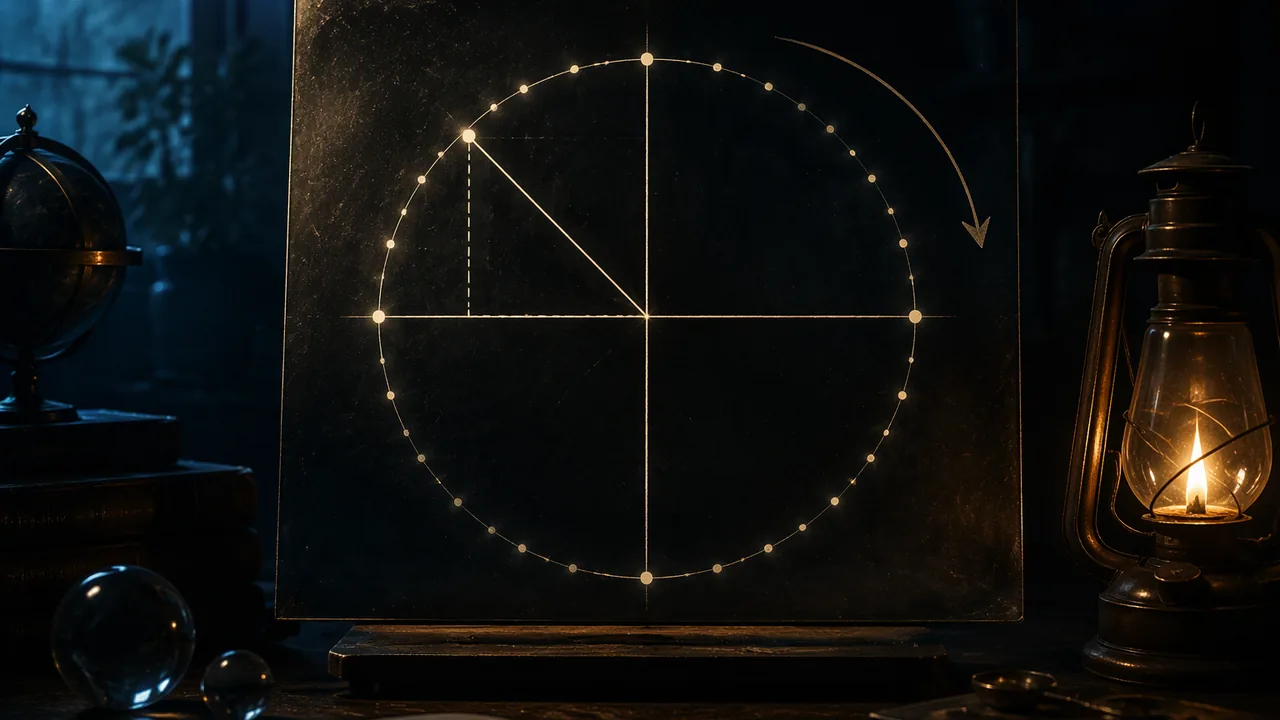
Proof. Let (x, y) be the point on the unit circle reached by turning θ radians from (1, 0). By definition, x = cos θ and y = sin θ. The point lies on the unit circle, so its distance from the origin is 1. By the distance formula, which comes from the Pythagorean Theorem, √(x2 + y2) = 1, so x2 + y2 = 1. Substituting, cos2θ + sin2θ = 1. ∎
Notice what the proof does not need: a right triangle drawn inside the first quadrant. A triangle-only argument would prove the identity for 0 < θ < π/2 and leave every other angle unproved. The unit-circle argument works for every θ, including negative ones and those past 2π, and for the quarter-turn points where no triangle exists. When you critique proofs in the lab, ask whether the argument covers all the cases it claims.
Related identities. Divide both sides by cos2θ (where cos θ ≠ 0): tan2θ + 1 = sec2θ. Divide instead by sin2θ: 1 + cot2θ = csc2θ. Each new identity carries a restriction from the division, and a careful proof states it.
Using the identity with the quadrant. The identity gives the size of one value from another; the quadrant gives the sign.
- Given sin θ = 3/5 with θ in Quadrant II. Then cos2θ = 1 − 9/25 = 16/25, so cos θ = ±4/5. In Quadrant II, x is negative, so cos θ = −4/5, and tan θ = (3/5)/(−4/5) = −3/4.
- Given tan θ = 2 with θ in Quadrant III. Then sec2θ = 1 + 4 = 5, so sec θ = ±√5. In Quadrant III, cosine is negative, so sec θ = −√5 and cos θ = −1/√5 ≈ −0.4472. Then sin θ = tan θ · cos θ = −2/√5 ≈ −0.8944. Check: 0.2 + 0.8 = 1.
A memory aid for signs: in Quadrant I all three are positive; in II only sine; in III only tangent; in IV only cosine. But you do not need the aid if you remember that cos is x and sin is y.
Proving other identities (enrichment). To prove an identity, start from one side and transform it, using known identities and algebra, until it becomes the other side. Do not work on both sides at once as if they were already equal; that assumes what you are trying to prove. Example: prove (1 − cos θ)(1 + cos θ) = sin2θ. Start on the left: multiplying gives 1 − cos2θ, and by the Pythagorean identity 1 − cos2θ = sin2θ. Done.
Discourse (MP.3). In the lab you will judge three “proofs”: one that only checks θ = π/6, one that uses a first-quadrant triangle, and the unit-circle proof. Rank them and write what each proves and fails to prove.
📖 Read for this lesson
The reading opens over the lesson; close it to come back to exactly where you were. The checks below draw on it.
Formative check
Work through these before moving on. They are not graded — they tell you whether the standard below has landed yet.
If sin θ = 3/5 and θ is in Quadrant II, what is tan θ?
If tan θ = 2 in Quadrant III, then sec θ = and cos θ ≈ .
Checking that sin2θ + cos2θ = 1 at θ = π/6, π/4 and π/3 proves the identity.
Write the unit-circle proof of the Pythagorean identity, giving a reason for each step. Then derive tan2θ + 1 = sec2θ from it, stating the restriction, and use it to find sin θ and cos θ if tan θ = −1/2 and θ is in Quadrant IV.
How confident are you that you can prove the Pythagorean identity and use it with the quadrant to find trigonometric values?
Practice
Work these on paper or in your notebook, then open Check your answer. Aim for all of Fluency and Application; try at least one Challenge.
Printable version: this unit’s practice workbook (PDF)
Fluency
Build speed and accuracy with the core skill.
- Find the exact value of tan(π/3).
Check your answer
Answer: √3Use the reference angle and the sign of the function in that quadrant. - Find the exact value of cos(3π/2).
Check your answer
Answer: 0Use the reference angle and the sign of the function in that quadrant. - Find the exact value of cos(π/4).
Check your answer
Answer: √2/2Use the reference angle and the sign of the function in that quadrant. - If cos θ = −5/13 and θ is in Quadrant III, find sin θ and tan θ.
Check your answer
Answer: sin θ = −12/13, tan θ = 12/5 - If sin θ = −1/2 and θ is in Quadrant IV, find cos θ and tan θ.
Check your answer
Answer: cos θ = √3/2, tan θ = −√3/3 - If sec θ = 3 and θ is in Quadrant IV, find cos θ and sin θ.
Check your answer
Answer: cos θ = 1/3, sin θ = −2√2/3 - If sin θ = 3/5 in Quadrant II, find cos θ and tan θ.
Check your answer
Answer: cos θ = −4/5, tan θ = −3/4 - If tan θ = −1/2 in Quadrant IV, find cos θ and sin θ.
Check your answer
Answer: cos θ = 2/√5 ≈ 0.8944, sin θ = −1/√5 ≈ −0.4472sec2 = 1 + 1/4.
Application
Use the skill in context. Show your reasoning.
- A wheelchair ramp makes an angle θ with the ground where sin θ = 0.28. Find cos θ and the ramp’s horizontal run if it is 7.5 m long.
Check your answer
Answer: cos θ = 0.96; run 7.2 mcos θ = √(1 − 0.0784). - Prove (1 − cos θ)(1 + cos θ) = sin2θ.
Check your answer
Answer: Left side = 1 − cos2θ = sin2θ by the Pythagorean identity. - Derive tan2θ + 1 = sec2θ from the Pythagorean identity and state the restriction.
Check your answer
Answer: Divide sin2θ + cos2θ = 1 by cos2θ; cos θ ≠ 0.
Challenge
Stretch problems. Expect to think before you write.
- Prove sin4θ − cos4θ = sin2θ − cos2θ.
Check your answer
Answer: Factor: (sin2θ − cos2θ)(sin2θ + cos2θ), and the second factor is 1.
Review
Keep earlier skills sharp.
- Complete the square to write y = x2 + 8x + 13 in vertex form, and give the vertex.
Check your answer
Answer: y = (x + 4)2 − 3; vertex (−4, −3)Half of 8 is 4; its square is 16. - A quantity starts at 15,000 and grows by 12% each year. Write a model and find its value after 14 years, to the nearest whole number.
Check your answer
Answer: A = 15,000(1.12)t; after 14 years ≈ 73,307The growth factor is 1 + 0.12 = 1.12.
Three Arguments for sin²θ + cos²θ = 1, Only One of Which Is a Proof
SLS original; the three arguments were written for this course, and no student wrote them · SLS original
Why this reading. The lesson ends by saying “in the lab you will judge three ‘proofs’… Rank them and write what each proves and fails to prove.” Here are the three. They were written for this lab, each built around a specific idea about what counts as proof. Read them before you rank them, and rank them on what they establish, not on how convincing they sound.
Argument 1 — The verification
“I will show that sin2θ + cos2θ = 1.
At θ = π/6: sinθ = 1/2 and cosθ = √3/2, so sin2θ + cos2θ = 1/4 + 3/4 = 1. ✓
At θ = π/4: both are √2/2, so the sum is 1/2 + 1/2 = 1. ✓
At θ = π/3: sinθ = √3/2 and cosθ = 1/2, so the sum is 3/4 + 1/4 = 1. ✓
At θ = 2.4 radians, by calculator: sinθ = 0.675463, cosθ = −0.737394, and 0.456251 + 0.543749 = 1.000000. ✓
At θ = −11.7 radians, by calculator: the sum is 1.000000. ✓
Five cases, including one irrational, one negative, and one past a full turn, and it works every time. Therefore sin2θ + cos2θ = 1 for every real θ.”
Argument 2 — The right triangle
“Draw a right triangle with an acute angle θ, opposite side a, adjacent side b, and hypotenuse c. By the definitions from Geometry, sinθ = a/c and cosθ = b/c. Then
sin2θ + cos2θ = a2/c2 + b2/c2 = (a2 + b2)/c2.
By the Pythagorean Theorem, a2 + b2 = c2, so the expression is c2/c2 = 1. The triangle was arbitrary, so this holds for every θ. ∎”
Argument 3 — The unit circle
“Let θ be any real number and let P = (x, y) be the point reached by turning θ radians counterclockwise from (1, 0) along the unit circle. By the definitions of sine and cosine for any real number, x = cosθ and y = sinθ.
P lies on the unit circle, which is the set of points at distance 1 from the origin. By the distance formula, √(x2 + y2) = 1. Both sides are non-negative, so squaring is reversible and x2 + y2 = 1. Substituting, cos2θ + sin2θ = 1.
Nothing in the argument assumed θ was between 0 and π/2, or positive, or less than 2π. Every real number determines a point on the circle, so the identity holds for every real θ. ∎”
What to write about each
For each argument, answer three questions in writing. What does it establish? What does it fail to establish? What would it take to repair it, if anything? Then rank all three.
Some things to test the arguments against, rather than accepting or rejecting them wholesale:
- Argument 1’s five cases are all true. Does an argument that never makes a false claim thereby prove something? Consider the claim “n2 + n + 41 is prime for every whole number n”: check n = 0, 1, 2, 3, 4 and then n = 40. The point is not that Argument 1 is unconvincing. It is that a method which cannot fail here also cannot fail there, and there it gives the wrong answer.
- Argument 2 is valid algebra and a correct use of the Pythagorean Theorem. Apply it to θ = 3π/4. What is the opposite side? Now apply it to θ = π/2. Where is the triangle? Name the exact sentence in the argument that stops being true, and say how much of the identity survives — which is not nothing.
- Argument 3 says “squaring is reversible” and gives a reason. Why does it bother? Try the same move on √(x2) = x and see what goes wrong when x < 0.
- Argument 3 leans on the distance formula, which is itself proved from the Pythagorean Theorem. Is Argument 3 therefore circular, or is it doing something Argument 2 is not? Write down which theorem each argument applies to what object, and the difference becomes clear.
Carrying the restriction forward
The derived identities inherit a condition from the division, and a complete proof says so. Divide sin2θ + cos2θ = 1 by cos2θ and you get tan2θ + 1 = sec2θ, for θ ≠ π/2 + kπ. Divide by sin2θ and you get 1 + cot2θ = csc2θ, for θ ≠ kπ. A student who writes tan2θ + 1 = sec2θ “for all θ” has made the same category of error as Argument 2: a true statement, asserted over a domain where its terms are not defined.
One more to judge, if your group finishes early. “Proof that (1 − cosθ)(1 + cosθ) = sin2θ: start with (1 − cosθ)(1 + cosθ) = sin2θ. Expand the left: 1 − cos2θ = sin2θ. Add cos2θ to both sides: 1 = sin2θ + cos2θ, which is true. Therefore the original is true.” Every line of that is a true equation. Say precisely what is wrong with it anyway, and rewrite it so that it is a proof.