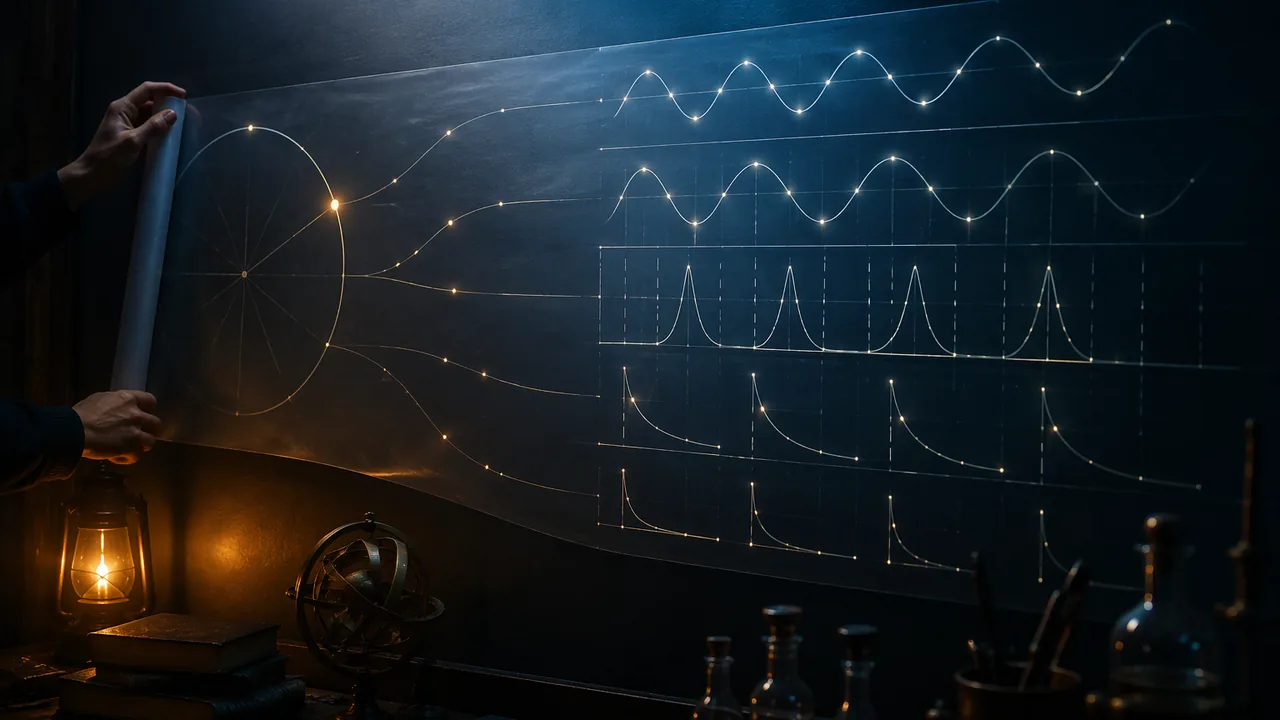
graph sine, cosine, tangent, cosecant, secant and cotangent, identifying period, amplitude, midline, zeros and asymptotes and relating each to the unit circle.
Instruction
Sine and cosine. Unroll the unit circle. As θ goes from 0 to 2π, the y-coordinate starts at 0, rises to 1 at π/2, returns to 0 at π, falls to −1 at 3π/2 and returns to 0 at 2π. Plotting y = sin θ against θ gives a wave. The x-coordinate starts at 1 and follows the same wave shifted left by π/2, so cos θ = sin(θ + π/2).
Key features (A2.BF.A.3): period 2π, the length of one full cycle; midline y = 0, the horizontal line halfway between maximum and minimum; amplitude 1, the distance from the midline to a maximum. Sine has zeros at 0, π, 2π, … (every multiple of π); cosine has zeros at π/2 + kπ. Sine is odd, sin(−θ) = −sin θ, and cosine is even, cos(−θ) = cos θ: on the unit circle, reflecting across the x-axis negates y and keeps x.
Tangent. tan θ = sin θ/cos θ, the slope of the radius to the point. It is 0 where sine is 0, and undefined where cosine is 0, at π/2 + kπ, where the graph has vertical asymptotes. Between asymptotes it rises from −∞ to +∞ through (0, 0), passing through (π/4, 1). Its period is π, not 2π: the points at θ and θ + π are opposite each other on the circle, and both coordinates change sign, so their ratio is unchanged.
The reciprocal functions.
- csc θ = 1/sin θ. Where sin θ = 0, csc has asymptotes. Where sin θ = ±1, csc θ = ±1, and those are the turning points of its U-shaped branches. csc(π/6) = 1/(1/2) = 2.
- sec θ = 1/cos θ, with asymptotes at the zeros of cosine. sec(π/3) = 2.
- cot θ = cos θ/sin θ = 1/tan θ, with period π, asymptotes at multiples of π, and decreasing branches. cot(π/4) = 1.
Sketching a reciprocal from its partner. Draw sin θ lightly. Put a dashed vertical asymptote at each of its zeros. Where sin θ is at its maximum 1, csc θ is also 1; as sin θ falls toward 0, csc θ grows toward infinity. Each hump of the sine wave becomes a U-shaped branch of cosecant sitting on top of it (or hanging below it, where sine is negative). The ranges show the relationship: sine takes values from −1 to 1, so cosecant takes values ≤ −1 or ≥ 1 and never anything in between.
Precision (MP.6). Label the horizontal axis in multiples of π/2 and the vertical axis with numbers. Mark asymptotes as dashed lines and state the period, midline and amplitude (where defined) for each graph. Tangent, cotangent, secant and cosecant have no amplitude, because they have no maximum value.
📖 Read for this lesson
The reading opens over the lesson; close it to come back to exactly where you were. The checks below draw on it.
Formative check
Work through these before moving on. They are not graded — they tell you whether the standard below has landed yet.
What is the period of y = tan θ?
csc(π/6) = , sec(π/3) = and cot(π/4) = .
The secant function has vertical asymptotes wherever cosine equals zero.
Graph y = sin θ and y = csc θ on the same axes from −2π to 2π. Label the asymptotes and the points where the graphs touch, and explain why csc θ never takes a value between −1 and 1.
How confident are you that you can graph all six trigonometric functions with their key features?
Practice
Work these on paper or in your notebook, then open Check your answer. Aim for all of Fluency and Application; try at least one Challenge.
Printable version: this unit’s practice workbook (PDF)
Fluency
Build speed and accuracy with the core skill.
- Find the exact value of sin(45°).
Check your answer
Answer: √2/2Use the reference angle and the sign of the function in that quadrant. - Find the exact value of cos(240°).
Check your answer
Answer: −1/2Use the reference angle and the sign of the function in that quadrant. - Find the exact value of sin(330°).
Check your answer
Answer: −1/2Use the reference angle and the sign of the function in that quadrant. - State the period of sin θ, tan θ and sec θ.
Check your answer
Answer: 2π, π, 2π - Where are the vertical asymptotes of sec θ and of cot θ?
Check your answer
Answer: sec: θ = π/2 + kπ; cot: θ = kπ - State the range of sin θ and of csc θ.
Check your answer
Answer: sin: −1 ≤ y ≤ 1; csc: y ≤ −1 or y ≥ 1 - Evaluate csc(π/6), sec(π/3), cot(π/4) and sec π.
Check your answer
Answer: 2, 2, 1, −1 - Find the zeros of cot θ on 0 ≤ θ ≤ 2π.
Check your answer
Answer: π/2 and 3π/2cot = cos/sin is zero where cos is zero.
Application
Use the skill in context. Show your reasoning.
- State the amplitude, period and midline of y = 3 sin(2θ).
Check your answer
Answer: Amplitude 3, period π, midline y = 0 - State the period and asymptotes of y = tan(θ/2) on −2π < θ < 2π.
Check your answer
Answer: Period 2π; asymptotes at θ = ±πθ/2 = ±π/2. - A voltage is modeled by V(t) = 170 sin(120πt). Find its amplitude, period and frequency.
Check your answer
Answer: 170 V; 1/60 s; 60 cycles per second
Challenge
Stretch problems. Expect to think before you write.
- Solve csc θ = 2 on 0 ≤ θ < 2π, and explain using the graph of sin θ.
Check your answer
Answer: θ = π/6 and 5π/6csc θ = 2 means sin θ = 1/2.
Review
Keep earlier skills sharp.
- Find the center and radius of the circle x2 − 6x + y2 − 12y + 44 = 0.
Check your answer
Answer: center (3, 6); radius 1Group and complete the square in x and in y. - Evaluate: log2 √2
Check your answer
Answer: 1/2Ask: 2 to what power gives √2?
The Six Functions: Exact Values, Key Features and the Graphs They Make
SLS original reference tables; exact values from the unit circle, decimals rounded to four places · SLS original
Why this reading. The lab’s output is “six labeled graphs over two periods with a key-features table.” You cannot label a graph accurately from a mini-lecture that works three examples; you need the values, all of them, in one place, and you need the features tabulated so that the table you build can be checked against something. That is what this is. Every value was computed for this course from the unit circle.
Table 1. Exact values on the unit circle
“u” means undefined. Read the row for the point (cosθ, sinθ) and every other entry is a quotient of those two.
| θ | degrees | sinθ | cosθ | tanθ | cscθ | secθ | cotθ |
|---|---|---|---|---|---|---|---|
| 0 | 0° | 0 | 1 | 0 | u | 1 | u |
| π/6 | 30° | 1/2 | √3/2 | √3/3 | 2 | 2√3/3 | √3 |
| π/4 | 45° | √2/2 | √2/2 | 1 | √2 | √2 | 1 |
| π/3 | 60° | √3/2 | 1/2 | √3 | 2√3/3 | 2 | √3/3 |
| π/2 | 90° | 1 | 0 | u | 1 | u | 0 |
| 2π/3 | 120° | √3/2 | −1/2 | −√3 | 2√3/3 | −2 | −√3/3 |
| 3π/4 | 135° | √2/2 | −√2/2 | −1 | √2 | −√2 | −1 |
| 5π/6 | 150° | 1/2 | −√3/2 | −√3/3 | 2 | −2√3/3 | −√3 |
| π | 180° | 0 | −1 | 0 | u | −1 | u |
| 7π/6 | 210° | −1/2 | −√3/2 | √3/3 | −2 | −2√3/3 | √3 |
| 5π/4 | 225° | −√2/2 | −√2/2 | 1 | −√2 | −√2 | 1 |
| 4π/3 | 240° | −√3/2 | −1/2 | √3 | −2√3/3 | −2 | √3/3 |
| 3π/2 | 270° | −1 | 0 | u | −1 | u | 0 |
| 5π/3 | 300° | −√3/2 | 1/2 | −√3 | −2√3/3 | 2 | −√3/3 |
| 7π/4 | 315° | −√2/2 | √2/2 | −1 | −√2 | √2 | −1 |
| 11π/6 | 330° | −1/2 | √3/2 | −√3/3 | −2 | 2√3/3 | −√3 |
Decimals for the recurring values, so you can check a calculator: √2/2 = 0.7071, √3/2 = 0.8660, √3/3 = 0.5774, √3 = 1.7321, 2√3/3 = 1.1547, √2 = 1.4142.
Table 2. Key features, for the table you have to build
| Function | Period | Amplitude | Midline | Domain | Range | Zeros | Vertical asymptotes |
|---|---|---|---|---|---|---|---|
| sinθ | 2π | 1 | y = 0 | all reals | [−1, 1] | kπ | none |
| cosθ | 2π | 1 | y = 0 | all reals | [−1, 1] | π/2 + kπ | none |
| tanθ | π | none | none | θ ≠ π/2 + kπ | all reals | kπ | π/2 + kπ |
| cotθ | π | none | none | θ ≠ kπ | all reals | π/2 + kπ | kπ |
| secθ | 2π | none | none | θ ≠ π/2 + kπ | (−∞, −1] ∪ [1, ∞) | none | π/2 + kπ |
| cscθ | 2π | none | none | θ ≠ kπ | (−∞, −1] ∪ [1, ∞) | none | kπ |
Four of the six have no amplitude and no midline, and the reason is the same for all four: amplitude is the distance from a midline to a maximum, and a function with no maximum has neither. Writing “amplitude 1” for secant because its branches turn at ±1 is the classic error. Those are local turning points, not maxima of the function.
Table 3. Twenty-four points for plotting, in decimals
Enough to draw all six curves over one period by hand. Values are rounded to two decimal places; “u” marks an asymptote.
| θ | 0 | π/6 | π/4 | π/3 | π/2 | 2π/3 | 3π/4 | 5π/6 | π | 7π/6 | 5π/4 | 4π/3 | 3π/2 | 5π/3 | 7π/4 | 11π/6 | 2π |
|---|---|---|---|---|---|---|---|---|---|---|---|---|---|---|---|---|---|
| sin | 0 | 0.50 | 0.71 | 0.87 | 1 | 0.87 | 0.71 | 0.50 | 0 | −0.50 | −0.71 | −0.87 | −1 | −0.87 | −0.71 | −0.50 | 0 |
| cos | 1 | 0.87 | 0.71 | 0.50 | 0 | −0.50 | −0.71 | −0.87 | −1 | −0.87 | −0.71 | −0.50 | 0 | 0.50 | 0.71 | 0.87 | 1 |
| tan | 0 | 0.58 | 1 | 1.73 | u | −1.73 | −1 | −0.58 | 0 | 0.58 | 1 | 1.73 | u | −1.73 | −1 | −0.58 | 0 |
| csc | u | 2 | 1.41 | 1.15 | 1 | 1.15 | 1.41 | 2 | u | −2 | −1.41 | −1.15 | −1 | −1.15 | −1.41 | −2 | u |
| sec | 1 | 1.15 | 1.41 | 2 | u | −2 | −1.41 | −1.15 | −1 | −1.15 | −1.41 | −2 | u | 2 | 1.41 | 1.15 | 1 |
| cot | u | 1.73 | 1 | 0.58 | 0 | −0.58 | −1 | −1.73 | u | 1.73 | 1 | 0.58 | 0 | −0.58 | −1 | −1.73 | u |
Three patterns to find in the tables, not to be told
- Compare the sin row with the cos row shifted four columns left. They match. That is cosθ = sin(θ + π/2), the quarter-period shift, visible as a column offset.
- Compare tan at π/6 and at 7π/6: both 0.58. Compare sin at those angles: 0.50 and −0.50. Both coordinates flip sign, so their ratio does not — which is the period-π argument, checkable in one column pair.
- Wherever sin is 1 or −1, csc equals it exactly; wherever sin heads to 0, csc heads to ±∞. The two curves touch and never cross, and csc takes no value strictly between −1 and 1 because sin takes no value outside [−1, 1] to be its reciprocal.