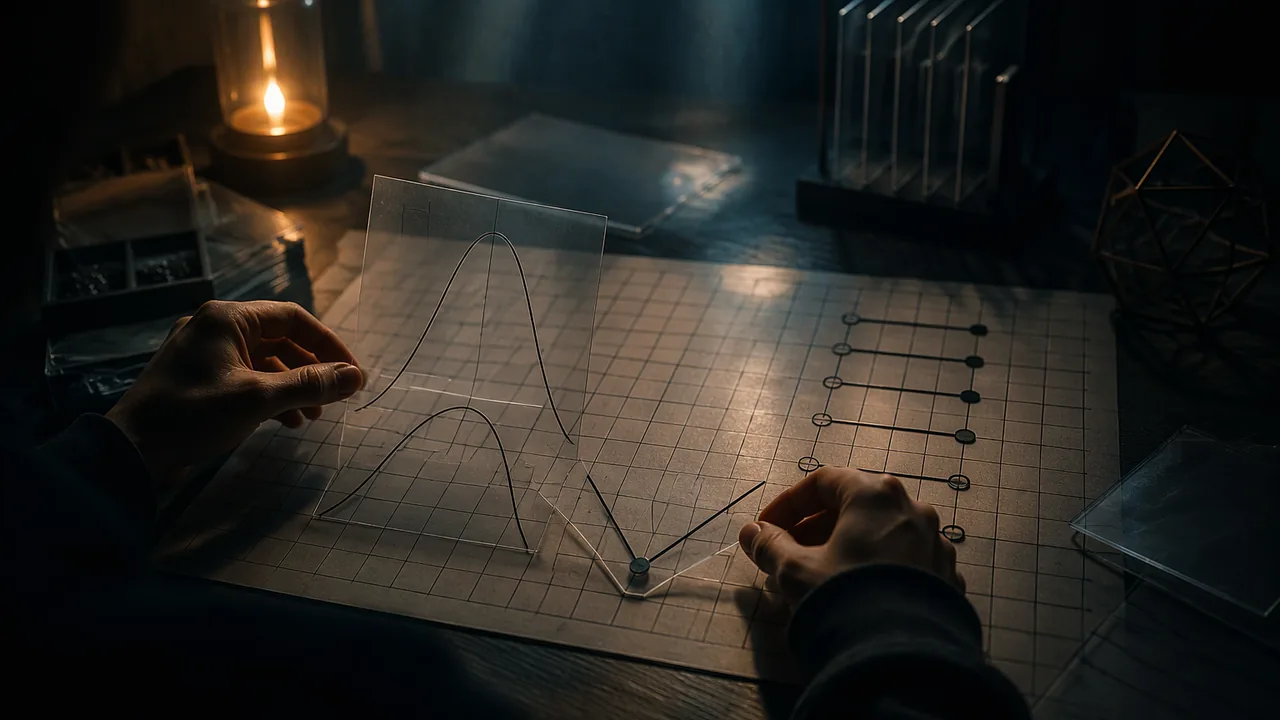
graph kf(x) and f(kx), graph absolute value, piecewise and step functions by hand, and compare functions presented in different representations.
Instruction
Vertical stretch: k·f(x). Multiplying every output by k stretches the graph away from the x-axis if k > 1 and compresses it toward the axis if 0 < k < 1. Points on the x-axis stay put. A negative k also reflects.
Horizontal stretch: f(kx). Multiplying the input by k compresses the graph toward the y-axis by a factor of 1/k when k > 1. The function f(2x) reaches at x = 1 the output f reached at 2: everything happens twice as fast, so the graph is squeezed to half its width. As with horizontal translation, the effect on the graph looks “opposite” to the number, and the reason is the same: changes inside act on inputs.
Absolute value. |x| is the distance from x to 0, so |x| = x when x ≥ 0 and −x when x < 0. Its graph is a V with vertex at the origin and slopes 1 and −1. Graph y = 2|x − 1| − 3 by transformations:
- x − 1 inside: shift right 1, so the vertex moves to (1, 0).
- Factor 2 outside: stretch vertically by 2, so the slopes become 2 and −2.
- −3 outside: shift down 3, so the vertex is (1, −3).
x-intercepts: 2|x − 1| = 3, so |x − 1| = 1.5 and x = 2.5 or −0.5. y-intercept: 2|−1| − 3 = −1. Plot the vertex, the intercepts and the slopes, and the graph is done.
Piecewise functions. A piecewise function uses different rules on different parts of its domain. A parking garage (illustrative prices) charges $3 for the first hour or less, then $2 for each additional hour or part of an hour, with a daily maximum of $15. The cost C(t) for t hours is a step function: C = 3 for 0 < t ≤ 1, C = 5 for 1 < t ≤ 2, C = 7 for 2 < t ≤ 3, and so on, reaching 15 for 6 < t ≤ 7 and staying at 15 after that. Graph each step as a horizontal segment with an open circle on the left end and a closed circle on the right, because 1 hour exactly costs $3 and 1 hour and 1 minute costs $5. The endpoints are where precision matters most (MP.6).
Absolute value is itself piecewise, and many piecewise functions are built by combining simpler ones (A2.BF.A.1). A tax that is 0 on income up to $10,000 and 10% of the amount above $10,000 can be written 0.05(x − 10,000) + 0.05|x − 10,000|. Check x = 30,000: 0.05(20,000) + 0.05(20,000) = 2,000, which is 10% of the 20,000 above the threshold.
Comparing representations (A2.IF.A.1). Suppose garage A is described by the step function above and garage B posts a table: 1 hour $4, 2 hours $6, 3 hours $8, all day $12. Which is cheaper for a 2.5-hour stay? A charges $7 (the 2 < t ≤ 3 step); B charges $8 if part hours round up. For a full day, B is cheaper. Put both on one graph to see where they cross, and state which features (starting value, rate, maximum) you compared.
📖 Read for this lesson
The reading opens over the lesson; close it to come back to exactly where you were. The checks below draw on it.
Formative check
Work through these before moving on. They are not graded — they tell you whether the standard below has landed yet.
What is the vertex of y = 2|x − 1| − 3?
In the illustrative garage, a stay of exactly 2 hours costs $ and a stay of 2 hours 5 minutes costs $.
The graph of f(2x) is the graph of f stretched horizontally to twice its width.
Graph the illustrative garage A step function and garage B’s table on the same axes for 0 < t ≤ 8. For which lengths of stay is each garage cheaper? Explain which features of the two representations you compared.
How confident are you that you can graph stretched, absolute value and piecewise functions accurately, including endpoints?
Practice
Work these on paper or in your notebook, then open Check your answer. Aim for all of Fluency and Application; try at least one Challenge.
Printable version: this unit’s practice workbook (PDF)
Fluency
Build speed and accuracy with the core skill.
- For y = 3|x + 2| − 6, give the vertex, the slopes of the two rays and the intercepts.
Check your answer
Answer: Vertex (−2, −6); slopes −3 and 3; x-intercepts 0 and −4; y-intercept 0|x + 2| = 2 gives x = 0 or −4. - If (6, 5) is on the graph of f, which point must be on y = f(2x), and which on y = 3f(x)?
Check your answer
Answer: (3, 5); (6, 15)Inside: inputs halve. Outside: outputs triple. - Graph y = −½|x − 4| + 1: vertex, direction and x-intercepts.
Check your answer
Answer: Vertex (4, 1), opens down, x-intercepts 2 and 6 - Find the x-intercepts of y = 2|x − 1| − 3.
Check your answer
Answer: x = 2.5 and x = −0.5|x − 1| = 1.5. - Write y = |2x − 6| as a piecewise function.
Check your answer
Answer: y = 2x − 6 for x ≥ 3; y = 6 − 2x for x < 3 - A garage (illustrative) charges $3 for the first hour or less, $2 for each additional hour or part, maximum $15. Find the cost for 1 hour, 1.25 hours, 4.5 hours and 9 hours.
Check your answer
Answer: $3, $5, $11, $15
Application
Use the skill in context. Show your reasoning.
- Garage B (illustrative) charges a flat $2.50 per started hour with no maximum. For which lengths of stay, up to 8 hours, is it cheaper than garage A above?
Check your answer
Answer: B is cheaper for stays of 1 hour or less; they cost the same for stays over 1 hour up to 2 hours; A is cheaper for every stay over 2 hours.By started hour, A costs $3, $5, $7, $9, $11, $13, $15, $15 and B costs $2.50, $5.00, $7.50, $10.00, $12.50, $15.00, $17.50, $20.00 for 1 to 8 hours. - A tax (illustrative) is 0 on income up to $10,000 and 10% of the amount above it. Show it equals 0.05(x − 10,000) + 0.05|x − 10,000| and evaluate at $8,000 and $30,000.
Check your answer
Answer: $0 and $2,000At 8,000 the two terms cancel; at 30,000 each is 1,000. - Compare f(x) = |x| + 1 with g given by the table (−2, 5), (0, 1), (2, 5). Which grows faster away from 0, and what is g‘s likely rule?
Check your answer
Answer: g; g(x) = 2|x| + 1
Challenge
Stretch problems. Expect to think before you write.
- Find k if the graph of y = f(kx) passes through (2, 7), given that f(8) = 7 and f takes the value 7 nowhere else.
Check your answer
Answer: k = 4f(2k) = 7 requires 2k = 8.
Review
Keep earlier skills sharp.
- Expand: log(x5y / z3)
Check your answer
Answer: 5 log x + log y − 3 log zProduct → sum, quotient → difference, power → coefficient. - A quantity starts at 1,200 and decreases by 2% each year. Write a model and find its value after 13 years, to the nearest whole number.
Check your answer
Answer: A = 1,200(0.98)t; after 13 years ≈ 923The growth factor is 1 − 0.02 = 0.98.
Postage by the Ounce: A Step Function the Government Publishes
USPS Notice 123, Price List, effective July 12, 2026 — retail First-Class Mail letters, large envelopes (flats) and mailpiece size limits; retrieved September 23, 2026 · Public domain (works of the United States government)
Why this reading. The lesson’s parking garage is invented, and it says so. Here is a step function that is not invented: the price of mailing something, as the Postal Service publishes it. Comparing two representations (A2.IF.A.1) is much more interesting when one of them is a real price list with a wrinkle in it.
Table 1. Retail First-Class Mail, effective July 12, 2026
| Weight not over (oz) | Letter, stamped | Letter, metered |
|---|---|---|
| 1 | $0.82 | $0.78 |
| 2 | $1.11 | $1.07 |
| 3 | $1.40 | $1.36 |
| 3.5 | $1.69 | $1.65 |
| Weight not over (oz) | 1 | 2 | 3 | 4 | 5 | 6 | 7 |
|---|---|---|---|---|---|---|---|
| Large envelope (flat) | $1.69 | $1.98 | $2.27 | $2.56 | $2.85 | $3.14 | $3.43 |
| Weight not over (oz) | 8 | 9 | 10 | 11 | 12 | 13 | |
| Large envelope (flat) | $3.72 | $4.02 | $4.32 | $4.62 | $4.93 | $5.24 |
Writing it as a function, endpoints and all
“Weight not over 1 oz” fixes the endpoint convention exactly, and it is the opposite of the garage’s. Let L(w) be the stamped-letter price for a piece weighing w ounces:
L(w) = 0.82 for 0 < w ≤ 1; 1.11 for 1 < w ≤ 2; 1.40 for 2 < w ≤ 3; 1.69 for 3 < w ≤ 3.5.
Each step is closed on the right and open on the left: a letter weighing exactly 2.00 oz costs $1.11, and one weighing 2.01 oz costs $1.40. Graph it with a closed circle at the right end of each segment and an open circle at the left. The domain stops at 3.5 oz; above that the piece is priced as a large envelope, which is a different function, so L is genuinely undefined past 3.5 rather than flat.
The wrinkle: the steps are not all the same size
| From oz | 1→2 | 2→3 | 3→4 | 4→5 | 5→6 | 6→7 | 7→8 | 8→9 | 9→10 | 10→11 | 11→12 | 12→13 |
|---|---|---|---|---|---|---|---|---|---|---|---|---|
| Flat increase | 0.29 | 0.29 | 0.29 | 0.29 | 0.29 | 0.29 | 0.29 | 0.30 | 0.30 | 0.30 | 0.31 | 0.31 |
Seven steps of $0.29, then three of $0.30, then two of $0.31. So the flats price is not 1.69 + 0.29(n − 1), however much it looks like it at the top of the table. Fit a line to the thirteen prices by least squares and you get $0.2948 an ounce with an intercept of $1.3804; the residuals run from +$0.027 down to −$0.019 and back, curving gently upward at both ends. A linear model is a good description and a false rule: use it to predict the 13-ounce price from the first four rows and you get $5.17 where the published price is $5.24.
Where the two price lists meet. A 3.5-ounce letter costs $1.69. A 1-ounce large envelope costs $1.69 — the same price, exactly. So the piecewise function that prices a mailpiece by weight and shape joins continuously at that corner, which is almost certainly deliberate. It also means the cheapest way to mail four ounces of paper depends entirely on what you fold it into: as a letter it cannot be done at all, and as a flat it is $2.56.
Table 2. The same publication, as tolerances
Notice 123 also prints the size a letter must be. Each row is a closed interval, which is an absolute value inequality in disguise — midpoint plus or minus half the width. You will need these in Lesson 2.3.
| Dimension | Minimum | Maximum | As |x − center| ≤ half-width |
|---|---|---|---|
| Length | 5 in | 11.5 in | |L − 8.25| ≤ 3.25 |
| Height | 3.5 in | 6.125 in | |H − 4.8125| ≤ 1.3125 |
| Thickness | 0.007 in | 0.25 in | |T − 0.1285| ≤ 0.1215 |
Notice how badly the absolute value form reads for thickness: the “center” of 0.1285 inch is not a target anyone aims at, and the tolerance is 95% of the center. Absolute value is the right tool when a specification really is target ± tolerance, and an awkward one when it is just a permitted range. Recognizing which of those you have is part of the skill.
Two questions the table can answer and the lesson cannot. Which costs more, mailing thirteen separate 1-ounce letters or one 13-ounce flat, and by how much? And: over the thirteen flat prices, is the average cost per ounce increasing or decreasing as the piece gets heavier? Work the second one out — $1.69 for the first ounce, $0.403 an ounce at 13 ounces — and you have described a step function’s long-run behavior without any calculus at all.
Sources: USPS Notice 123, Price List (Postal Explorer) (pe.usps.com); USPS Notice 123 (PDF, effective July 12, 2026) (pe.usps.com)