document an original biomedical design from problem to tested prototype and present it as a hypothetical patent application with drawings to USPTO conventions, then defend it.
Instruction
This task asks you to present your invention in two professional forms at once: the designer’s portfolio, which tells the story of how you got there, and the patent application, which describes what you made so precisely that its boundaries are clear. Both are media works with strict conventions, and your skill lies in using those conventions well.
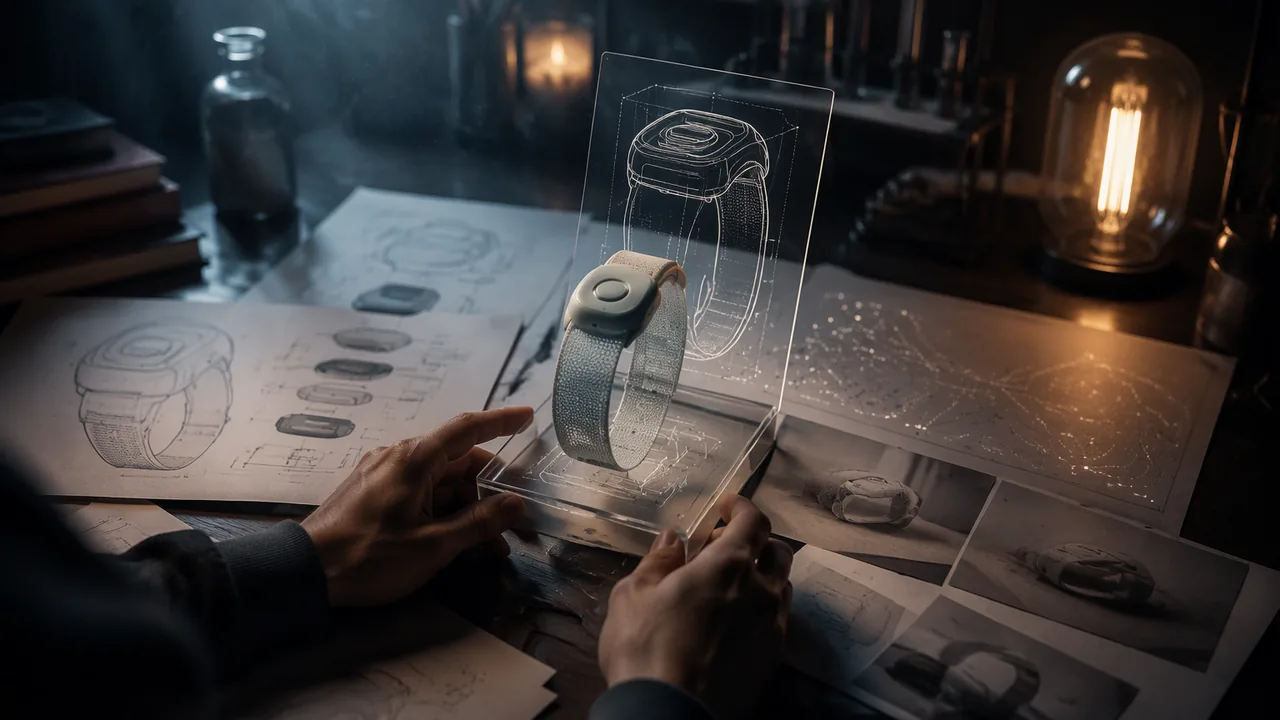
The design portfolio. Present, in order: the problem statement with criteria and constraints; research on existing solutions, including the real patent you annotated; your concept sketches; the weighted decision matrix with its calculations; the data-flow diagram of your AI component with the human oversight point marked; photographs of your prototype at each fidelity; and your test plan, results and the changes you made. Design it as a document or slide sequence with a consistent grid and type system. A reader should be able to follow your thinking without you in the room.
The hypothetical patent. Follow the structure you annotated. Title: short and descriptive. Abstract: no more than 150 words, as USPTO practice requires, stating what the invention is and does. Background: the problem and existing approaches. Summary: the invention in a paragraph. Brief description of the drawings: one line per figure (“FIG. 1 is a front view of…”). Detailed description: walk through the invention using your reference numerals, so every numbered part in the drawings appears in the text. Claims: at least three, one independent claim listing the essential elements and at least two dependent claims each adding a feature. Drawings: at least three figures to the conventions you practiced.
Important limits. This is a learning exercise, not a real application, and the course does not give legal advice. If you ever want to patent a real invention, talk to a registered patent attorney or agent first, because public disclosure, including an exhibition, can affect patent rights. The U.S. gives inventors a one-year grace period after their own public disclosure, but many other countries do not.
AI and authorship in your application. If you used AI tools while developing the design, say which and for what, in your portfolio. Under current U.S. law inventors must be people, so your application names you and explains your contribution.
The four stages. Stage 1: plan with the portfolio outline, figure list and draft claims. Stage 2: set the draft aside for a day, then review it yourself in two roles with the reading’s sheets: first as a patent examiner (Are the claims clear? Is every numeral described? Is it new and non-obvious compared with the patent you found?), then as a design critic (Is the portfolio readable and well designed? Is the test honest?). A family member or other adult may also read it as the critic. Submit both reviews and your revision plan. Stage 3: revised final portfolio and application. Stage 4: a recorded five-minute pitch, followed by your recorded answers to the three published examiner questions in the reading.
📖 Read for this lesson
The reading opens over the lesson; close it to come back to exactly where you were. The checks below draw on it.
Formative check
Work through these before moving on. They are not graded — they tell you whether the standard below has landed yet.
Your detailed description mentions parts 10, 20 and 30, but FIG. 2 also shows a part labeled 40. What should you fix?
Showing your invention at a public exhibition can affect your ability to patent it later, especially outside the U.S.
How confident are you that you can document and defend an original design as a portfolio and a hypothetical patent application?
Unit 3 checkpoint
Do this before you start the task. It covers the whole unit and tells you what to review first.
Until what year did the U.S. Patent Office generally require a working model with a patent application?
USPTO drawing rules call for gray-tone shading to show curved surfaces.
Patricia Bath patented a device and method that used a to remove cataracts.
In aligned orthographic views, the right-side view shows which two dimensions?
Each patent view is labeled as a figure; the first view is labeled 1 (abbreviation).
What defines the legal boundary of a patent?
Under Myriad (2013), naturally occurring DNA can be patented once it has been isolated.
Under Thaler v. Vidal (2022), who can be named as an inventor on a U.S. patent?
With weights 0.35, 0.25, 0.20, 0.20, a concept scores 4, 4, 3, 3. What is its weighted total?
‘I will build a smart pill box’ is a well-formed problem statement.
How closely a prototype resembles the final product is its .
Submit: design portfolio + hypothetical patent (abstract of 150 words or fewer, 3+ claims, 3+ figures) + recorded pitch and examiner answers
Task: Document your biomedical design with an AI component from problem statement to tested prototype, and present it as a hypothetical patent application: title, abstract (150 words or fewer), background, summary, brief description of the drawings, detailed description using reference numerals, at least three claims (one independent, two or more dependent) and at least three figures drawn to USPTO conventions. Then record a pitch and your answers to the three published examiner questions.
Submission workflow
- Stage 1 — Plan. Portfolio outline, list of figures and first draft of the claims.
- Stage 2 — Examiner and critic self-review. After a day away, review your draft as a patent examiner and then as a design critic, using the reading’s sheets (a family member or other adult may also read it); submit both reviews and your revision plan.
- Stage 3 — Revised final. Complete design portfolio and hypothetical patent application with drawings.
- Stage 4 — Pitch and defense. Record a five-minute pitch, then record your answers to the three published examiner questions.
How it is scored
| Criterion | What proficient looks like |
|---|---|
| Professional presentation (MA:Pr6A.III) | Portfolio and application are curated and designed for their professional audiences with intentional impact. |
| Drawing and production craft (MA:Cr3A.III) | Figures follow patent conventions precisely; portfolio design is purposeful and polished. |
| Integration of design, science and AI (MA:Pr4A.II) | Design process, body-system science and the AI component with human oversight form one coherent account. |
| Technical writing (WHST.11-12.2) | Abstract, description and claims are precise; every numeral is described; claims are properly structured. |
| Self-evaluation and defense (MA:Re9A.III, SL.11-12.4) | Rigorous response to your examiner and critic self-reviews; clear, well-reasoned recorded answers to the examiner questions. |
Design Portfolio and Hypothetical Patent: The Full Brief, an Exemplar Application and the Self-Review Sheets
SLS original brief, exemplar, criteria, self-review sheets and examiner questions; rules from 37 CFR 1.71, 1.72, 1.75, 1.77, 1.84 (eCFR retrieved 2026-09-26) and 35 U.S.C. 102(b)(1); the exemplar device is invented · SLS original, with public-domain rules from the U.S. Code of Federal Regulations and U.S. Code
Why this reading. The task names the parts of a patent application and the criteria, but you need the brief itself: the assignment, what each part must contain under the rules, an exemplar application to measure your own against, the two self-review sheets for Stage 2, the pitch structure and the three published examiner questions you answer on your recording. The exemplar is an invented device written for teaching; it is not a real application.
The assignment
- Document your design from problem statement to tested prototype (the Lesson 3.4 process).
- Write a hypothetical patent application: title; abstract; background; summary; brief description of the drawings; detailed description using reference numerals; at least three claims (one independent, two or more dependent); at least three figures.
- At Stage 2, set the draft aside for a day, then review it yourself in two roles using the sheets below: first as patent examiner, then as design critic. A family member or other adult may also read it and fill in the critic sheet. Revise.
- Record a five-minute pitch, then record your answers to the three published examiner questions below.
What the rules say (37 CFR, retrieved from eCFR Sept. 26, 2026)
- Order of the specification (1.77(b)): title; cross-reference to related applications; statement regarding federally sponsored research; background of the invention; brief summary; brief description of the several views of the drawing; detailed description; claims; abstract.
- Abstract (1.72(b)): on a separate sheet, “as concise as the disclosure permits, preferably not exceeding 150 words.” The rule says preferably; this task uses 150 words as a firm limit.
- Claims (1.75): the specification must conclude with a claim “particularly pointing out and distinctly claiming” the invention; claims may be dependent, “referring back to and further limiting” another claim; terms in the claims must find clear support in the description.
- Description (1.71): in “full, clear, concise, and exact terms” so a person skilled in the field could make and use the invention.
- Drawings (1.84): see Reading 3.1; numerals at least 1/8 inch tall, lead lines, black lines.
Exemplar application (SLS original, invented)
Title: Medication tray with camera check.
Abstract (72 words): A medication tray has a base with seven compartments, a lid, and a camera aimed at the compartments. A processor classifies each compartment as empty or occupied from a camera image and shows the result on a light beside the compartment. A confirm button lets a user override any light. The tray records the confirmed result on the tray only and does not instruct a user to take or skip a dose.
Background. People who take several medications at home often cannot tell whether a dose has been taken. Printed cards and reminder programs do not check the medication itself.
Summary. The tray checks each compartment with a camera and shows the result, while leaving the decision to the user.
Brief description of the drawings. FIG. 1 is a top view of a tray. FIG. 2 is a side view in section. FIG. 3 is a diagram of the data flow.
Detailed description. A tray 10 has a base 12 with seven compartments 14 and a hinged lid 16. A camera 18 in the lid is aimed at the compartments 14. A processor 20 in the base receives an image from the camera 18 and classifies each compartment 14 as empty or occupied. A light 22 beside each compartment 14 shows the classification. A confirm button 24 lets the user override the light 22.
Claims.
- A medication tray comprising: a base having a plurality of compartments; a lid; a camera positioned to image the compartments; a processor configured to classify each compartment as empty or occupied from an image of the camera; an indicator that displays the classification of each compartment; and a confirm input by which a user overrides the classification.
- The medication tray of claim 1, wherein the plurality of compartments is seven.
- The medication tray of claim 1, wherein the indicator comprises a light adjacent each compartment.
Numeral audit (every numeral in the drawings must appear in the description, and every numeral in the description must appear in a drawing):
| Numeral | Part | In description? | In which figures |
|---|---|---|---|
| 10 | Tray | Yes | FIG. 1, 2 |
| 12 | Base | Yes | FIG. 1, 2 |
| 14 | Compartments | Yes | FIG. 1, 2 |
| 16 | Lid | Yes | FIG. 2 |
| 18 | Camera | Yes | FIG. 2, 3 |
| 20 | Processor | Yes | FIG. 2, 3 |
| 22 | Light | Yes | FIG. 1, 3 |
| 24 | Confirm button | Yes | FIG. 1, 3 |
Claim support check: every term in claim 1 (base, compartment, lid, camera, processor, indicator, confirm input) appears in the description; the claim says “indicator” where the description says “light,” so the summary should say the light is one kind of indicator, a gap your examiner review should catch.
Criteria at four levels (SLS original)
| Criterion | 2 Developing | 3 Proficient | 4 Exemplary |
|---|---|---|---|
| Professional presentation | Portfolio is a folder of work | Consistent grid and type; ordered as the brief lists | A reader follows the thinking without you in the room |
| Drawing and production craft | Some patent conventions | Numerals, lead lines and views follow 37 CFR 1.84 | Mock-up built from your drawings confirmed they are buildable |
| Integration of design, science and AI | Parts described separately | AI component with human oversight point marked | Failure mode and limit of harm described and tested |
| Technical writing | Abstract over 150 words or a numeral undescribed | Abstract within limit; every numeral described; claims structured | Claims supported by the description; independent claim lists only the essentials |
| Defense | Answers vaguely | Answers the published examiner questions accurately | Concedes limits and cites evidence |
Self-review sheets for Stage 2 (complete a day after finishing the draft)
Examiner:
| Check | Yes / No | Where |
|---|---|---|
| Abstract 150 words or fewer? | ||
| Every numeral in the drawings appears in the description, and the reverse? | ||
| At least one independent and two dependent claims, each dependent claim referring back? | ||
| Every claim term appears in the description? | ||
| Three questions I would ask an inventor: |
Design critic:
| Question | Score 1-4 | Evidence |
|---|---|---|
| Is the problem a user and a need, with no solution named? | ||
| Does the matrix show its arithmetic, and does the winner survive a 0.05 change? | ||
| Is the human check marked in the data-flow diagram? | ||
| Does the test log show a change between trials? |
Pitch: five minutes
Record it; keep the recording private unless a parent agrees to share it. Problem, 45 seconds; user and criteria, 45; concept choice and matrix, 60; the invention and its drawings, 90; test results and limits, 45; close, 15 (total 300 seconds). The three published examiner questions (record an answer to each, about 60 seconds apiece, after the pitch): (1) “What in claim 1 could a competitor leave out?” (2) “What happens when the classifier is wrong?” (3) “Did an AI tool help write this, and what did you contribute?” On the last, say which AI tools you used and for what. Under the USPTO’s November 2025 guidance an AI system cannot be an inventor and is treated as a tool used by the human inventor.
A limit to state
This is a learning exercise, not a real application, and it is not legal advice. In U.S. law, under 35 U.S.C. 102(b)(1), a disclosure made 1 year or less before the effective filing date is not prior art if it was made by the inventor; the lesson notes that many other countries have no such grace period, a claim this reading does not host.