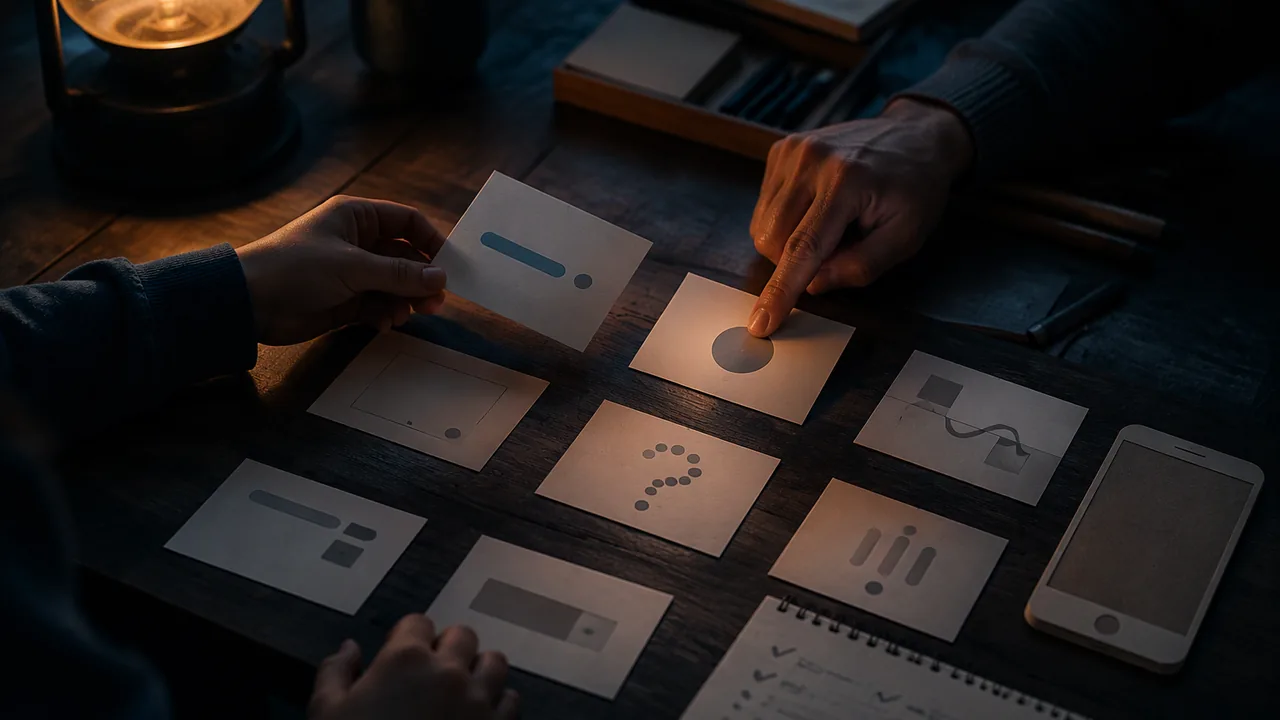
build a paper and physical prototype of my capstone and test it through think-aloud sessions with family members or other adults I know, recording problems and revising the design.
Instruction
The fastest way to find out whether a design works is to put a rough version in front of a real person and watch. In this lab you will build a prototype in an hour and test it with three users, family members or other adults you know, in person at home, using the think-aloud method, a standard technique in user-experience research.
Paper prototyping. If your innovation has a screen (an app, a dashboard, a device display), draw each screen on an index card or sticky note at roughly the real size. Draw buttons, labels and messages by hand. Keep extra blank cards for new screens. During the test you play the computer: when the user taps a paper button, you swap in the next card. It feels silly and works remarkably well, because people respond to the design, not the polish, and you can change a screen in seconds.
Physical prototyping. If your innovation is an object (a wearable, a sensor housing, a clinic station), build it from card, foam, clay or found materials at full size. Mark where lights, buttons or sensors would go. Test how it feels in the hand, how it fits on a wrist, how a user with gloves or limited dexterity would use it.
Simulating the AI. Your prototype does not need working AI yet. In a Wizard of Oz test, you (or a family member reading from your script) produce the “AI” output by hand, for example turning over a card with the classifier’s result, so you can test whether users understand and trust it before building it. Decide in advance what the wizard will say for each input, and include at least one wrong or uncertain output to see how users react to an error. How your design handles uncertainty, such as “low confidence: please retake the photo”, is one of the most important things to test.
Think-aloud testing. Give the user a realistic task (“You have just taken your evening reading. Find out whether you should contact your clinic.”), then ask them to say out loud everything they are thinking as they work. Do not help or explain; if they ask, say “What would you do if I weren’t here?” Watch for hesitation, wrong turns, misread words and surprise. Record what they do and say, not what you hoped they would do. After the task, ask two questions: what was confusing, and what did you expect to happen that didn’t?
Three users are enough to start. Usability practitioners have long observed that a handful of users reveals most of the major problems in a design. Test with three, fix the biggest problems, then test again with new users. Two rounds of small tests usually teach more than one big one.
Ethics of testing. Your testers are people you know trying a prototype, not patients. Read the consent script in the reading before every test: what will happen, that they can say no or stop at any time, and that you will write notes only. If a tester is under 18, get a parent’s or guardian’s OK before you observe them. Use fictional data only, and never ask testers about their own health. If no one is available, a self-test after a day away counts as one user; label it in your log.
📖 Read for this lesson
The reading opens over the lesson; close it to come back to exactly where you were. The checks below draw on it.
Studio: An hour to build, three users to test
Question. Where do real users hesitate, misunderstand or distrust my capstone design, and what changes fix it?
Materials
- Index cards or sticky notes and fine markers for paper screens
- Card, foam sheet, air-dry clay, tape and found materials for physical prototypes
- Round-tip scissors and a low-temperature glue gun (used only with an adult present)
- A timer and a think-aloud test log sheet
- Phone or tablet to photograph each prototype version
- The consent script from the reading
- Use the low-temperature glue gun only with an adult present, resting it on its stand; do not touch the nozzle or fresh glue, and keep a cup of cold water nearby for accidental contact.
- Use round-tip scissors; an adult cuts thick foam or card.
- Testers are family members or other adults you know, in person at home, who agree after hearing the consent script; get a parent’s OK before observing anyone under 18. Use fictional scenarios only; never ask a tester about their own health, write notes only (no photos or recordings of testers), and stop a test if a tester is uncomfortable.
Procedure
- Write one realistic task a user should be able to complete with your design, and decide what the wizard will say for each input, including one wrong or uncertain output.
- Build the paper screens or physical prototype in no more than 60 minutes. Photograph it.
- Read the consent script to the first user and start only after a clear yes. Then run the think-aloud test: read the task, ask them to speak their thoughts, do not help, and record actions and quotations on the log.
- Ask the two follow-up questions: what was confusing, and what did you expect that didn’t happen?
- Repeat with two more users, each a different person, ideally of different ages. If you cannot find three, set the prototype aside for a day and self-test, marking that row “self-test”.
- List the problems by how many users met them and how serious they were, then sketch the revision to fix the top two. Photograph the revised prototype.
Data
| User | Task completed? (yes/partly/no) | Time | Where they hesitated or went wrong | Reaction to the uncertain AI output | Quotation |
|---|---|---|---|---|---|
| 1 | |||||
| 2 | |||||
| 3 |
Analysis
- What problem did more than one user meet, and what caused it in the design?
- How did users react to the wrong or uncertain AI output? Did they notice it, trust it or question it? What does that mean for your design?
- Which revision will you make first, and how will you know it worked?
- What did testing reveal that you could not have found by looking at the prototype yourself?
If you cannot do this studio in person: If only one or two people can test, complete the remaining rows as self-tests after a day away, reading the task and script aloud and logging every hesitation; note in your analysis that a self-test finds fewer problems than a fresh user.
Formative check
Work through these before moving on. They are not graded — they tell you whether the standard below has landed yet.
During a think-aloud test, the user asks, ‘Which button do I press?’ What should you say?
A Wizard of Oz test can include a deliberately wrong AI output to see how users respond to errors.
Summarize your three tests (say which, if any, were self-tests): the most common problem, how users reacted to the uncertain output, and the two revisions you sketched. Attach before-and-after photographs of the prototype.
How confident are you that you can prototype my capstone quickly and test it with users through think-aloud sessions?
Practice
Work these on paper or in your notebook, then open Check your answer. Aim for all of Fluency and Application; try at least one Challenge.
Printable version: this unit’s practice workbook (PDF)
Fluency
Build speed and accuracy with the core skill.
- Define paper prototype, think-aloud test, Wizard of Oz test and usability.
Check your answer
Answer: Paper prototype: a hand-drawn interface on cards, operated by a person playing the computer. Think-aloud test: users say what they are thinking as they try a task. Wizard of Oz test: a hidden person produces the system’s responses by hand to simulate technology not yet built. Usability: how easily and effectively people can use a design to do what they need.All three tests can run at home with paper and card. - What should you say if a user asks for help during a think-aloud test, and what two questions do you ask after the task?
Check your answer
Answer: ‘What would you do if I weren’t here?’ After: what was confusing, and what did you expect to happen that didn’t?Helping hides the design problem you are trying to find. - List three things the consent script tells a tester before every test.
Check your answer
Answer: What will happen; that they can say no or stop at any time; that you will write notes only.Get a parent’s or guardian’s OK before observing anyone under 18, and never ask testers about their own health.
Application
Use the skill in context. Show your reasoning.
- Write a Wizard of Oz script for a classifier that checks whether a photo of a pill compartment shows it empty or full. Give the outputs for three inputs, including one uncertain output.
Check your answer
Answer: Model: Clear photo of a full compartment: card reads ‘Full: dose not taken yet.’ Clear photo of an empty compartment: ‘Empty: dose taken.’ Blurry or dark photo: ‘Low confidence: please retake the photo.’Decide outputs in advance and include at least one wrong or uncertain output to test how users react to errors. - An invented think-aloud log for three users shows: Problem P1 (did not notice the retake message) met by 3 users; P2 (misread a button label) met by 1 user; P3 (expected a confirmation screen) met by 2 users. Rank the problems and say which two to fix first. What share of users met each?
Check your answer
Answer: P1 (3 of 3, 100%), P3 (2 of 3, about 67%), P2 (1 of 3, about 33%). Fix P1 and P3 first, then also weigh seriousness: missing the retake message means a wrong AI result could be trusted.3 / 3 = 100%; 2 / 3 = 66.7%; 1 / 3 = 33.3%. The lab ranks by how many users met a problem and how serious it was. - Rewrite this task so it is realistic and does not give away the answer: ‘Press the green Report button to report your reading.’
Check your answer
Answer: Model: ‘You have just taken your evening reading. Find out whether you should contact your clinic.’A realistic task states the goal, not the steps or the button, so you can see whether the design leads the user there. Readings are fictional. - Why does the lesson recommend two rounds of three users rather than one round of six? Explain in 2 sentences.
Check your answer
Answer: A handful of users reveals most of the major problems, so after three you already know what to fix. Fixing them and testing again with new users checks whether the fixes work and uncovers the next problems, which one big test cannot do.Two rounds of small tests usually teach more than one big one.
Review
Keep earlier skills sharp.
- Review 2.4: Your capstone shows a heart-rate flag. In the Wizard of Oz test, which kind of output from Unit 2 should you deliberately include to see how users react, and why?
Check your answer
Answer: A false alarm (like the minute-11 flag in rule version 1) or an uncertain output, because how users handle wrong and uncertain results is one of the most important things to test.Unit 2 showed a transparent rule can raise a false alarm on an ordinary reading.
Think-Aloud Testing at Home: Consent, the Script, a Worked Log and Ranking the Problems
SLS original technique sheet and consent script (RLP at-home version, 2026-11-10); the sample-size statement is from FDA human factors guidance (retrieved 2026-09-26) · SLS original, with a public-domain statement from the U.S. FDA
Why this reading. The lab has you run a think-aloud test with three users and log what happens. Your users are family members or other adults you know, tested in person at home; if no one is available, a self-test after a day away counts as one user. This technique sheet gives who may test and how to ask, a consent script, the moderator script word for word, a worked log with three invented users, and the arithmetic for ranking problems. It is SLS original guidance; the sample-size note is from the FDA’s human factors guidance.
Who may test, and asking first
- Test with family members or other adults you know, in person at home. Do not test with strangers, online contacts or anyone who has not agreed.
- If a tester is under 18, a brother, sister or cousin, for example, get a parent’s or guardian’s OK before you observe them, and then ask the tester too.
- Write notes only. Do not photograph, film or record testers; photograph the prototype instead.
- Self-test option. If no one can test, set the prototype aside for at least a day, then work the task yourself reading the script aloud, writing down every hesitation. Mark the row “self-test” in the log; a self-test finds fewer problems than a fresh user, so say so in your analysis.
Consent script (read it before you start)
- “I’m testing a design I made for my online course. It takes about ten minutes.”
- “You can say no, and you can stop at any time. Nothing bad happens if you stop.”
- “It’s a made-up situation. I won’t ask about your own health, and I’ll write notes only, with no recording and no names in my notes.”
- “Is it OK to start?” Start only after a clear yes. (For a tester under 18: “Your parent said it’s OK. Do you also want to try it?”)
Moderator script (say it as written)
- “Thank you for helping. I am testing the design, not you. You cannot make a mistake.”
- “Remember, you can stop at any time.”
- “Please say out loud what you are thinking as you try this task: [read the task].”
- If the user asks how to do something, say “What would you do if I weren’t here?” Do not point.
- After the task: “What was confusing?” and “What did you expect that didn’t happen?”
Worked log (invented: two adult family members and one self-test after a day away)
| User | Task done? | Time | Where they hesitated | Reaction to the wrong AI output | Quotation |
|---|---|---|---|---|---|
| 1 | Yes | 1 min 40 s | Could not find the confirm button | Did not notice | “Where do I say it’s right?” |
| 2 | Partly | 2 min 10 s | Could not find the confirm button | Questioned it | “That doesn’t look right.” |
| 3 (self-test) | Yes | 1 min 15 s | None | Trusted it | “It says so, so it must be.” |
Ranking the problems
| Problem | Users who met it | Share of users | Seriousness (1-3) |
|---|---|---|---|
| Could not find the confirm button | 2 of 3 | 67% | 2 |
| Did not notice or trusted a wrong AI output | 2 of 3 | 67% | 3 |
| Time above 2 minutes | 1 of 3 | 33% | 1 |
Fix first the problem that is both common and serious: the wrong AI output went unquestioned by 2 of 3 users. A revision might add a plain-word uncertainty label (“check this”) and retest. With 3 users these shares are a guide to where to look, not a measurement. For a real medical device, the FDA’s human factors guidance says validation testing should generally include at least 15 participants from each user population, and the guidance is a set of nonbinding recommendations (FDA, Applying Human Factors and Usability Engineering to Medical Devices, reissued Aug. 3, 2026).
Sources: FDA, Applying Human Factors and Usability Engineering to Medical Devices (fda.gov)