analyze how artists have used rule-based and learning systems as collaborators and what their work says about authorship, and explain how a sequence model such as a recurrent neural network differs from an image classifier.
Instruction
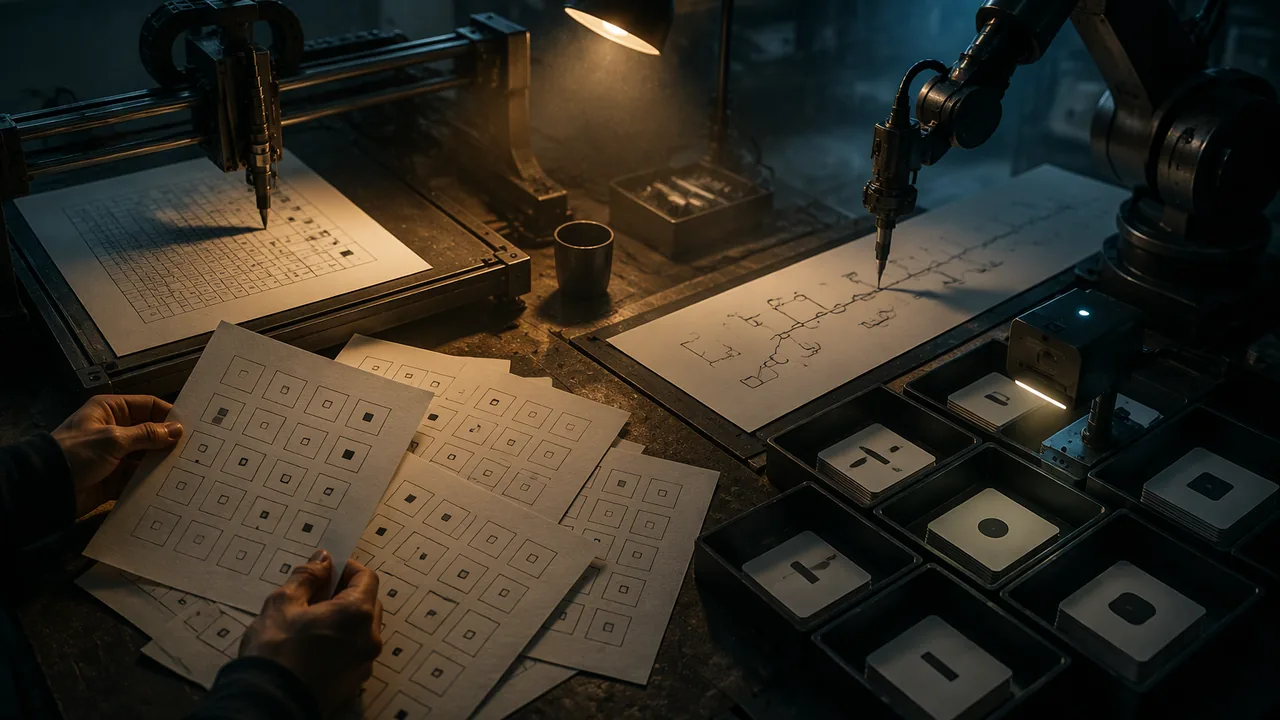
Artists were working with computers long before AI was in the news, and their work asks the questions you will face: who is the author, what does the machine contribute, and what does the human decide?
Vera Molnar (1924-2023). A Hungarian-born artist working in Paris, Molnar began making drawings with a computer and plotter in 1968. Before that she worked with what she called a “machine imaginaire”: step-by-step rules she followed by hand. Her works vary a simple element, such as a square, through systematic changes and small random disruptions. The computer let her explore thousands of variations; she chose which to keep. Authorship lay in the rules and the choosing.
Lillian Schwartz (1927-2024). Working with engineers at Bell Labs from the late 1960s, Schwartz made some of the earliest computer-generated films, combining programmed imagery with hand processes and music. Her work shows the computer as one medium among many in a finished piece.
Harold Cohen and AARON. Cohen, a British painter who moved to the United States, began writing a drawing program called AARON in the early 1970s and developed it for more than four decades. AARON produced drawings from rules Cohen wrote about composition and form; it did not learn from images. Cohen described it as a long collaboration and often colored its drawings himself. AARON is rule-based, not machine learning, a distinction you now know how to make.
Living artists (described). Refik Anadol, a Turkish-American artist, makes large, moving “data paintings” and installations generated from very large datasets, such as archives of images or environmental measurements, processed with machine-learning models. Sougwen Chung, a Chinese-Canadian artist, performs drawings alongside robotic arms whose behavior is trained in part on her own drawing, so the machine’s marks carry her style back to her. Both train systems on data they have chosen or made, which is one answer to the consent questions you met in Semester A.
Sequence models. Your classifiers so far looked at one image at a time. Many health signals are sequences: heartbeats, breathing, glucose readings over a day. Order matters; a heart rate of 96 means something different after a run than after sleep. A recurrent neural network (RNN) processes a sequence one step at a time, keeping an internal state, a kind of running summary, that is updated at each step and passed to the next. That lets it use earlier readings when interpreting later ones. Variants such as LSTMs were designed to keep useful information over longer spans. In recent years transformer models, which look at all positions of a sequence at once, have replaced RNNs in many tasks, but the idea of learning from order is the same. Training an RNN well needs a lot of labeled sequence data and computing time, so in this unit you will build a simpler rule that also uses recent history, and compare what it can and cannot do.
For your study. For two artists, describe what the human decided, what the system contributed and how the finished work shows the collaboration.
📖 Read for this lesson
The reading opens over the lesson; close it to come back to exactly where you were. The checks below draw on it.
Formative check
Work through these before moving on. They are not graded — they tell you whether the standard below has landed yet.
Why is AARON not an example of machine learning?
An RNN processes a sequence one step at a time and carries a state that summarizes earlier steps.
Vera Molnar
Tap to revealComputer drawings from 1968; systematic variation of simple forms; she chose which to keep
Lillian Schwartz
Tap to revealEarly computer films at Bell Labs combining code, hand processes and music
Harold Cohen
Tap to revealAARON, a rule-based drawing program developed for over forty years
Sougwen Chung
Tap to revealPerforms with robotic arms trained partly on her own drawings
For two artists, describe what the human decided, what the system contributed, and how the work shows the collaboration. Which model of authorship would you adopt for your own prototype, and why?
How confident are you that you can analyze how artists collaborate with machines and explain what a sequence model does?
Practice
Work these on paper or in your notebook, then open Check your answer. Aim for all of Fluency and Application; try at least one Challenge.
Printable version: this unit’s practice workbook (PDF)
Fluency
Build speed and accuracy with the core skill.
- Match each artist to the description: Vera Molnar; Lillian Schwartz; Harold Cohen; Sougwen Chung; Refik Anadol. Descriptions: (a) early computer-generated films with Bell Labs engineers; (b) the rule-based drawing program AARON; (c) computer and plotter drawings from 1968 that vary a simple form; (d) performs drawings with robotic arms trained partly on her own drawing; (e) large moving ‘data paintings’ made from very large datasets with machine-learning models.
Check your answer
Answer: Molnar (c); Schwartz (a); Cohen (b); Chung (d); Anadol (e).Molnar and Cohen worked with rule-based systems; Chung and Anadol use machine learning on data they chose or made. - Define rule-based system, sequence data and state (in an RNN).
Check your answer
Answer: A rule-based system follows instructions written by people rather than learning patterns from data. Sequence data is data in which order matters, such as heart-rate readings over time. State is the running summary of what an RNN has seen so far, updated at each step.AARON is the lesson’s example of a rule-based system. - What was Molnar’s ‘machine imaginaire’, and where did authorship lie in her work, according to the lesson?
Check your answer
Answer: Step-by-step rules she followed by hand before she used a computer. Authorship lay in the rules and the choosing: the computer explored thousands of variations, and she chose which to keep.The same question, who decides, applies to your own prototype.
Application
Use the skill in context. Show your reasoning.
- Classify each as rule-based or machine learning and give the reason: (a) AARON; (b) Chung’s robotic arms; (c) the Semester A rule ‘if ratio > 2.0, label sickle’ written by hand; (d) a myoelectric arm using pattern-recognition control.
Check your answer
Answer: (a) Rule-based: it followed rules Cohen wrote and did not learn from images. (b) Machine learning: behavior trained in part on her own drawing. (c) Rule-based: a person wrote the rule (though choosing the threshold from data is a simple form of training). (d) Machine learning: a classifier learns which muscle-signal pattern means which movement.The test is whether behavior comes from written instructions or from patterns learned from examples. - Explain in 2-3 sentences why order matters in heart-rate data, using the lesson’s example, and how an RNN uses order.
Check your answer
Answer: A heart rate of 96 means something different after a run than after sleep, so a reading must be read in the context of what came before. An RNN processes the sequence one step at a time and carries a state, a running summary, from each step to the next, so earlier readings shape how later ones are interpreted.An image classifier looks at one image at a time and has no such memory. - For Harold Cohen and AARON, state what the human decided, what the system contributed, and how the finished work shows the collaboration.
Check your answer
Answer: Cohen decided the rules about composition and form and often colored the drawings himself. AARON produced the drawings from those rules. The work shows the collaboration because each drawing is machine-made line work under human rules, finished by a human hand, developed over more than four decades.A strong answer separates the three parts clearly and does not call AARON machine learning. - How do Anadol and Chung answer the consent questions about training data raised in Semester A?
Check your answer
Answer: Both train systems on data they have chosen or made (Chung partly on her own drawing; Anadol on datasets such as image archives or environmental measurements), rather than on other artists’ work taken without consent.Semester A noted that many image generators were trained on artists’ work without their consent.
Review
Keep earlier skills sharp.
- Review (Semester A, Unit 2): Which 1966 program imitated a psychotherapist, who described it, and is it rule-based or learned?
Check your answer
Answer: ELIZA, by Joseph Weizenbaum at MIT. It is rule-based: it rephrased users’ words back as questions.Like AARON, ELIZA followed rules people wrote.
Cohen, Molnar and Chung: Records, Statements and a Sequence-Model Worked Example
V&A Collections API records E.326-2009, E.964-2008, E.18-2020, E.907-2022, E.906-2022 (retrieved 2026-09-26); Art Institute of Chicago API record 2023.3498 (CC0 data); H. Cohen, The Further Exploits of AARON, Painter, Stanford Humanities Review 4(2), 1995; sougwen.com; state example is SLS original and illustrative · SLS original (descriptions, tables, worked example); short quotations from Cohen and Chung, cited; museum records cited as data (Art Institute of Chicago data CC0)
Why this reading. The lesson asks you to describe, for two artists, what the human decided, what the system contributed and how the work shows the collaboration, then to choose a model of authorship. That needs the works and the artists’ own words in front of you. This reading gives three artists’ records and statements, a table to fill in, and a small worked example of the running “state” that separates a sequence model from an image classifier. Images are not reproduced; each work is described, and the records tell you where it is held.
Artist 1. Harold Cohen and AARON
| Record | Work 1 | Work 2 |
|---|---|---|
| Creator | Harold Cohen (born 1928) | Harold Cohen / AARON, the program Cohen wrote |
| Title and date | Untitled drawing, 1974 | “20:28”, drawn August 16, 1985 |
| Medium | Computer-generated drawing with hand coloring, on paper | Computer-generated black and white plotter contour-line drawing, on paper |
| Held by; number | Victoria and Albert Museum, London, E.326-2009. Given by Harold Cohen. | Victoria and Albert Museum, London, E.964-2008. Given by the American Friends of the V&A through the generosity of Patric Prince. |
| Inscription | Signed and dated in pencil, lower right: “Harold Cohen 1974” | Inscribed “Aaron 8-16-85 20:28” (the program signs with the date and time it drew the picture) |
Rights. Museum records are cited as data; the artworks are not reproduced here, and the descriptions are the catalog’s and SLS’s own.
Describing Work 2. The V&A’s catalog describes a line drawing in black on white: three figures, one male and two female, with three balls. The male figure sits on a ball, watching the two women, who are apparently dancing. Only contours are drawn, with no shading or color. Below the figures is the program’s own signature and time stamp. Notice that the title of the work is a time of day.
What the creator wrote. In “The Further Exploits of AARON, Painter” (written October 1994, published in Stanford Humanities Review 4(2), 1995) Cohen says AARON began, some time in the mid-seventies, as an attempt to answer the question “What is the minimum condition under which a set of marks functions as an image?” He reports that the earliest versions could little more than tell figure from ground and closed forms from open ones, and that they worked in “feedback mode”: every decision about how to continue a drawing was made by considering what the program “wanted to do in relation to what it had done already.” On color: he had always colored some of AARON’s drawings himself; by 1986 it seemed inappropriate that a program able to generate an endless stream of original drawings could not color them, and by the end of 1992 he could see AARON working as “a modestly able colorist.”
What the museum says. The V&A’s record for the 1974 drawing says that in its early years AARON could produce only monochrome line drawings, and that this example was colored by hand by Cohen. The record for the 1985 drawing says that AARON cannot learn new techniques or imagery on its own; this must be hand-coded by Cohen. Note a dating difference among the sources: the V&A places the program’s development at Stanford’s Artificial Intelligence Laboratory in the early 1970s, while Cohen himself writes “some time in the mid-seventies.” When sources disagree, say so.
Artist 2. Vera Molnar
| Record | Work 1 | Work 2 |
|---|---|---|
| Creator | Vera Molnar (born 1924, Hungary; worked in Paris) | Vera Molnar |
| Title and date | “Parcours 10×10 cinq rectangles”, 1976 | “Inclinasions (1-5-71)”, 1971 |
| Medium | Signed EP print: analog electrophotographic printing with dry toner | Blue, green and red felt-tip pen over graphite on ivory wove paper, 50.8 x 50.2 cm |
| Held by; number | Victoria and Albert Museum, E.18-2020. Given by Computer Art Society (CAS). | Art Institute of Chicago, 2023.3498. Gift of the Irving Stenn, Jr. Family. (Museum data licensed CC0.) |
Describing Work 1. The V&A’s physical description: a computer-generated drawing on paper of five overlapping rectangles arranged systematically in a 10 by 10 grid. Its catalog summary says the piece is one of a series, that five rectangles sit in each cell of the grid, and that she sets rules while adding small random variations, exploring order and randomness. Read the catalog with care: the same summary prints her life dates as “1924-1923,” which cannot be right, and it attributes software details this reading does not repeat. A museum record is a source that can contain errors.
From the lesson. The mini-lecture reports that Molnar worked before computers with a “machine imaginaire,” step-by-step rules she followed by hand, and that the computer let her explore thousands of variations of a simple element while she chose which to keep. Treat those two statements as the lesson’s account rather than as a hosted source.
Artist 3. Sougwen Chung
| Record | Work 1 | Work 2 |
|---|---|---|
| Creator | Sougwen Chung | Sougwen Chung |
| Title and date | “Drawing Operations Memory I”, print from the series Drawing Operations Unit: Generation 2: MEMORY, 2017-2022 | Explanatory performance video from the same series, 2017-2022 |
| Medium | Born-digital video | |
| Held by; number | Victoria and Albert Museum, E.907-2022. Given by Sougwen Chung. | Victoria and Albert Museum, E.906-2022. Given by Sougwen Chung. |
What the creator wrote. Chung’s website states the project began in 2015 and describes seven generations of a robotic drawing system called D.O.U.G., and says of her practice: “Rather than rehearsing inherited binaries of human versus machine, art versus science, each body of work proposes a dynamic, catalytic interval between agencies.” The site also says the MEMORY work is in the V&A’s permanent collection and calls it the first AI model acquired by a major cultural institution; that is the artist’s claim, and the V&A records above confirm only that the V&A holds the works. The mini-lecture adds that the machine’s behavior is trained in part on her own drawing; that too is the lesson’s account.
Not hosted. The lesson’s flashcard also names Lillian Schwartz. No record or primary statement of hers could be verified for this reading, so use Cohen, Molnar or Chung for the two-artist study.
A table to fill in, with one row done
| Artist and work | What the human decided | What the system contributed | How the work shows it |
|---|---|---|---|
| Cohen, “20:28” (1985) | The rules of drawing (figure and ground, closed and open forms, what to draw next), written by Cohen; the decision to let the program sign and date each drawing | Executing those rules in a new arrangement each time, so that the same program produces an endless stream of different drawings | A program signature and time stamp; contour lines only; no color, so the human coloring step is absent |
| (your second artist and work) |
Three models of authorship to choose among: the tool-user (the human authors; the machine is a brush), the rule-writer and selector (the human authors the rules and the choosing; the machine varies and executes) and the co-performer (human and machine act together and change each other). Say which fits your own prototype and why.
Sequence model versus image classifier: a worked example of “state”
SLS original / illustrative. A classifier from Semester A looks at one input and answers. A recurrent network reads a sequence one step at a time and carries a state, a running summary. Here is the simplest possible running summary, not a real neural network: after each reading x, the new state is half the old state plus half the reading, s = 0.5 × (old s) + 0.5 × x, starting from s = 72. Use the twelve heart-rate readings of Lesson 2.4 (invented for teaching, not a real patient).
| Minute | Reading (bpm) | State after this reading |
|---|---|---|
| 1 | 72 | 72.00 |
| 2 | 74 | 73.00 |
| 3 | 71 | 72.00 |
| 4 | 73 | 72.50 |
| 5 | 75 | 73.75 |
| 6 | 72 | 72.88 |
| 7 | 70 | 71.44 |
| 8 | 96 | 83.72 |
| 9 | 98 | 90.86 |
| 10 | 74 | 82.43 |
| 11 | 73 | 77.71 |
| 12 | 72 | 74.86 |
Look at minute 10. The reading is 74, the same number as at minute 2, but the state is about 82.4 (against 73.0 at minute 2) because the recent spike is still in the summary. A classifier that sees only “74” cannot tell those two moments apart; a model that carries a state can. That is the difference to sketch in your diagram: a box for the model, an arrow in for each reading, and a loop that carries the state to the next step.
Sources: V&A, Harold Cohen / AARON, drawing “20:28” (E.964-2008) (collections.vam.ac.uk); V&A, Harold Cohen, computer-generated drawing with hand colouring, 1974 (E.326-2009) (collections.vam.ac.uk); V&A, Vera Molnar, Parcours 10×10 cinq rectangles, 1976 (E.18-2020) (collections.vam.ac.uk); Art Institute of Chicago, Vera Molnar, Inclinasions (1-5-71), 2023.3498 (api.artic.edu); V&A, Sougwen Chung, Drawing Operations Memory I (E.907-2022) (collections.vam.ac.uk); Harold Cohen, The Further Exploits of AARON, Painter (text for Stanford Humanities Review, Oct. 1994) (cs.uml.edu); Sougwen Chung, artist website (sougwen.com)