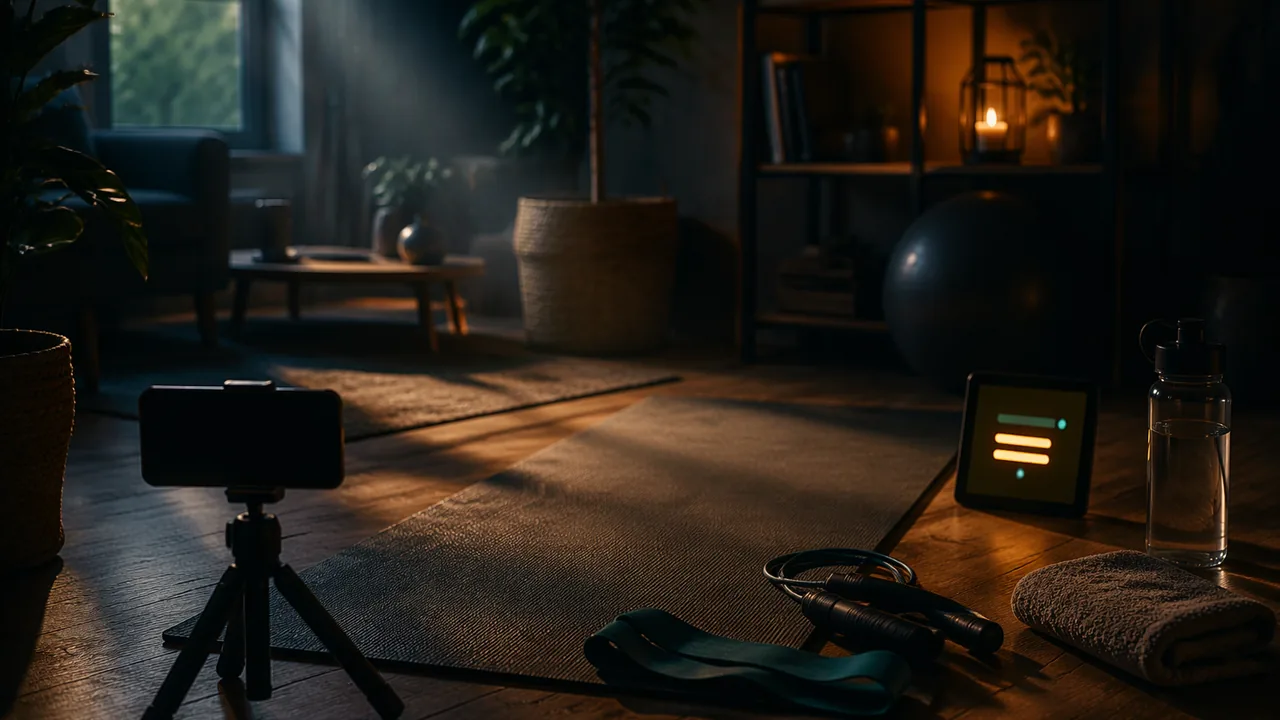
design, perform and record a safe 20-minute home routine with a warm-up, a main set of foundational exercises and a cool-down, showing safety, etiquette and correct technique.
Instruction
Pulling the unit together. You have checked your readiness, prepared a safe space, measured a warm-up and cool-down, practiced four foundational movements and predicted the risks in your activities. Now you design a complete 20-minute routine you can actually use at home, perform it safely and record the evidence. This is the routine you will build on all semester.
The structure of a safe session
Every session in this course follows three phases. The warm-up (about 5 minutes) raises heart rate gradually and rehearses the movements to come. The main set (about 10 minutes) is the training itself. The cool-down (about 5 minutes) lowers heart rate gradually and finishes with static stretches. The federal guidelines ask young people for 60 minutes of moderate-to-vigorous activity a day, including muscle-strengthening activity on at least 3 days a week (Physical Activity Guidelines for Americans, 2nd ed.). A 20-minute routine done three times a week covers the muscle-strengthening part and contributes a third of a day’s minutes each time it is done.
Building the main set
A simple, effective design is a circuit: move from one exercise to the next with short rests. Use the four studio movements plus one or two of your choice:
- Squats (or chair squats), 30 seconds
- Push-ups at your level (wall, counter, knees or toes), 30 seconds
- Hip hinges, 30 seconds
- Plank (forearms, knees or toes), 20-30 seconds
- Your choice, for example step-ups on the bottom stair holding the rail, marching with high knees, or glute bridges, 30 seconds
Rest 30 seconds between exercises and 1 minute between rounds; three rounds take about 10 minutes. For each exercise, name the muscle groups it trains. Choose a level at which every repetition meets the critical elements; the moment form breaks, rest or drop a level.
Safety and etiquette at home
Missouri’s expectation for personal etiquette, respect and safety applies at home as much as in a gym. Safety means the checklist from Lesson 1.2, your stop signs, water, a cool room and a plan for emergencies. Etiquette and respect mean choosing a time and place that do not disrupt others, keeping noise reasonable, putting furniture back, wiping down any shared equipment and asking before using a family member’s things. If someone at home watches or helps, thank them.
Recording the evidence
You will record your full routine, or at least one complete round plus the warm-up and cool-down, with the camera placed so your whole body is visible. Recordings stay private. If you cannot record, an equal-credit option is a written log with timestamps, heart-rate readings and two photos of your prepared space (without people in them). A parent or guardian may watch, film or help, but no one else’s involvement is required.
Stop signs, always: chest pain, dizziness, unusual shortness of breath or joint pain mean stop and tell a parent or guardian; call 911 for an emergency.
Formative check
Work through these before moving on. They are not graded — they tell you whether the standard below has landed yet.
Which order makes a complete, safe session?
Putting furniture back and choosing a time that does not disrupt others at home are part of physical activity etiquette.
Draft your routine card: list the warm-up moves, the five main-set exercises with time and level, the major muscle groups each trains, one safety note per exercise, and the cool-down stretches. Add one sentence on when and where you will do it so that it respects others at home.
How confident are you that you can design, perform and record a safe, complete 20-minute home routine?
Unit 1 checkpoint
Do this before you start the task. It covers the whole unit and tells you what to review first.
Which of these is a skill-related fitness component?
Young people aged 6 to 17 need at least minutes of moderate-to-vigorous activity every day.
A brisk trail walk mostly builds flexibility and power.
A 15-second pulse count is 25 beats. What is the heart rate?
During moderate activity, the talk test says you can talk but not .
Which item is a hazard on the safe-space checklist?
The gluteals and hamstrings are the prime movers in a hip hinge.
In a push-up, about how far should the elbows be from the body?
A sprain is a stretched or torn ; a strain is a stretched or torn muscle or tendon.
Heat stroke can include a body temperature of 103°F or higher and confusion, and it calls for 911.
Which training habit most raises the risk of an overuse injury?
Submit: My safe home workout space + a recorded 20-minute routine with warm-up and cool-down
Task: Prepare and document a safe home activity space, design a 20-minute routine (5-minute warm-up, 10-minute main set, 5-minute cool-down) that uses the squat, hip hinge, push-up and plank plus one exercise of your choice, perform it, and record it. Write or record a short reflection on safety, etiquette, technique and how your body responded.
Every exercise can be done at a low-impact or seated level for full credit (for example chair squats, wall push-ups, seated marching, seated torso holds). No part of the task asks you to share health information. A parent or guardian may watch or help; it is never required. Keep recordings private and never post them online.
Stop signs: chest pain, dizziness, unusual shortness of breath or joint pain mean stop and tell a parent or guardian; call 911 for an emergency.
Submission workflow
- Stage 1 — Plan. Complete the safe-space checklist (floor, overhead, edges, air, shoes, water, someone at home knows) and draw or photograph the space without people in it. Write your routine card: each phase, exercise, time, level, the muscle groups each main-set exercise trains, and one safety note per exercise.
- Stage 2 — Self-checked draft. Do one practice round. Record it and score yourself against the critical-element checklist from Lesson 1.3 and the safety checklist. Change at least one thing (level, cue, timing or space) and write a two-sentence revision note explaining why.
- Stage 3 — Do it and log it. Perform the full 20-minute routine and record it (or keep the equal-credit written log with timestamps and photos of the space). Take your pulse at rest, after the warm-up, after the main set and after the cool-down. Log the minutes and intensity in your weekly activity log for your parent or guardian to initial.
- Stage 4 — Final + reflection. Submit the final routine card, the recording or log, the heart-rate readings and a reflection (a 1-2 minute recording or about 250 written words): how the warm-up and cool-down changed your heart rate, which critical element you improved, how you showed safety and respect for others at home, and what you will change next time.
How it is scored
| Criterion | What proficient looks like |
|---|---|
| Safe space and readiness (PE.PA3Aa) | Checklist complete; hazards fixed; stop signs and emergency plan stated; water and a cool space in place. |
| Session structure (PE.PA3Aa) | Warm-up raises heart rate gradually with dynamic moves; main set is about 10 minutes; cool-down lowers heart rate and ends with static stretches; readings recorded. |
| Technique and muscle groups (PE.PA1Da) | Each main-set exercise names its major muscle groups correctly and is performed at a level that meets its critical elements; one correction documented. |
| Etiquette, respect and safety (PE.PA2Aa) | Routine planned around others at home; space restored; safety behaviors visible in the recording or log; reflection explains them. |
| Reflection | Uses the heart-rate data and the self-check to explain what happened and names a specific next change. |