calculate a personal target heart-rate zone, measure intensity accurately by pulse count, phone or wearable and perceived exertion, and use self-analysis to correct errors in measurement technique.
Instruction
How hard is hard enough? The federal guidelines are written in terms of moderate and vigorous activity. To meet them, and to compare the benefits of different activities fairly, you need a way to measure intensity. This studio teaches three tools and the technique that makes each one accurate.
Tool 1: target heart-rate zones
The CDC estimates your maximum heart rate by subtracting your age from 220. Moderate-intensity activity is about 64% to 76% of that maximum, and vigorous activity about 77% to 93% (CDC, Target Heart Rate and Estimated Maximum Heart Rate). Worked example for a 15-year-old:
- Estimated maximum: 220 − 15 = 205 beats per minute
- Moderate zone: 205 × 0.64 ≈ 131 to 205 × 0.76 ≈ 156 beats per minute
- Vigorous zone: 205 × 0.77 ≈ 158 to 205 × 0.93 ≈ 191 beats per minute
The formula is an estimate for a population; your true maximum may be higher or lower, which is why the next two tools matter too.
Tool 2: perceived exertion and the talk test
The CDC also describes a 0-10 effort scale, where 0 is sitting and 10 is the hardest effort possible. Moderate activity is about 5 or 6; vigorous activity begins at about 7 or 8. The talk test is a quick check: during moderate activity you can talk but not sing; during vigorous activity you cannot say more than a few words without pausing for breath (CDC, Measuring Physical Activity Intensity). These tools work for anyone, including people whose heart rate is affected by medicine.
Tool 3: devices
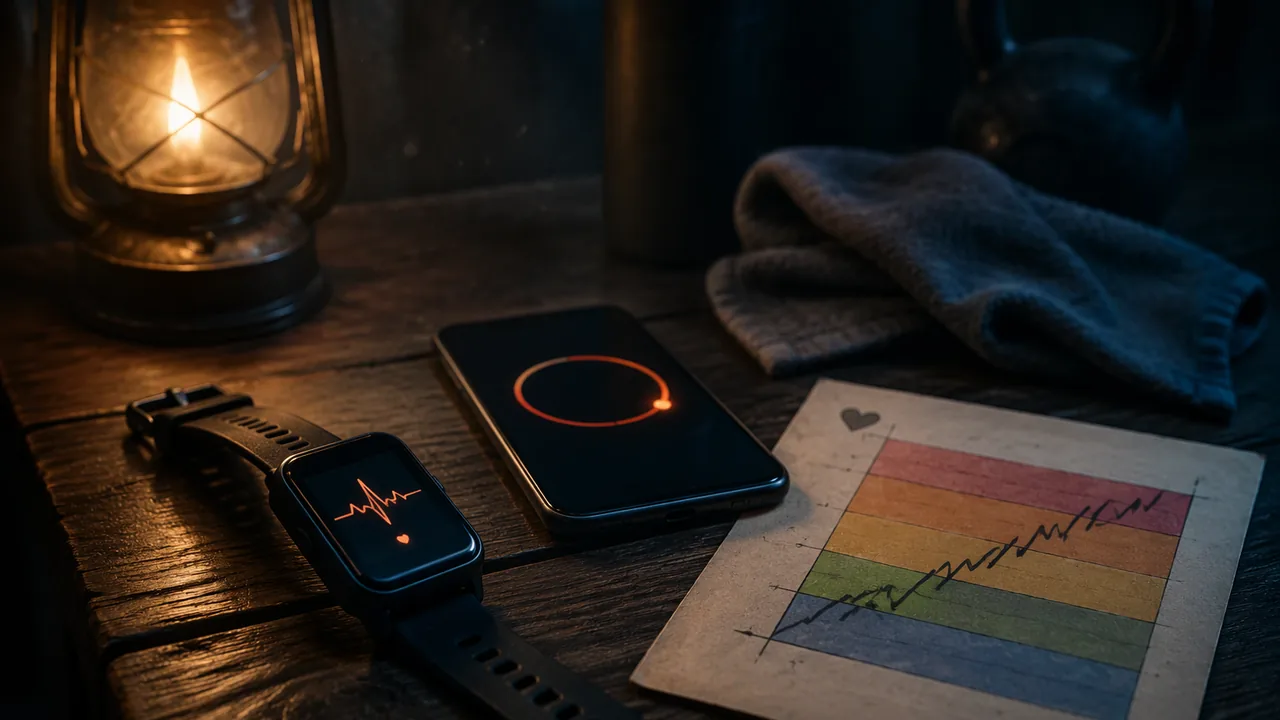
Pedometers count steps; phone apps and wearables estimate heart rate with light sensors on the wrist or fingertip. Devices are convenient, but wrist sensors can be thrown off by a loose band, movement, cold skin or tattoos. Check your device against a manual pulse count at rest and after activity; if they differ by more than a few beats, trust the careful manual count.
Technique for an accurate pulse count
MedlinePlus describes the method: place two fingers (not the thumb, which has its own pulse) on the thumb side of the inside of the wrist, or beside the windpipe on one side of the neck only, never both sides at once. During exercise, heart rate drops quickly once you stop, so count within a few seconds of stopping, for 10 seconds and multiply by 6, or 15 seconds and multiply by 4. Common errors: starting the timer late, counting the first beat as “one” instead of “zero,” pressing too hard, and losing count. Your studio task is to record yourself taking an exercise pulse, check the recording against the checklist below, fix one error and record again.
| Critical element | Check |
|---|---|
| Two fingertips, not the thumb | yes / not yet |
| Light pressure on one site | yes / not yet |
| Count started within 5 seconds of stopping | yes / not yet |
| First beat counted as zero; timer and count started together | yes / not yet |
| Correct multiplier used | yes / not yet |
Comparing activities with data
With these tools you can compare activities on evidence instead of guesses. A slow walk might give 100 beats per minute and an effort of 3; brisk walking 135 and 5; jumping rope 170 and 8. Those numbers tell you which activities count toward your moderate and vigorous minutes and how to adjust any activity (walk faster, add hills) to reach your zone.
Formative check
Work through these before moving on. They are not graded — they tell you whether the standard below has landed yet.
For a 16-year-old, the CDC formula estimates a maximum heart rate of beats per minute.
On the CDC 0-10 effort scale, where does vigorous activity begin?
When checking an exercise heart rate, waiting a minute before starting to count gives the most accurate result.
Calculate and write your own moderate and vigorous zones. Then do three activities for 3 minutes each (for example slow walking, brisk walking or marching, and jumping jacks or jumping rope). After each, take your pulse (and your device reading, if you have one) and rate your effort and talk-test result. Record one pulse check on video, score it against the five critical elements, fix one error and record again. Which activity reached your moderate zone, and which reached vigorous?
How confident are you that you can calculate my target zones and measure exercise intensity accurately with pulse, device and perceived exertion?
Practice
Work these on paper or in your notebook, then open Check your answer. Aim for all of Fluency and Application; try at least one Challenge.
Printable version: this unit’s practice workbook (PDF)
Fluency
Build speed and accuracy with the core skill.
- Using the CDC formula, find the estimated maximum heart rate for ages 14, 17 and 18.
Check your answer
Answer: 206, 203 and 202 beats per minute.220 − 14 = 206; 220 − 17 = 203; 220 − 18 = 202. - Give the CDC percentage ranges of maximum heart rate for moderate and for vigorous activity, and the 0-10 effort ratings for each.
Check your answer
Answer: Moderate: about 64% to 76% of maximum, effort about 5 or 6. Vigorous: about 77% to 93% of maximum, effort beginning at about 7 or 8.Talk test: moderate, you can talk but not sing; vigorous, only a few words without pausing. - Convert each exercise count to beats per minute: (a) 24 beats in 10 seconds; (b) 41 beats in 15 seconds.
Check your answer
Answer: (a) 144 bpm; (b) 164 bpm.(a) 24 × 6 = 144. (b) 41 × 4 = 164.
Application
Use the skill in context. Show your reasoning.
- Calculate the moderate and vigorous heart-rate zones for an example 17-year-old. Round to the nearest whole beat.
Check your answer
Answer: Maximum 203 bpm. Moderate about 130 to 154 bpm. Vigorous about 156 to 189 bpm.220 − 17 = 203. 203 × 0.64 = 129.92 ≈ 130; 203 × 0.76 = 154.28 ≈ 154; 203 × 0.77 = 156.31 ≈ 156; 203 × 0.93 = 188.79 ≈ 189. - An example 14-year-old, Priya, records these after 3 minutes of each activity: slow walk 102 bpm, marching with high knees 140 bpm, jumping rope 168 bpm. Her maximum is 206. Which activities reached her moderate zone and which reached vigorous?
Check your answer
Answer: Moderate zone is about 132 to 157 bpm; vigorous about 159 to 192 bpm. Marching (140) is moderate; jumping rope (168) is vigorous; the slow walk (102) is below moderate.206 × 0.64 = 131.84 ≈ 132; 206 × 0.76 = 156.56 ≈ 157; 206 × 0.77 = 158.62 ≈ 159; 206 × 0.93 = 191.58 ≈ 192. - An example student watches his own pulse-check recording. He counted the first beat as “one” and started the timer 8 seconds after stopping. Name both errors and the correct technique.
Check your answer
Answer: Errors: the first beat should be counted as zero (with the timer and count started together), and the count must start within 5 seconds of stopping because heart rate falls quickly. Correct technique also uses two fingertips (not the thumb) with light pressure on one site and the right multiplier.These are critical elements on the lesson’s pulse-check checklist. - An example student’s wrist device shows 118 bpm, but her careful manual count right after jumping jacks is 15 seconds × 4 = 148 bpm. Which should she trust, and what could explain the difference?
Check your answer
Answer: Trust the careful manual count. Wrist sensors can be thrown off by a loose band, movement, cold skin or tattoos; the readings differ by far more than a few beats.148 − 118 = 30 beats difference; the lesson says to trust the manual count when they differ by more than a few beats.
Challenge
Stretch problems. Expect to think before you write.
- An example person takes a medicine that keeps her heart rate low. Which intensity tools should she use instead of target heart-rate zones, and why does the lesson say the 220-minus-age formula is only an estimate?
Check your answer
Answer: Perceived exertion (the 0-10 scale) and the talk test, which work for anyone, including people whose heart rate is affected by medicine. The formula is an estimate for a population; an individual’s true maximum may be higher or lower.Using more than one tool is why the lesson teaches three.
Review
Keep earlier skills sharp.
- Review (Lesson 1.2): where on the wrist do you feel the radial pulse, and which finger should you not use? Why?
Check your answer
Answer: On the thumb side of the inside of the wrist, with two fingertips. Do not use the thumb, because it has its own pulse.For the neck site, use one side only, never both at once.