safely complete home versions of five fitness assessments under consistent conditions and record a reliable baseline for each health-related component tested.
Instruction
Today you collect your baseline. These five tests are home versions of standard field tests. They are not meant to match official scoring tables exactly; their job is to give you an honest starting point that you can repeat in the same way later. That makes consistency the most important skill today. Write down your conditions (time of day, shoes, surface, step height, how you counted), because you will copy them exactly when you retest.
Test order and why it matters
Fatigue from one test affects the next, so the order is planned: resting heart rate first (before any activity), then a warm-up, then flexibility (warm muscles stretch more consistently), then the two muscular tests with rest between, and the cardiorespiratory test last, because it leaves you the most tired. You can split the tests over two sessions; keep the same order and note which day each was done.
The five tests
1. Resting heart rate. Sit quietly for at least 10 minutes, as MedlinePlus recommends, then count your wrist pulse for 30 seconds and multiply by 2. Ideally repeat on two mornings and average them.
2. Sit-and-reach, one leg at a time. Sit on the floor with one leg straight and the sole of that foot flat against a sturdy box or the bottom stair; bend the other knee with that foot flat on the floor. Lay a yardstick on the box so the 9-inch mark is at the edge where your foot is. With one hand on top of the other, reach forward slowly along the stick and hold for 1 second; no bouncing. Record the best of three reaches for each leg, to the nearest half inch. Testing one leg at a time is gentler on the lower back.
3. Push-ups. Choose the level you used in Unit 1 (wall, counter, knees or toes) and record which one. Do as many as you can with full form, at a steady pace of about one every 3 seconds, lowering until the elbows bend to about 90 degrees. Stop when you can no longer keep the straight body line or the pace. Record the number.
4. Curl-ups. Lie on your back, knees bent at about 90 degrees, feet flat, arms straight with palms on your thighs. Curl up slowly until your fingertips reach your kneecaps, then lower until your shoulders touch the floor; keep a pace of about one every 3 seconds and keep your neck relaxed. Stop at 75 or when you can no longer keep the pace or form. Record the number.
5. Cardiorespiratory test: choose one. Step test (indoors): the YMCA version uses a 12-inch step at 24 steps per minute (a 96-beat metronome, one foot per beat: up, up, down, down) for 3 minutes, then counts heart rate for 1 full minute starting within 5 seconds of stopping; a lower recovery count means better fitness. At home, use the bottom stair, holding the rail. A household stair is usually lower than 12 inches, so your number will not match published charts; it is a baseline for you. Write down the step height. 1-mile walk/run (outdoors): only on a track or a measured, safe route, with a parent or guardian present, and not in the heat of the day. Walk, jog or mix the two at the fastest pace you can keep; record your time and your heart rate within 15 seconds of finishing.
Safety on test day
A test is a hard effort, but never a reason to push through warning signs. Missouri DHSS advises scheduling outdoor activity in the morning or evening and avoiding the warmest part of the day. Drink water, rest between tests, and stop at once for any stop sign. Your score is only useful if it was collected safely.
Activity: Home fitness assessment day: a five-test baseline
Question. Where does my fitness stand today in cardiorespiratory endurance, muscular strength and endurance, and flexibility, measured so that I can repeat the tests exactly?
Materials
- A clear, non-slip space (the safe space from Unit 1) and a mat, towel or carpet for floor tests
- A timer or phone clock that shows seconds, and a free metronome app or 96-beat-per-minute music track for the step test
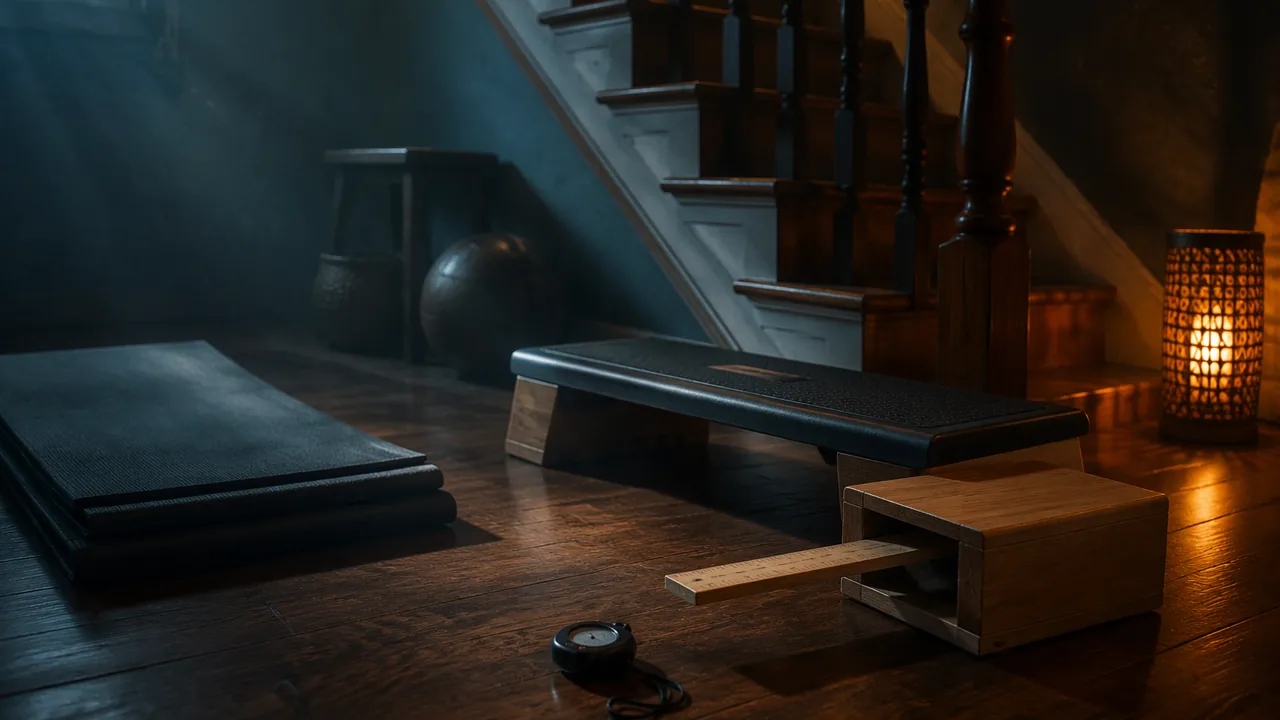
- A yardstick or tape measure and a sturdy box or the bottom stair for the sit-and-reach
- The bottom stair of a staircase with a rail (step test) or a track or measured safe route plus a parent or guardian (mile)
- Water, athletic shoes and this lesson’s data table
- Re-check your readiness questionnaire first; if anything has changed, talk with your parent or guardian and your doctor before testing.
- Stop at once and tell a parent or guardian if you feel chest pain or pressure, dizziness or lightheadedness, unusual shortness of breath, or sharp or unusual joint pain; call 911 for an emergency such as fainting, chest pain that does not go away or trouble breathing.
- Warm up before the flexibility, muscular and cardiorespiratory tests, cool down afterward, and rest at least 3 minutes between tests.
- Never bounce in the sit-and-reach; reach slowly and stop at mild tension, not pain. Keep the neck relaxed in curl-ups.
- Hold the stair rail during the step test. The mile is done only outdoors with a parent or guardian present, on a safe route, in the morning or evening, with water; skip it on hot, humid days and use the step test instead.
Procedure
- Record conditions: date, time, shoes, surface, step height in inches, and push-up level. Resting heart rate: sit quietly 10 minutes, count your pulse 30 seconds and multiply by 2. Record it.
- Warm up for 5-8 minutes with the dynamic warm-up from Lesson 1.2 until you are warm and breathing a little faster.
- Sit-and-reach: three slow reaches per leg, holding each 1 second, with the 9-inch mark at the box edge. Record the best reach for each leg to the nearest half inch. Rest 3 minutes.
- Push-ups at your chosen level: as many as possible with full form at about one every 3 seconds. Record the number. Rest at least 3 minutes, sipping water.
- Curl-ups: as many as possible at about one every 3 seconds, to a maximum of 75. Record the number. Rest at least 3 minutes.
- Cardiorespiratory test. Step test: step up, up, down, down on the bottom stair with the metronome at 96 beats per minute (24 steps per minute) for 3 minutes, holding the rail; sit down and, within 5 seconds, count your pulse for a full 60 seconds. Or the mile (with an adult present): record your time and count your pulse for 15 seconds within 15 seconds of finishing, then multiply by 4.
- Cool down for 5 minutes of easy walking plus static stretches. Log your minutes and intensity in your weekly activity log and record any condition that might have affected a score (poor sleep, heat, sore muscles).
Data
| Conditions | Record |
|---|---|
| Date and time | |
| Shoes and surface | |
| Step height (inches) or mile route | |
| Push-up level | |
| Anything that may have affected scores |
| Test | Component | Baseline result | Effort (0-10) |
|---|---|---|---|
| Resting heart rate (beats per minute) | |||
| Sit-and-reach, right leg (inches) | |||
| Sit-and-reach, left leg (inches) | |||
| Push-ups (number) | |||
| Curl-ups (number) | |||
| Step test recovery heart rate (beats in 1 minute) or mile time and finish heart rate |
Analysis
- Fill in the component column for each test. Which component looks strongest and which needs the most work? Support your answer with your numbers and the health standards from Lesson 2.1 where they apply.
- Compare your resting heart rate with the MedlinePlus normal range of 60 to 100 beats per minute for people 10 and older. List two things other than fitness that can raise resting heart rate on a given day.
- Identify two possible sources of error in your testing (for example counting, pace, step height or fatigue) and explain exactly how you will control each one at retest.
- If your two sit-and-reach results differ by more than an inch, what might that tell you, and how could your plan address it?
If you cannot do this activity in person: Low-impact or seated version (full credit): resting heart rate is unchanged. Flexibility: a seated chair sit-and-reach (sit near the front of a sturdy chair, one leg straight with the heel on the floor, reach slowly toward the toes and have the distance from fingertips to toes measured with a ruler; record the best of three per leg). Upper body: wall push-ups at a steady 3-second pace, counted until form breaks. Trunk: seated knee lifts (sit tall, hands on the seat edge, lift both knees a few inches and lower) for as many as possible in 60 seconds. Cardiorespiratory: 3 minutes of seated marching at a steady 96-beat metronome (one knee lift per beat), then count your pulse for 60 seconds starting within 5 seconds. Record the same conditions and answer the same analysis questions.
Formative check
Work through these before moving on. They are not graded — they tell you whether the standard below has landed yet.
Why is the cardiorespiratory test done last on assessment day?
In the step test, what does a lower 1-minute recovery heart rate indicate?
The standard YMCA step test uses a 12-inch step at steps per minute for minutes.
After your assessment day, write a short baseline summary: your result for each test (shared only in this course), the component it measures, which is your strongest and weakest area, and the three test conditions you must repeat exactly at retest. You do not need to compare yourself with anyone else.
How confident are you that you can complete a safe home fitness assessment and record a baseline I can repeat reliably?
Practice
Work these on paper or in your notebook, then open Check your answer. Aim for all of Fluency and Application; try at least one Challenge.
Printable version: this unit’s practice workbook (PDF)
Fluency
Build speed and accuracy with the core skill.
- Put the assessment-day steps in the planned order: curl-ups, step test, resting heart rate, sit-and-reach, warm-up, push-ups.
Check your answer
Answer: Resting heart rate, warm-up, sit-and-reach, push-ups, curl-ups, step test.Resting heart rate before any activity; flexibility when warm; muscular tests with rest between; the most tiring cardiorespiratory test last. - What pace (cadence) is used for push-ups and curl-ups, and when does the curl-up test stop?
Check your answer
Answer: About one repetition every 3 seconds. Curl-ups stop at 75 or when you can no longer keep the pace or form.Push-ups stop when you can no longer keep the straight body line or the pace. - In the step test, the metronome is set to 96 beats per minute with one foot per beat (up, up, down, down). How many beats make one full step, and how many full steps are done in 3 minutes?
Check your answer
Answer: 4 beats per step; 72 steps.96 ÷ 4 = 24 steps per minute; 24 × 3 = 72 steps.
Application
Use the skill in context. Show your reasoning.
- In the sit-and-reach, the 9-inch mark sits at the box edge where the foot is. An example student, Jae, reaches 11.5 inches with the right leg and 9.5 inches with the left. (a) How far past the foot does each reach go? (b) How large is the difference between legs, and what might it tell him?
Check your answer
Answer: (a) Right: 2.5 inches past the foot; left: 0.5 inch past. (b) 2 inches; a difference of more than an inch suggests one side’s hamstring and low back are tighter, so his plan could give extra stretching to the left side.11.5 − 9 = 2.5; 9.5 − 9 = 0.5; 11.5 − 9.5 = 2.0 inches. - An example student’s resting heart rate is 76 bpm on Monday morning and 70 bpm on Tuesday morning. What baseline should she record, and why does the lesson suggest averaging two mornings?
Check your answer
Answer: 73 bpm. Averaging two mornings smooths out day-to-day changes (sleep, stress) and gives a more reliable baseline.(76 + 70) ÷ 2 = 146 ÷ 2 = 73 bpm. - An example student’s household stair is 7 inches high. Can he compare his step-test recovery count with published YMCA charts? Explain what he should do instead.
Check your answer
Answer: No. The YMCA charts assume a 12-inch step, so a lower stair gives a number that will not match. He should write down the 7-inch step height and use his count as a personal baseline, retesting on the same stair.Consistency, not matching official tables, is the goal of the home tests. - After the 1-mile walk/run, an example student counts 38 beats in 15 seconds. What is her finish heart rate? Name two safety conditions the lesson sets for the mile.
Check your answer
Answer: 152 bpm. Conditions (any two): only on a track or measured safe route; a parent or guardian present; not in the heat of the day (morning or evening); carry water; skip it on hot, humid days and use the step test instead.38 × 4 = 152 bpm.
Challenge
Stretch problems. Expect to think before you write.
- Identify two possible sources of error on assessment day other than step height, and write how you would control each at retest.
Check your answer
Answer: Model: (1) Counting errors in the pulse (starting late or losing count): start counting within 5 seconds of stopping and use the same counting rules. (2) Pace drifting in push-ups or curl-ups: use the same 3-second cadence with a timer or metronome. Other acceptable sources: fatigue from a changed test order, different shoes or surface, different time of day.A strong answer names a specific error and a specific control.
Review
Keep earlier skills sharp.
- Review (Lesson 2.1): in the step test, is a recovery count of 95 better or worse than a count of 110 on the same stair? Explain.
Check your answer
Answer: Better. A lower recovery heart rate means better cardiorespiratory endurance, because a fitter heart recovers faster.Lower is better for the step test score.