Under what conditions can individual self-interest truly benefit society?
analyze Adam Smith’s account of self-interest, the division of labor and the invisible hand, explain the roles of property rights, competition and profit, and write an argument about markets and liberty.
Adam Smith, a Scottish moral philosopher, published The Wealth of Nations in 1776, the same year as the Declaration of Independence. It is the founding text of modern economics, and it is far more interesting than the slogans made from it.
Adam Smith believed that self-interest can promote the public good, but only when guided by competition, secure property rights, and the rule of law.
📖 Read for this lesson
The reading opens over the lesson; close it to come back to exactly where you were. The checks below draw on it.
How does the pursuit of individual self-interest, as described by Smith, influence the goods and services available in your community?
Which statement best reflects Smith’s view?
The division of labor
Adam Smith was not just an economist; he was a moral philosopher whose first major work, The Theory of Moral Sentiments, explored the foundations of human morality and sympathy.
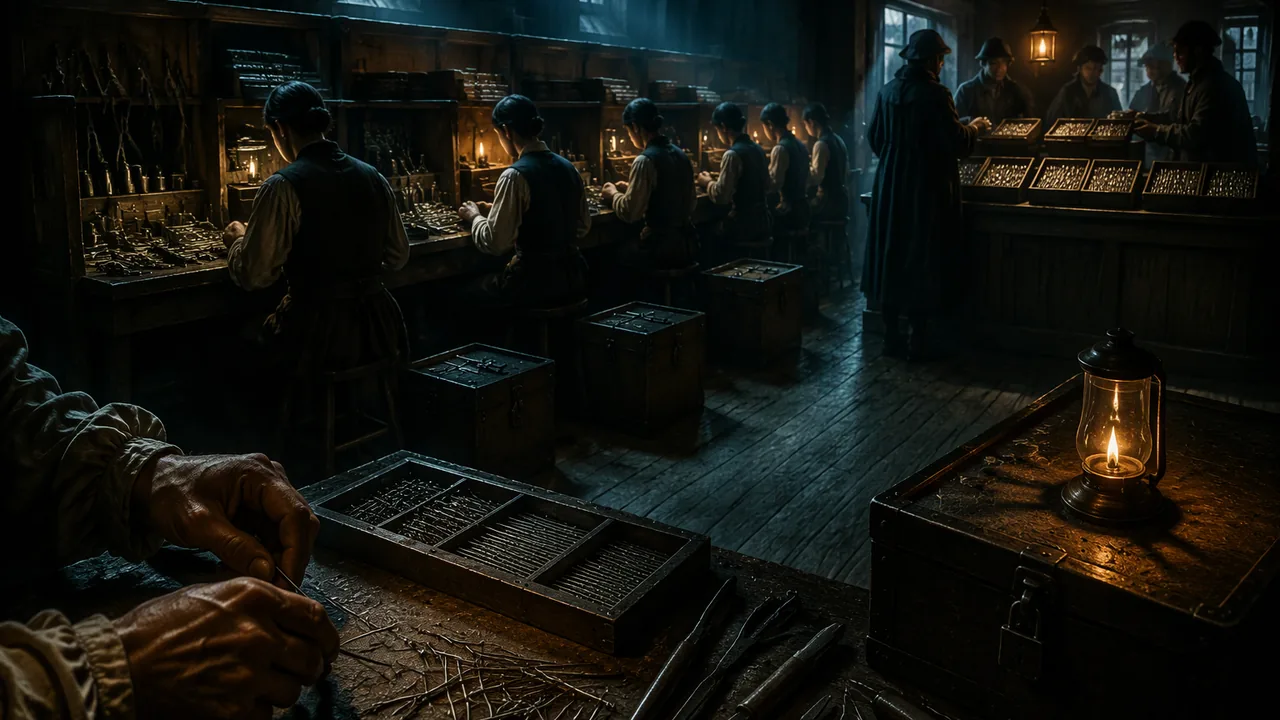
Smith opens with a pin factory. One untrained worker, Smith wrote, could scarcely make one pin a day and certainly not twenty; ten workers each specializing in a few steps made upward of 48,000. Specialization raises productivity — and it requires exchange, because a specialist must trade for everything else.
Secure property rights generally give owners an incentive to conserve resources.
Self-interest and the invisible hand
We get dinner not from the butcher’s benevolence but from his “regard to [his] own interest.” In a competitive market, a person who seeks profit must serve customers well, and is “led by an invisible hand” to promote the public good without intending it. Smith’s claim is not that greed is good; it is that under the right conditions — competition and law — self-interest can be channeled into social benefit.
Smith’s metaphor for how self-interest in competitive markets can promote the public good.
Write your 500-600 word argument: did Smith believe markets would take care of themselves? Quote at least two passages in context, explain the roles of property, competition and profit in his account, and address the most common misreading of the invisible hand.
The conditions matter
Smith was deeply suspicious of businesses: “People of the same trade seldom meet together… but the conversation ends in a conspiracy against the public.” He opposed monopolies, mercantilist trade restrictions and government favors to merchants. The invisible hand works only where there is competition.
Adam Smith thought that greed is good and that markets work best with no rules or government involvement.
Smith argued that self-interest can promote the public good, but only within a framework of competition, law, and secure property rights. He was deeply suspicious of businesses conspiring against the public and opposed monopolies.
Property rights
People invest effort and resources in what they can own and keep. Secure property rights — defined and enforced by law — give owners an incentive to conserve and improve resources. A farmer who owns land has reason to protect its soil; no one has the same reason to protect land that belongs to no one, a problem economists call the tragedy of the commons. Renewable resources such as fisheries and groundwater are classic cases: Missouri’s Constitution (Article IV, Section 40(a)) vests control of the state’s fish, game and other wildlife resources in a conservation commission, and Section 43(a) pays for it with a sales tax of one-eighth of one percent, because wildlife that belongs to no one in particular can be taken faster than it replenishes. Nonrenewable resources such as oil raise a different question — how their owners weigh selling now against selling later.
Legally enforced rights to own, use and transfer resources.
Overuse of a shared resource no one owns or controls.
Competition and profit
Competition pushes firms to cut costs, improve quality and innovate. Profit rewards those that succeed and signals where resources are most valued; losses signal where they are not.
Markets and liberty
Smith and later writers argued that markets protect personal and political liberty: they let people choose their work and what to buy, disperse economic power, and give citizens means independent of the government. Critics answer that concentrated private power can also threaten liberty, and that market outcomes can leave people without the resources to use their freedoms. Your argument should engage both.
The workshop
Write a 500-600 word argument responding to this question: Did Smith believe markets would take care of themselves? Use at least two quotations in context (RH.11-12.1), and address the most common misreading of the invisible hand.
Key terms
Splitting production into specialized tasks, raising productivity.
The policy of building national wealth through trade surpluses and restrictions, which Smith opposed.
Reading: Self-interest, the division of labor and the invisible hand
Adam Smith, An Inquiry into the Nature and Causes of the Wealth of Nations (1776), Book I ch. 1-2; Book IV ch. 2 · Public domain
Smith’s butcher passage is often quoted alone. Read what comes before and after it.
It is not from the benevolence of the butcher, the brewer, or the baker, that we expect our dinner, but from their regard to their own interest. We address ourselves, not to their humanity, but to their self-love.
[He] intends only his own gain, and he is in this, as in many other cases, led by an invisible hand to promote an end which was no part of his intention… By pursuing his own interest he frequently promotes that of the society more effectually than when he really intends to promote it.
People of the same trade seldom meet together, even for merriment and diversion, but the conversation ends in a conspiracy against the public, or in some contrivance to raise prices.
Practice
Work these on paper or in your notebook, then open Check your answer. Aim for all of Fluency and Application; try at least one Challenge.
Printable version: this unit’s practice workbook (PDF)
Fluency
Build speed and accuracy with the core skill.
- Smith’s pin factory: 10 specialized workers made about 48,000 pins a day; one untrained worker could scarcely make 20. How many pins per worker in the factory, and how many times the lone worker’s upper figure?
Check your answer
Answer: 4,800 pins per worker a day — 240 times 2048,000 ÷ 10 = 4,800; 4,800 ÷ 20 = 240. - In one sentence, what did Smith mean by the invisible hand?
Check your answer
Answer: In a competitive market, people pursuing their own gain are led to serve others without intending it.It depends on competition and law; it is not a claim that greed is good. - Define the tragedy of the commons and give a Missouri example.
Check your answer
Answer: Overuse of a shared resource no one owns or controls; unmanaged taking of wild fish and game, which is why the Missouri Constitution (Article IV, Section 40(a)) vests control of wildlife resources in a conservation commission.Fisheries are another classic case. - Why does a farmer who owns land have more reason to protect its soil than a farmer renting it for one season?
Check your answer
Answer: The owner keeps the future value of the land, so bears the cost of depleting it; the one-season renter does not.Secure property rights are an incentive to conserve.
Application
Use the skill in context. Show your reasoning.
- Five outfitters share one lake’s fish (illustrative numbers). If an outfitter takes extra fish beyond the limit, it gains $10,000, but the falling fish stock costs every outfitter, including itself, $3,000. What does one outfitter gain by taking extra? What happens to each outfitter if all five do? What does this show?
Check your answer
Answer: One outfitter alone: +$10,000 − $3,000 = +$7,000. All five: each gains $10,000 but loses 5 × $3,000 = $15,000, a net −$5,000. Each outfitter’s rational choice leaves all worse off — the tragedy of the commons, which is why catch limits are set by an agency such as the Missouri Conservation Commission.Compare the private gain with the cost spread across everyone. - Evaluate the claim: “Smith said greed is good and government should stay out of markets.” Use two pieces of evidence from the reading.
Check your answer
Answer: Inaccurate. Smith warned that people of the same trade conspire “to raise prices”, and he opposed monopolies and government favors to merchants; the invisible hand works only under competition and law.Read the butcher passage in context. - A new café in St. Louis earns large profits. Using Smith and Lesson 1.2, predict what happens to the number of cafés and to prices, and explain the role of profit.
Check your answer
Answer: Profit signals that resources are highly valued here, so new cafés enter; supply shifts right, pushing prices and profits down.Profits draw competitors in; losses push firms out. - Three gas stations at one highway exit agree to charge 20¢ a gallon more than they otherwise would. They sell 30,000 gallons a week. How much do drivers lose each week, and what did Smith say about such meetings?
Check your answer
Answer: $6,000 a week (0.20 × 30,000). Smith warned that such conversations end “in a conspiracy against the public”; U.S. antitrust law now forbids price-fixing.Collusion removes the competition that makes the invisible hand work.
Challenge
Stretch problems. Expect to think before you write.
- Write a claim and counterclaim, one sentence each, on whether markets protect liberty, drawing on the lesson’s arguments.
Check your answer
Answer: Claim: markets protect liberty by letting people choose their work and purchases and by dispersing economic power away from the state. Counterclaim: concentrated private power can also threaten liberty, and people without resources cannot use their freedoms.Engage both sides, as the workshop asks. - A smoothie shop has two workers who each make whole smoothies, 12 an hour each. When one blends and the other preps and serves, they make 32 an hour together. What is the percent gain, and why does specialization require exchange?
Check your answer
Answer: From 24 to 32 an hour: 33.3% more. Each specialist produces only part of what they need, so they must trade for the rest.(32 − 24) ÷ 24.
Review
Keep earlier skills sharp.
- Missouri’s resident population estimate rose from 6,154,426 (July 2020) to 6,196,156 (July 2023), according to the Census Bureau. Percent change?
Check your answer
Answer: 0.7%(6,196,156 − 6,154,426) ÷ 6,154,426 = 41,730 ÷ 6,154,426. - A ratio of 80 : 90 is how much as a decimal, to two places?
Check your answer
Answer: 0.8980 ÷ 90.
The tragedy of the commons, where shared resources are overused, is a real issue for wildlife: Missouri’s Constitution gives a conservation commission control of the state’s fish, game and other wildlife (Article IV, Section 40(a)) and pays for it with a one-eighth of one percent sales tax (Section 43(a)).
Considering Smith’s arguments about competition, property rights, and the dangers of monopolies, what are the essential conditions for markets to truly benefit society?
How confident are you that you can explain what Smith actually argued about self-interest, competition and liberty?
The Shift
- Specialization boosts productivity and necessitates trade.
- Self-interest can serve society when guided by competition and law.
- Property rights motivate individuals to conserve and improve resources.
Adam Smith in His Own Words: The Pin Factory, the Butcher, the Invisible Hand and the Conspiracy
Adam Smith, An Inquiry into the Nature and Causes of the Wealth of Nations (1776), Books I, IV and the conclusion of Book I ch. XI, via Project Gutenberg (quotations checked against the Gutenberg text, retrieved November 5, 2026); with an SLS headnote and afterword that cites the Missouri Constitution, Article IV, Sections 40(a) and 43(a) · Public domain
Why this reading. Your 500–600 word argument answers one question: did Smith believe markets would take care of themselves? You need at least two quotations in context, an account of property, competition and profit, and the most common misreading of the invisible hand. Every passage you need is below, in Smith’s own eighteenth-century spelling and punctuation, with the book and chapter for each. What to look for: the famous sentences are short; the sentences immediately around them are long and carry the conditions. Read the surroundings, and notice that the man who wrote “invisible hand” also wrote that merchants “have generally an interest to deceive and even to oppress the public.” Both are Smith. Your essay has to hold them together.
The pin factory: why specialization makes a nation rich
Book I, Chapter I, “Of the Division of Labour.”
To take an example, therefore, from a very trifling manufacture, but one in which the division of labour has been very often taken notice of, the trade of a pin-maker: a workman not educated to this business […] could scarce, perhaps, with his utmost industry, make one pin in a day, and certainly could not make twenty. But in the way in which this business is now carried on, not only the whole work is a peculiar trade, but it is divided into a number of branches […] One man draws out the wire; another straights it; a third cuts it; a fourth points it; a fifth grinds it at the top for receiving the head; to make the head requires two or three distinct operations; to put it on is a peculiar business; to whiten the pins is another; it is even a trade by itself to put them into the paper; and the important business of making a pin is, in this manner, divided into about eighteen distinct operations […] I have seen a small manufactory of this kind, where ten men only were employed […] they could, when they exerted themselves, make among them about twelve pounds of pins in a day. There are in a pound upwards of four thousand pins of a middling size. Those ten persons, therefore, could make among them upwards of forty-eight thousand pins in a day. Each person, therefore, making a tenth part of forty-eight thousand pins, might be considered as making four thousand eight hundred pins in a day. But if they had all wrought separately and independently […] they certainly could not each of them have made twenty, perhaps not one pin in a day; that is, certainly, not the two hundred and fortieth, perhaps not the four thousand eight hundredth, part of what they are at present capable of performing, in consequence of a proper division and combination of their different operations.
Keep the arithmetic straight when you cite this. Ten men, twelve pounds, upwards of four thousand pins to the pound, therefore upwards of 48,000 pins — 4,800 each. Alone, at twenty pins a head, they would manage 200. That is the 240-fold figure Smith gives. Specialization is not about working harder; it is about a different arrangement of the same ten people.
The butcher: why strangers cooperate
Book I, Chapter II, “Of the Principle which gives Occasion to the Division of Labour.”
But man has almost constant occasion for the help of his brethren, and it is in vain for him to expect it from their benevolence only. He will be more likely to prevail if he can interest their self-love in his favour, and shew them that it is for their own advantage to do for him what he requires of them. Whoever offers to another a bargain of any kind, proposes to do this. Give me that which I want, and you shall have this which you want, is the meaning of every such offer; and it is in this manner that we obtain from one another the far greater part of those good offices which we stand in need of. It is not from the benevolence of the butcher, the brewer, or the baker that we expect our dinner, but from their regard to their own interest. We address ourselves, not to their humanity, but to their self-love, and never talk to them of our own necessities, but of their advantages.
Note what the passage is actually an argument about. It sits in a chapter explaining why the division of labor is possible at all. A specialist cannot eat pins; he must trade. Smith’s point is that exchange lets people cooperate with strangers whose goodwill they have no claim on. He is not saying benevolence does not exist — he had written a whole book, The Theory of Moral Sentiments (1759), about sympathy and fellow-feeling. He is saying that a large society cannot run on benevolence alone, because there are too many strangers.
The conspiracy: what Smith thought of businessmen
Book I, Chapter X.
People of the same trade seldom meet together, even for merriment and diversion, but the conversation ends in a conspiracy against the public, or in some contrivance to raise prices. It is impossible, indeed, to prevent such meetings, by any law which either could be executed, or would be consistent with liberty and justice. But though the law cannot hinder people of the same trade from sometimes assembling together, it ought to do nothing to facilitate such assemblies, much less to render them necessary.
Conclusion of Book I, Chapter XI.
The interest of the dealers, however, in any particular branch of trade or manufactures, is always in some respects different from, and even opposite to, that of the public. To widen the market, and to narrow the competition, is always the interest of the dealers. To widen the market may frequently be agreeable enough to the interest of the public; but to narrow the competition must always be against it, and can only serve to enable the dealers, by raising their profits above what they naturally would be, to levy, for their own benefit, an absurd tax upon the rest of their fellow-citizens. The proposal of any new law or regulation of commerce which comes from this order, ought always to be listened to with great precaution, and ought never to be adopted till after having been long and carefully examined, not only with the most scrupulous, but with the most suspicious attention. It comes from an order of men, whose interest is never exactly the same with that of the public, who have generally an interest to deceive and even to oppress the public, and who accordingly have, upon many occasions, both deceived and oppressed it.
This is the passage that most often surprises students, and it is the hinge of your essay. Smith does not trust merchants. He expects them to combine against the public whenever they can. What restrains them, in his account, is not their virtue but the competition of other merchants — and a legislature that refuses to do them favors.
Property: the “encouragement which industry requires”
Book I, Chapter XI. Explaining why some countries grew rich and others did not, Smith attributes the difference to
the fall of the feudal system, and from the establishment of a government which afforded to industry the only encouragement which it requires, some tolerable security that it shall enjoy the fruits of its own labour.
Two things are packed into that clause. The only encouragement industry requires is security — not subsidy, not direction. And security is something a government affords; it does not arise on its own. Property rights, in Smith, are a public institution that makes private effort worth making.
The invisible hand, in full
Book IV, Chapter II, “Of Restraints upon the Importation from Foreign Countries.” Smith is arguing against laws that force merchants to buy at home.
As every individual, therefore, endeavours as much as he can, both to employ his capital in the support of domestic industry, and so to direct that industry that its produce maybe of the greatest value; every individual necessarily labours to render the annual revenue of the society as great as he can. He generally, indeed, neither intends to promote the public interest, nor knows how much he is promoting it. By preferring the support of domestic to that of foreign industry, he intends only his own security; and by directing that industry in such a manner as its produce may be of the greatest value, he intends only his own gain; and he is in this, as in many other cases, led by an invisible hand to promote an end which was no part of his intention. Nor is it always the worse for the society that it was no part of it. By pursuing his own interest, he frequently promotes that of the society more effectually than when he really intends to promote it. I have never known much good done by those who affected to trade for the public good. It is an affectation, indeed, not very common among merchants, and very few words need be employed in dissuading them from it.
Read the hedges, because they are where the argument lives. “Frequently promotes”, not always. “Nor is it always the worse”, not never. “In this, as in many other cases”, not in all cases. The phrase appears exactly once in the whole of The Wealth of Nations, in the middle of a technical argument about import restrictions — not as a general law of markets.
What the sovereign must do
Book IV, Chapter IX. Having dismantled the mercantile and agricultural systems, Smith states what is left for government.
All systems, either of preference or of restraint, therefore, being thus completely taken away, the obvious and simple system of natural liberty establishes itself of its own accord. Every man, as long as he does not violate the laws of justice, is left perfectly free to pursue his own interest his own way, and to bring both his industry and capital into competition with those of any other man, or order of men. […] According to the system of natural liberty, the sovereign has only three duties to attend to; three duties of great importance, indeed, but plain and intelligible to common understandings: first, the duty of protecting the society from the violence and invasion of other independent societies; secondly, the duty of protecting, as far as possible, every member of the society from the injustice or oppression of every other member of it, or the duty of establishing an exact administration of justice; and, thirdly, the duty of erecting and maintaining certain public works, and certain public institutions, which it can never be for the interest of any individual, or small number of individuals to erect and maintain; because the profit could never repay the expense to any individual, or small number of individuals, though it may frequently do much more than repay it to a great society.
Notice the qualifier in the first sentence: “as long as he does not violate the laws of justice.” Natural liberty operates inside a legal framework, and the second duty is the whole of contract, property and tort law. The third duty — public works that no private party will build because they cannot capture the profit — is what economists now call a public good, and it is Smith’s, not a later addition.
Afterword: property, competition and profit, and the argument about liberty
This section is not Smith; it is the editor’s, and it is here so that you can build the second half of your essay without leaving the reading.
Property rights. A property right is a legally enforced claim to use, exclude others from, and transfer a resource. Smith’s reason for valuing it is forward-looking: an owner who will keep the fruits has reason to plant. The converse is the tragedy of the commons — when no one owns or governs a shared resource, each user gets the whole benefit of taking one more unit while bearing only a fraction of the cost of depletion, so it is taken too fast. Fisheries, grazing land and groundwater basins are the standard cases. Missouri’s answer for wild fish and game is written into its Constitution: Article IV, Section 40(a) places “[t]he control, management, restoration, conservation and regulation of the bird, fish, game, forestry and all wildlife resources of the state” in a conservation commission, and Section 43(a) levies “an additional sales tax of one-eighth of one percent” to pay for it. Wildlife that belongs to no one in particular is governed by an agency with the power to set and enforce limits, which is a way of supplying the governance the commons lacked. Note that the remedy need not be private ownership: rules and enforcement by a community or a state can serve the same function.
Competition. Competition is what converts a seller’s self-interest into a customer’s benefit. If a baker who raises prices or lets quality slip loses customers to another baker, then serving customers well and serving himself are the same act. Remove the alternative bakers and the two come apart at once. This is why Smith’s hostility to monopoly is not a departure from his system but a requirement of it, and why the United States eventually wrote his warning into law: the Sherman Act of 1890 makes agreements in restraint of trade, and monopolization, federal crimes. You will study it in Unit 2.
Profit. Profit is revenue minus all costs, including the opportunity cost of the owner’s own time and capital. It does two jobs. It rewards the person who took the risk and organized the resources. And it signals: unusually high profits in an industry advertise that customers want more of something, which attracts entrants, which competes the profit back down; losses signal the reverse and push resources out. In this account the level of profit matters less than its mobility — profits that cannot be competed away are the ones Smith called “an absurd tax upon the rest of their fellow-citizens.”
Markets and liberty — the argument. Defenders of markets make three claims: that the ability to choose one’s work, purchases and associations is itself a component of freedom; that dispersing economic decisions among millions of people prevents any single authority from controlling the means of life; and that people with independent means can dissent from a government without starving. Critics answer with three of their own: that concentrated private power — a single employer in a company town, a platform that controls access to customers — can constrain a person’s choices as effectively as a state can; that formal freedom is thin when someone lacks the resources to use it, so that a right to choose one’s job means little to a person who must take the first offer; and that markets distribute not only goods but political influence, which can turn economic inequality into unequal citizenship. A strong essay states the opposing case in its strongest form and then says why it is or is not decisive — which is the standard your writing workshop is applying.
The misreading to address
The common misreading is that “the invisible hand” means markets are self-correcting and government should stand aside. The evidence against it is in the text above, and you can cite it: the phrase appears once, inside an argument about import restrictions; Smith expects traders to conspire whenever they meet; he tells legislators to treat merchants’ proposals with “the most suspicious attention”; he makes the security of property a duty of government; and he assigns the sovereign an exact administration of justice and the building of public works that no private party will build. The honest version of Smith’s position is conditional: self-interest is channeled into public benefit by competition and by law, and where either is missing, it is not.
Sources: Adam Smith, An Inquiry into the Nature and Causes of the Wealth of Nations (1776), Project Gutenberg (gutenberg.org); Sherman Antitrust Act, 15 U.S.C. § 1, Cornell Legal Information Institute (law.cornell.edu); Missouri Constitution, Article IV, Section 40(a), Conservation commission (revisor.mo.gov); Missouri Constitution, Article IV, Section 43(a), Sales tax, use for conservation purposes (revisor.mo.gov)