define i and complex numbers, and add, subtract and multiply complex numbers using i2 = −1 and the properties of operations.
Instruction
Every time the number system has grown, it was to solve an equation that had no solution before. Negative numbers solve x + 5 = 2. Fractions solve 3x = 2. Irrationals such as √2 solve x2 = 2. But x2 = −1 has no real solution, because every real number squared is at least 0. Mathematicians of the 1500s working on cubic equations found that calculating with square roots of negatives sometimes led them to correct real answers, and eventually the new numbers were accepted.
The definition. We introduce a number i with the property i2 = −1. A complex number is any number of the form a + bi, where a and b are real. a is the real part and b the imaginary part. Real numbers are complex numbers with b = 0; numbers like 3i with a = 0 are called imaginary. Square roots of negatives are now defined: √(−9) = 3i, because (3i)2 = 9i2 = −9.
Arithmetic (A2.NQ.B.6). The decision behind complex numbers is that the commutative, associative and distributive properties still hold. Everything else follows.
- Adding: combine real parts and imaginary parts, like collecting like terms. (2 + i) − (5 − 3i) = (2 − 5) + (1 + 3)i = −3 + 4i.
- Multiplying: distribute, then replace i2 by −1. (3 + 2i)(1 − 4i) = 3 − 12i + 2i − 8i2 = 3 − 10i + 8 = 11 − 10i.
- (1 + i)2 = 1 + 2i + i2 = 2i. A complex number can square to a purely imaginary one.
- Conjugates: (2 + 3i)(2 − 3i) = 4 − 9i2 = 13, a real number. In general (a + bi)(a − bi) = a2 + b2. That fact lets you divide: (3 + i)/(1 − i) = (3 + i)(1 + i)/((1 − i)(1 + i)) = (2 + 4i)/2 = 1 + 2i.
Powers of i (MP.7). i1 = i, i2 = −1, i3 = i2 · i = −i, i4 = (i2)2 = 1, and then the cycle repeats. So i23 = i20 · i3 = 1 · (−i) = −i: divide the exponent by 4 and use the remainder.
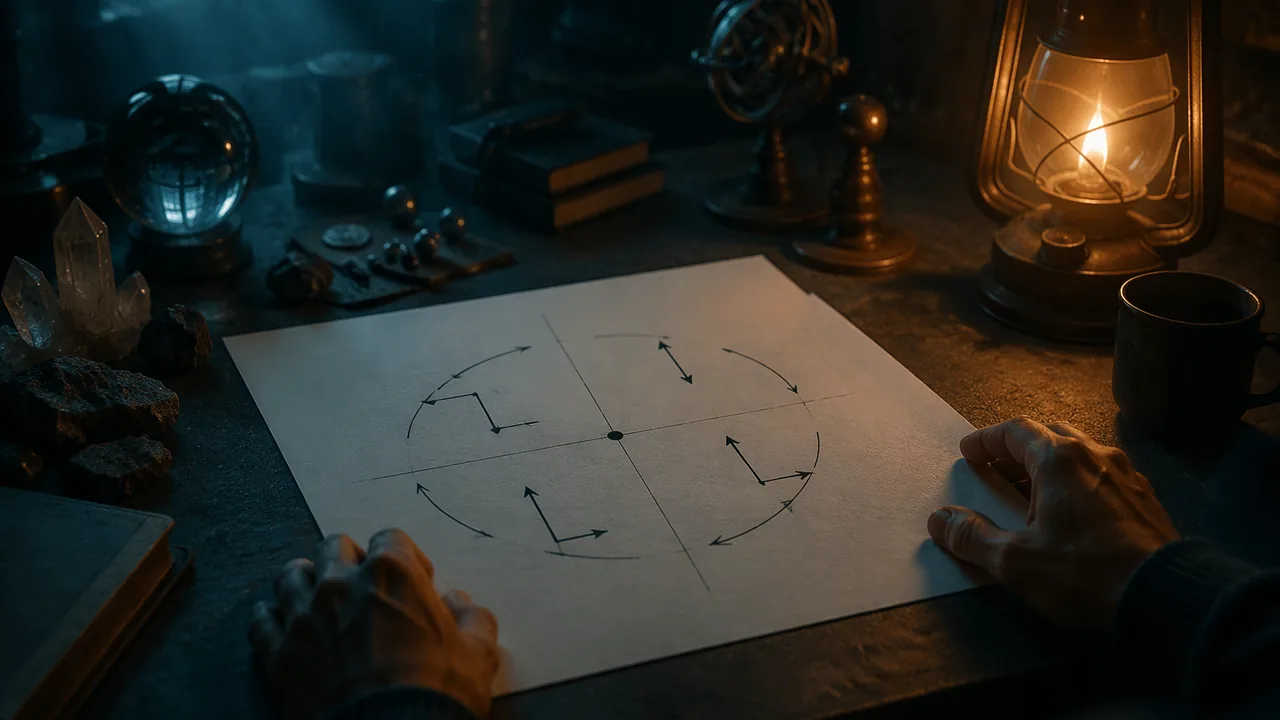
A picture. Plot a + bi as the point (a, b) in the complex plane, real part across, imaginary part up. Adding complex numbers adds them like vectors. Multiplying by i turns out to rotate a point a quarter-turn counterclockwise about the origin: 1 → i → −1 → −i → 1. That is why the powers of i cycle with period 4, and it is one reason electrical engineers use complex numbers to describe alternating current.
Discourse task (MP.3). A common false step is √(−4) · √(−9) = √36 = 6. Compute it correctly (2i · 3i = 6i2 = −6) and argue about which rule was misapplied: √a · √b = √(ab) is guaranteed only when a and b are not both negative. Your partner must either accept your explanation with a reason or produce a counterexample.
📖 Read for this lesson
The reading opens over the lesson; close it to come back to exactly where you were. The checks below draw on it.
Formative check
Work through these before moving on. They are not graded — they tell you whether the standard below has landed yet.
What is (3 + 2i)(1 − 4i)?
i3 = , i4 = and i23 = .
√(−4) · √(−9) = 6.
Show that (a + bi)(a − bi) = a2 + b2 for all real a and b, naming the property used at each step. Then use this fact to write (4 − 3i)/(2 + i) in the form p + qi.
How confident are you that you can define complex numbers and add, subtract and multiply them correctly?
Practice
Work these on paper or in your notebook, then open Check your answer. Aim for all of Fluency and Application; try at least one Challenge.
Printable version: this unit’s practice workbook (PDF)
Fluency
Build speed and accuracy with the core skill.
- Simplify: (2 − i) + (7 + 4i)
Check your answer
Answer: 9 + 3i - Simplify: (−7 − i) + (2 + 5i)
Check your answer
Answer: −5 + 4i - Simplify: (−6 + 6i) + (7 − 6i)
Check your answer
Answer: 1 - Simplify: (−7 + 4i)(−1 + 2i)
Check your answer
Answer: −1 − 18iUse i2 = −1. - Simplify: (−1 − 4i)(−5 − 6i)
Check your answer
Answer: −19 + 26iUse i2 = −1. - Simplify: (3 − 4i)(−3 + i)
Check your answer
Answer: −5 + 15iUse i2 = −1. - Simplify: i12
Check your answer
Answer: 1The powers of i repeat every 4. - Simplify: i18
Check your answer
Answer: −1The powers of i repeat every 4. - Simplify: i27
Check your answer
Answer: −iThe powers of i repeat every 4.
Application
Use the skill in context. Show your reasoning.
- Compute (1 + i)2 and use it to find (1 + i)4 and (1 + i)8.
Check your answer
Answer: 2i; −4; 16(2i)2 = −4; (−4)2 = 16. - In circuits, impedance is written as a complex number. Show that (3 + 4i)(3 − 4i) is real and find it.
Check your answer
Answer: 259 − 16i2 = 9 + 16. - Multiply 2 + 5i by i, plot both in the complex plane, and describe the motion.
Check your answer
Answer: −5 + 2i; a quarter turn counterclockwise about the origin
Challenge
Stretch problems. Expect to think before you write.
- Find real numbers a and b with (a + bi)2 = −5 + 12i.
Check your answer
Answer: 2 + 3i or −2 − 3ia2 − b2 = −5 and 2ab = 12; a = 2, b = 3 works.
Review
Keep earlier skills sharp.
- Evaluate exactly: 45/2
Check your answer
Answer: 32Take the 2th root of 4 first, then raise to the 5 power. - Solve: 3 / (x + 2) = 5 / (x + 1)
Check your answer
Answer: x = −7/2Cross-multiply, solve, and check the solution does not make a denominator zero.
Three Arguments About i, and the Arithmetic That Referees Them
SLS original constructed student claims and worked complex arithmetic for Algebra 2 A Lesson 4.3 · SLS original
Why this reading. The lab turns on a false step that looks completely reasonable, and on whether you can say which rule it breaks rather than merely that the answer is wrong. The three claims below are written for this lesson. Every computation in the tables is exact, and each was done twice: once by distributing and replacing i2 with −1, once by multiplying the pairs as ordered pairs of real numbers.
The three claims
Claim 1 (Nadia). “√(−4) · √(−9) = √((−4)(−9)) = √36 = 6. The rule √a · √b = √(ab) is one of the first things we learned about radicals and I have never seen it fail.”
Claim 2 (Owen). “i is not a number, it is a bookkeeping symbol. Nothing in the world has a length of 3i. So complex answers are a way of writing down that a problem has no answer, and you should not do arithmetic with them any more than you would do arithmetic with the word ‘none.’”
Claim 3 (Lucia). “You cannot divide by a complex number, because division means undoing a multiplication and there is no way to undo multiplying by something imaginary.”
Table 1. The powers of i
| n | 0 | 1 | 2 | 3 | 4 | 5 | 6 | 7 | 8 | 23 | 100 |
|---|---|---|---|---|---|---|---|---|---|---|---|
| in | 1 | i | −1 | −i | 1 | i | −1 | −i | 1 | −i | 1 |
| n mod 4 | 0 | 1 | 2 | 3 | 0 | 1 | 2 | 3 | 0 | 3 | 0 |
Nothing repeats by accident here: i4 = (i2)2 = (−1)2 = 1, so multiplying by i4 changes nothing and only the remainder on division by 4 matters. 23 = 4(5) + 3, so i23 = i3 = −i.
Table 2. Arithmetic, worked
| Expression | The working | Result |
|---|---|---|
| (2 + 5i) + (7 − 3i) | (2 + 7) + (5 − 3)i | 9 + 2i |
| (2 + i) − (5 − 3i) | (2 − 5) + (1 + 3)i | −3 + 4i |
| (3 + 2i)(1 − 4i) | 3 − 12i + 2i − 8i2 = 3 − 10i + 8 | 11 − 10i |
| (6 − i)(2 + 3i) | 12 + 18i − 2i − 3i2 = 12 + 16i + 3 | 15 + 16i |
| (1 + i)2 | 1 + 2i + i2 = 1 + 2i − 1 | 2i |
| (1 + i)4 | (2i)2 = 4i2 | −4 |
| √(−4) · √(−9) | 2i · 3i = 6i2 | −6 |
Table 3. Conjugates, and the division they make possible
| Number | Conjugate | Product | a2 + b2 |
|---|---|---|---|
| 2 + 3i | 2 − 3i | 4 − 9i2 = 13 | 4 + 9 = 13 |
| 5 − 2i | 5 + 2i | 25 − 4i2 = 29 | 25 + 4 = 29 |
| 1 − i | 1 + i | 1 − i2 = 2 | 1 + 1 = 2 |
| 2 + i | 2 − i | 4 − i2 = 5 | 4 + 1 = 5 |
| i | −i | −i2 = 1 | 0 + 1 = 1 |
| Quotient | Multiply above and below by | Working | Result |
|---|---|---|---|
| (3 + i)/(1 − i) | 1 + i | (2 + 4i)/2 | 1 + 2i |
| (4 − 3i)/(2 + i) | 2 − i | (5 − 10i)/5 | 1 − 2i |
| 1/i | −i | −i/1 | −i |
| (3 − 4i)/(3 + 4i) | 3 − 4i | (−7 − 24i)/25 | −0.28 − 0.96i |
Refereeing the three claims
Claim 1 is false, and the table says so in one line. 2i · 3i = 6i2 = −6, not 6. But the useful part of the critique is naming the rule rather than the answer. √a · √b = √(ab) is a theorem about nonnegative reals, and its proof uses the fact that the principal square root is nonnegative, which is exactly what does not survive when a and b are negative. If the rule held for all numbers you could also write √(−1) · √(−1) = √1 = 1, which contradicts the definition i2 = −1 directly. Nadia is right that she has never seen it fail; she has never used it outside the region where it holds. A rule with unstated hypotheses is the most dangerous thing in algebra, and this is the cleanest example of one you will meet all year.
Claim 2 deserves a better answer than “yes it is a number.” Owen is right that nothing has a length of 3i. He is wrong that this makes complex numbers useless, and for the same reason that negative numbers survived the same objection: nothing has a length of −3 either, yet negatives are indispensable because they answer questions lengths cannot. What makes i a number is not that something measures it but that it obeys the commutative, associative and distributive laws — check any row of Table 2 in either order and it will agree — so the whole of arithmetic goes through unchanged. Notice Table 3’s last column: the conjugate product of a + bi is a2 + b2, a real number, which by the Pythagorean theorem is the square of the distance from the origin to the point (a, b). Complex numbers measure something after all: positions in a plane rather than lengths on a line.
Claim 3 is false and Table 3 is the refutation. Every quotient in it is a complex number in the form p + qi, obtained by multiplying above and below by the conjugate — a step that works because the conjugate product a2 + b2 is real and is zero only when a and b are both zero. So every complex number except 0 has a reciprocal, which is precisely what “you can divide” means. Row 3 is the one to show Lucia: 1/i = −i, and you can verify it without any theory at all, since i · (−i) = −i2 = 1.
A picture to argue with. Plot a + bi at the point (a, b). Multiplying by i sends 1 to i, i to −1, −1 to −i and −i back to 1 — that is, (1, 0) → (0, 1) → (−1, 0) → (0, −1) → (1, 0), a quarter turn counterclockwise each time. Four quarter turns is a full circle, which is Table 1 restated as geometry: the powers of i cycle with period 4 because a right angle fits into a revolution exactly four times. That is also why engineers describing alternating current, which cycles, reach for complex numbers rather than inventing new bookkeeping.