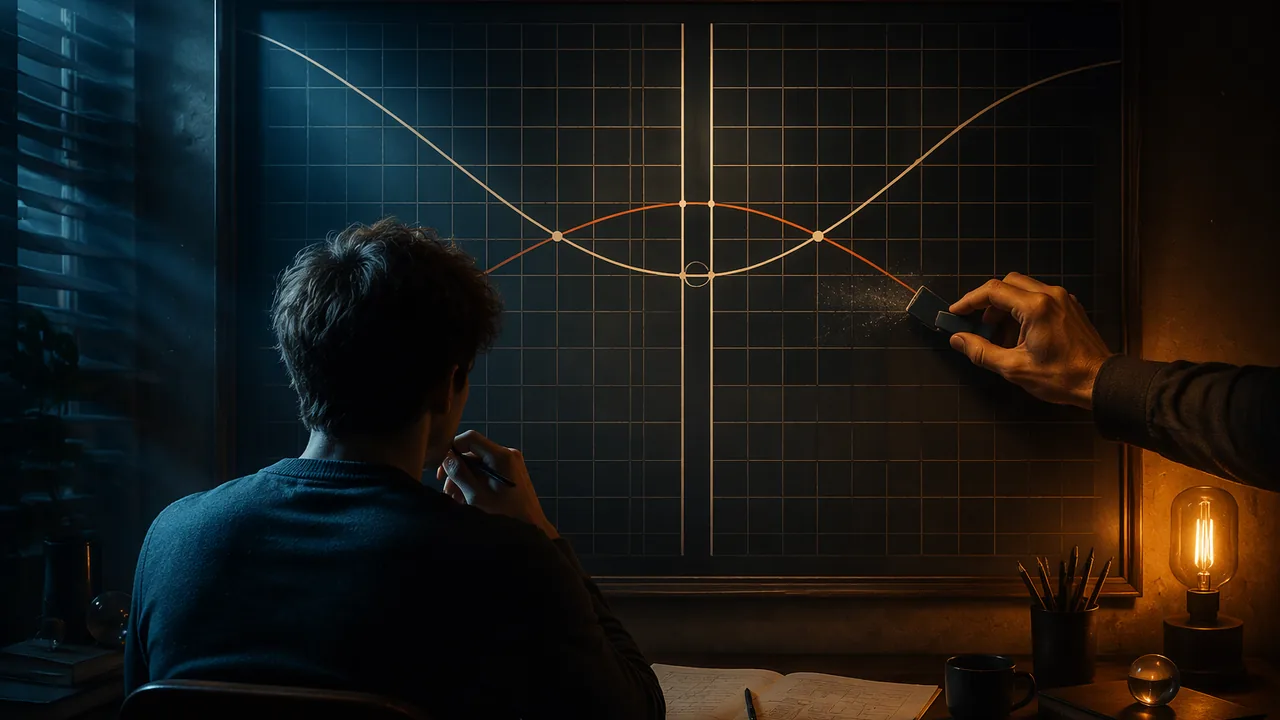
solve rational equations, explain how extraneous solutions arise and detect them, and interpret solutions as intersections of graphs.
Instruction
The standard way to solve an equation with fractions is to clear the denominators by multiplying both sides by their common denominator. It works, but it can quietly add solutions that are not really there. Today’s lab is about why.
Example 1. Solve x/(x − 2) + 1 = 2/(x − 2). Multiply every term by x − 2: x + (x − 2) = 2, so 2x = 4 and x = 2. But x = 2 makes the original denominators zero, so it is not in the domain of the equation. The equation has no solution. The value 2 is extraneous: a solution of the transformed equation that is not a solution of the original.
Why it happens. Multiplying both sides of an equation by an expression is reversible only when that expression is not zero. At x = 2 we multiplied by 0, and 0 · (anything) = 0 · (anything else) is always true, so the new equation accepted a value the old one rejected. Each step of solving should produce an equivalent equation; this step did so for every x except 2. That is why checking in the original equation is not optional.
Example 2. Solve x/(x − 1) − 2/(x + 1) = 2/(x2 − 1). The common denominator is (x − 1)(x + 1) = x2 − 1, and the restrictions are x ≠ ±1. Multiplying: x(x + 1) − 2(x − 1) = 2, so x2 − x + 2 = 2, giving x2 − x = 0 and x = 0 or x = 1. Since 1 is excluded, the only solution is x = 0. Check: 0 − 2 = −2 and 2/(−1) = −2.
Example 3, and the graphs. Solve 3/x + 1/(x + 2) = 1. Multiply by x(x + 2): 3(x + 2) + x = x(x + 2), so x2 − 2x − 6 = 0 and x = 1 ± √7, about 3.646 and −1.646. Neither is 0 or −2, so both stand. Now graph y = 3/x + 1/(x + 2) and y = 1. They cross at exactly two points, with x-coordinates near 3.646 and −1.646. That is no coincidence (A2.REI.B.3): a point lies on both graphs exactly when its x makes the two sides equal, so the intersection x-values are the solutions. The graph also shows why extraneous values do not appear: at an excluded x the rational graph has an asymptote and no point at all.
Creating equations (A2.REI.A.1). Rational equations come from rates. If a club’s printer average cost is (600 + 2.5n)/n, then “when is the average $4?” is the rational equation you solved in Lesson 3.1. If one pipe fills a tank in 6 hours and another in t hours, and together they take 4 hours, then 1/6 + 1/t = 1/4, and t = 12.
Discourse task (MP.3). You will receive a worked solution with an error or a missing check. Decide whether the conclusion is right, and write a critique that names the step, explains the reasoning error and fixes it. A critique that says only “they forgot to check” is incomplete; say which value fails and why it fails.
📖 Read for this lesson
The reading opens over the lesson; close it to come back to exactly where you were. The checks below draw on it.
Formative check
Work through these before moving on. They are not graded — they tell you whether the standard below has landed yet.
What is the solution set of x/(x − 1) − 2/(x + 1) = 2/(x2 − 1)?
Extraneous solutions appear because of arithmetic mistakes.
The graphs of y = 3/x + 1/(x + 2) and y = 1 cross at two points. What do their x-coordinates represent?
A classmate solves 4/(x − 3) = (x + 1)/(x − 3) and writes x = 3. Critique the solution: name the step where the problem arises, explain why the value fails, and state the correct solution set. Then write your own rational equation that has exactly one extraneous solution, and show that it does.
How confident are you that you can solve rational equations, catch extraneous solutions and explain why they arise?
Practice
Work these on paper or in your notebook, then open Check your answer. Aim for all of Fluency and Application; try at least one Challenge.
Printable version: this unit’s practice workbook (PDF)
Fluency
Build speed and accuracy with the core skill.
- Solve: 7 / (x + 1) = 4 / (x − 6)
Check your answer
Answer: x = 46/3Cross-multiply, solve, and check the solution does not make a denominator zero. - Solve: 6 / (x + 5) = 3 / (x − 2)
Check your answer
Answer: x = 9Cross-multiply, solve, and check the solution does not make a denominator zero. - Solve: 9 / (x + 1) = 1 / (x − 3)
Check your answer
Answer: x = 7/2Cross-multiply, solve, and check the solution does not make a denominator zero. - Solve: 1 / (x + 5) = 4 / (x + 3)
Check your answer
Answer: x = −17/3Cross-multiply, solve, and check the solution does not make a denominator zero. - Solve: 4 / (x + 5) = 9 / (x − 2)
Check your answer
Answer: x = −53/5Cross-multiply, solve, and check the solution does not make a denominator zero. - Solve: x2 / (x − 4) = 16 / (x − 4)
Check your answer
Answer: x = −4 (x = 4 is extraneous)Multiplying by x − 4 gives x2 = 16, so x = ±4; but x = 4 makes a denominator zero. - Solve: x2 / (x + 5) = 25 / (x + 5)
Check your answer
Answer: x = 5 (x = −5 is extraneous)Multiplying by x + 5 gives x2 = 25, so x = ±5; but x = −5 makes a denominator zero. - Solve: (x + 6) / (x − 6) = 12 / (x − 6)
Check your answer
Answer: No solution (x = 6 is extraneous)Multiplying by x − 6 gives x + 6 = 12, so x = 6; but that makes the denominator zero.
Application
Use the skill in context. Show your reasoning.
- Pipe A fills a Central Valley storage tank 5 hours faster than pipe B. Together they fill it in 6 hours. How long does each take alone?
Check your answer
Answer: A: 10 hours; B: 15 hours1/t + 1/(t + 5) = 1/6 gives t2 − 7t − 30 = 0, so t = 10 (reject −3). - A shop’s average cost per T-shirt is (1,200 + 4n)/n dollars. Solve for the number of shirts that brings the average to $10, and confirm with a graph.
Check your answer
Answer: 200 shirts1,200 + 4n = 10n; the graphs of the average cost and y = 10 cross at n = 200. - Solve 3/x + 1/(x + 2) = 1 and give decimal approximations. Are any solutions extraneous?
Check your answer
Answer: x = 1 ± √7 ≈ 3.646 and −1.646; neither is extraneous.Clearing gives x2 − 2x − 6 = 0; neither root is 0 or −2.
Challenge
Stretch problems. Expect to think before you write.
- Solve 1/(x − 2) + 1/(x + 2) = 4/(x2 − 4) and explain the result.
Check your answer
Answer: No solution: the only candidate, x = 2, is extraneous.Multiplying by x2 − 4 gives 2x = 4, but x = 2 makes denominators zero; the multiplication was by 0 there.
Review
Keep earlier skills sharp.
- Divide x3 + x2 − 7x − 4 by x − 5. State the quotient and remainder, and use the remainder to evaluate p(5).
Check your answer
Answer: quotient x2 + 6x + 23, remainder 111; p(5) = 111Remainder Theorem: the remainder on division by x − a is p(a). - Solve: x2 − 6x − 16 = 0
Check your answer
Answer: x = −2 or x = 8Factor, then use the zero-product property.
Ten Rational Equations and Two Disputed Solutions
SLS original constructed student work and worked solution set for Algebra 2 A Lesson 3.3; the two write-ups are composites made for critique · SLS original
Why this reading. The lab hands you a flawed solution and asks for a critique that names the step, explains the reasoning error and fixes it. To do that you need more than one worked case, because the interesting question is not “did they check?” but “what kind of thing went wrong?” — and there are at least four kinds in the table below. The two write-ups are constructed for this lesson, not real students’ work.
The disputed solutions
Write-up A (Priya).
Solve 4/(x − 3) = (x + 1)/(x − 3). The denominators are the same, so the numerators must be equal: 4 = x + 1, so x = 3. Checked: both sides are 4/0 and (3+1)/0, and those are the same thing, so it works.
Write-up B (Sam).
Solve x/(x − 1) − 2/(x + 1) = 2/(x2 − 1). Multiply everything by x2 − 1: x(x + 1) − 2(x − 1) = 2, so x2 − x + 2 = 2, so x2 − x = 0 and x = 0 or x = 1. The answer is {0, 1}. I do not need to check, because I did not square anything — squaring is what creates extraneous solutions, and every step here was multiplication.
The solution set
| # | Equation | Restrictions | Candidates after clearing | Solution set | Why |
|---|---|---|---|---|---|
| 1 | x/(x − 2) + 1 = 2/(x − 2) | x ≠ 2 | 2 | { } | the only candidate is excluded |
| 2 | x/(x − 1) − 2/(x + 1) = 2/(x2 − 1) | x ≠ 1, −1 | 0, 1 | {0} | one candidate excluded, one genuine |
| 3 | 3/x + 1/(x + 2) = 1 | x ≠ 0, −2 | 1 ± √7 | {1 − √7, 1 + √7} | both genuine |
| 4 | 4/(x − 3) = (x + 1)/(x − 3) | x ≠ 3 | 3 | { } | the only candidate is excluded |
| 5 | 1/6 + 1/t = 1/4 | t ≠ 0 | 12 | {12} | genuine |
| 6 | (x + 3)/(x2 − 9) = 1/(x − 3) | x ≠ 3, −3 | every x | all x except 3 and −3 | an identity on its domain |
| 7 | 2/(x − 1) + 1 = (x + 1)/(x − 1) | x ≠ 1 | every x | all x except 1 | an identity on its domain |
| 8 | x/(x + 2) = 2/(x + 2) + 1 | x ≠ −2 | none: 0 = 4 | { } | a contradiction, not an exclusion |
| 9 | 1/(x − 1) + 1/(x + 1) = 2/(x2 − 1) | x ≠ 1, −1 | 1 | { } | the only candidate is excluded |
| 10 | (x2 − 4)/(x − 2) = 4 | x ≠ 2 | 2 | { } | the only candidate is excluded |
Row 3, seen on a graph
Values of y = 3/x + 1/(x + 2), with y = 1 to compare against:
| x | −3 | −2.5 | −1.8 | −1.6458 | −1 | −0.5 | 0.5 | 1 | 2 | 3 | 3.6458 | 4 | 5 |
|---|---|---|---|---|---|---|---|---|---|---|---|---|---|
| y | −2.000 | −3.200 | 3.333 | 1.000 | −2.000 | −5.333 | 6.400 | 3.333 | 1.750 | 1.200 | 1.000 | 0.917 | 0.743 |
Two crossings, at the two roots 1 ± √7 = −1.6458 and 3.6458, exactly as the algebra said. And notice what the table does not contain: any row at x = 0 or x = −2. The excluded values are not points where the graph fails to cross the line; they are points where the graph has no point at all. An extraneous root can never show up as a crossing, which is why the graph is a genuine check and not just a picture.
Four different things that look alike
An excluded candidate (rows 1, 4, 9, 10) is a number that satisfies the cleared equation and is outside the domain of the original. Multiplying by an expression that equals zero at that value is a legal step everywhere else and an illegal one there, so the new equation has a solution the old one never had. Rows 4 and 10 show that this has nothing to do with how complicated the equation is: (x2 − 4)/(x − 2) is x + 2 everywhere it is defined, and x + 2 = 4 at x = 2 — the one point where the equality does not hold.
A contradiction (row 8) also gives an empty solution set, for an unrelated reason: the equation is false for every x, and nothing was excluded. Reporting “no solution” for rows 8 and 9 is correct in both cases, and a report that does not distinguish them has not explained anything.
An identity on a restricted domain (rows 6, 7) gives infinitely many solutions, and the restrictions are the entire content of the answer. “All real numbers” is wrong here; “all real numbers except 1” is right.
A genuine root (rows 2, 3, 5) survives the check. Row 2 is worth doing by hand: at x = 0 the left side is 0 − (−2) = 2 and the right side is 2/(−1) = −2. Those do not agree — unless you compute the left side correctly: 0/(0 − 1) − 2/(0 + 1) = 0 − 2 = −2, which does equal −2. Checking means substituting into the original, carefully.
The two write-ups
Priya’s arithmetic is right and her conclusion is the opposite of right. The step that fails is the very first: “the denominators are the same, so the numerators must be equal” assumes the denominators are a legal thing to cancel, which requires x ≠ 3. Her check then compounds it, because 4/0 and 4/0 are not “the same thing”; neither is a number, and an expression that is undefined is not equal to anything, including itself. The solution set is empty.
Sam is more interesting, because the belief is half true and the algebra is flawless. Squaring does create extraneous solutions — you will meet that in Unit 4 — but it is not the only operation that does. The general rule is that any step which is not reversible can gain solutions, and multiplying by an expression that is zero somewhere is exactly such a step: it is reversible precisely where that expression is nonzero. Sam multiplied by x2 − 1, which is zero at x = 1, and x = 1 duly appeared. The solution set is {0}. A critique of Sam that says only “you forgot to check” misses the point he actually got wrong.