identify a speech’s rhetorical situation and explain how the speaker builds ethos, pathos and logos, citing the exact phrases that do the work.
Workbook: page 7 of your Unit 3 Student Workbook. Draft on paper first; anything scored is submitted online in this lesson.
Instruction

Every act of persuasion sits inside a rhetorical situation: a speaker, an audience, a purpose, and an occasion that makes speaking necessary now rather than at some other time. Change any one of the four and the same words do something different. This is why “what is the author’s tone?” is a weaker question than “what is this person trying to do to these people today?”
Aristotle named three ways a speaker moves an audience.
Ethos is the appeal from character: the audience acts because of who they take the speaker to be. Ethos is constructed, not possessed. A speaker builds it by demonstrating shared values, by conceding something, by displaying knowledge, or — most powerfully — by appearing reluctant to speak at all.
Pathos is the appeal to emotion, and it is not the opposite of reasoning. Pathos is how a speaker makes an audience care enough to weigh an argument. Its abuse is real, which is why you will learn to name it precisely rather than treat every emotional passage as manipulation.
Logos is the appeal from reasoning: evidence, causal chains, definitions, comparison. Logos is the appeal students most often assume is the honest one. It is also the easiest to fake, because a confident structure of reasons can be built on premises nobody has examined.
Now the occasion, which is the point of this text. In the winter of 431 BCE, Athens held a public funeral for the first year’s war dead. Pericles was asked to give the customary eulogy. He gave a speech that barely mentions the dead men for its first two-thirds.
Instead he describes Athens: its constitution, its openness, its tolerance of private life, its confidence that ordinary citizens can judge policy. Only after that portrait does he turn to the fallen — and the turn is the argument. This is what they died for; so this is what you must now be worthy of. Watch the ethos: “I shall begin with our ancestors,” he says, locating himself inside a shared inheritance before he asks anything. Watch the logos: “Our constitution does not copy the laws of neighboring states; we are rather a pattern to others than imitators ourselves” — a claim developed by contrast, then refined by specifics about law, class and merit. Watch the pathos arrive last and land hardest: “you must yourselves realize the power of Athens, and feed your eyes upon her from day to day, till love of her fills your hearts.”
A funeral oration that spends its time praising a city rather than mourning men is either a failure of tact or a deliberate act of persuasion aimed at an audience who will have to send more sons. Deciding which is the analytical work.
As you read, keep a three-column chart: the quoted phrase, the appeal it makes, and — the column students most often skip — what that appeal asks the audience to do. An appeal with no request attached is usually a phrase you have mislabelled.
Reading: Pericles’ Funeral Oration (Crawley, 1874): four passages, the situation, and a worked appeal sort
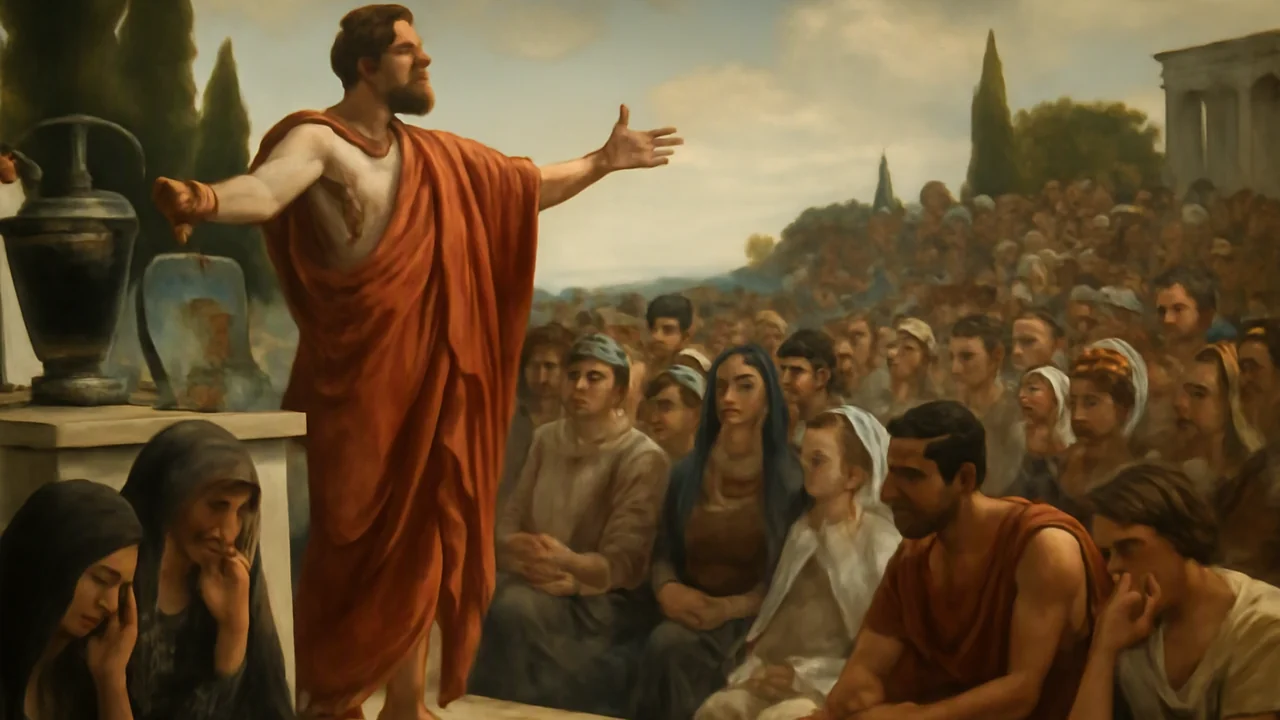
Thucydides, The History of the Peloponnesian War, Book 2, tr. Richard Crawley (1874), Project Gutenberg 7142; all retrieved 26 Sept. 2026 · SLS original; quoted passages are public domain (Thucydides, tr. Crawley, 1874)
Read all four passages, then sort your three phrases by appeal.
Edition. Crawley’s 1874 translation, Book 2, the Funeral Oration of Pericles. The oration is long, so this page hosts the passages the lesson’s tasks turn on, in order, and leaves out the rest. It leaves out the middle, on the character of Athenian life and the dead men’s conduct, and the closing addresses to the parents, sons and widows of the dead; read the whole speech at the Project Gutenberg link. The occasion, the framing and the model are SLS original.
The rhetorical situation
 Speaker: Pericles, a leading Athenian statesman. Audience: an assembly of Athenian citizens and foreigners, many of them grieving relatives. Occasion: the public funeral for the first Athenians to die in the Peloponnesian War, at the end of the first year of fighting, about 431 BCE. Purpose: the speech is a eulogy, but as you will see it spends most of its length describing Athens. Ask what he wants his listeners to feel and do by the end.
Passage 1. The opening move
“I shall begin with our ancestors: it is both just and proper that they should have the honour of the first mention on an occasion like the present. They dwelt in the country without break in the succession from generation to generation, and handed it down free to the present time by their valour. And if our more remote ancestors deserve praise, much more do our own fathers, who added to their inheritance the empire which we now possess, and spared no pains to be able to leave their acquisitions to us of the present generation. Lastly, there are few parts of our dominions that have not been augmented by those of us here, who are still more or less in the vigour of life; while the mother country has been furnished by us with everything that can enable her to depend on her own resources whether for war or for peace. That part of our history which tells of the military achievements which gave us our several possessions, or of the ready valour with which either we or our fathers stemmed the tide of Hellenic or foreign aggression, is a theme too familiar to my hearers for me to dilate on, and I shall therefore pass it by. But what was the road by which we reached our position, what the form of government under which our greatness grew, what the national habits out of which it sprang; these are questions which I may try to solve before I proceed to my panegyric upon these men; since I think this to be a subject upon which on the present occasion a speaker may properly dwell, and to which the whole assemblage, whether citizens or foreigners, may listen with advantage.
Passage 2. The portrait of the city
“Our constitution does not copy the laws of neighbouring states; we are rather a pattern to others than imitators ourselves. Its administration favours the many instead of the few; this is why it is called a democracy. If we look to the laws, they afford equal justice to all in their private differences; if no social standing, advancement in public life falls to reputation for capacity, class considerations not being allowed to interfere with merit; nor again does poverty bar the way, if a man is able to serve the state, he is not hindered by the obscurity of his condition. The freedom which we enjoy in our government extends also to our ordinary life. There, far from exercising a jealous surveillance over each other, we do not feel called upon to be angry with our neighbour for doing what he likes, or even to indulge in those injurious looks which cannot fail to be offensive, although they inflict no positive penalty. But all this ease in our private relations does not make us lawless as citizens. Against this fear is our chief safeguard, teaching us to obey the magistrates and the laws, particularly such as regard the protection of the injured, whether they are actually on the statute book, or belong to that code which, although unwritten, yet cannot be broken without acknowledged disgrace.
Passage 3. The claim, and the turn to the dead
“In short, I say that as a city we are the school of Hellas, while I doubt if the world can produce a man who, where he has only himself to depend upon, is equal to so many emergencies, and graced by so happy a versatility, as the Athenian. And that this is no mere boast thrown out for the occasion, but plain matter of fact, the power of the state acquired by these habits proves. For Athens alone of her contemporaries is found when tested to be greater than her reputation, and alone gives no occasion to her assailants to blush at the antagonist by whom they have been worsted, or to her subjects to question her title by merit to rule. Rather, the admiration of the present and succeeding ages will be ours, since we have not left our power without witness, but have shown it by mighty proofs; and far from needing a Homer for our panegyrist, or other of his craft whose verses might charm for the moment only for the impression which they gave to melt at the touch of fact, we have forced every sea and land to be the highway of our daring, and everywhere, whether for evil or for good, have left imperishable monuments behind us. Such is the Athens for which these men, in the assertion of their resolve not to lose her, nobly fought and died; and well may every one of their survivors be ready to suffer in her cause.
Passage 4. What the listeners are asked to do
“So died these men as became Athenians. You, their survivors, must determine to have as unfaltering a resolution in the field, though you may pray that it may have a happier issue. And not contented with ideas derived only from words of the advantages which are bound up with the defence of your country, though these would furnish a valuable text to a speaker even before an audience so alive to them as the present, you must yourselves realize the power of Athens, and feed your eyes upon her from day to day, till love of her fills your hearts; and then, when all her greatness shall break upon you, you must reflect that it was by courage, sense of duty, and a keen feeling of honour in action that men were enabled to win all this, and that no personal failure in an enterprise could make them consent to deprive their country of their valour, but they laid it at her feet as the most glorious contribution that they could offer. For this offering of their lives made in common by them all they each of them individually received that renown which never grows old, and for a sepulchre, not so much that in which their bones have been deposited, but that noblest of shrines wherein their glory is laid up to be eternally remembered upon every occasion on which deed or story shall call for its commemoration. For heroes have the whole earth for their tomb; and in lands far from their own, where the column with its epitaph declares it, there is enshrined in every breast a record unwritten with no tablet to preserve it, except that of the heart. These take as your model and, judging happiness to be the fruit of freedom and freedom of valour, never decline the dangers of war.
Three appeals, defined
Ethos is the appeal from character: the audience accepts a claim because of who they take the speaker to be. It is built inside the speech, by sharing values, by conceding, by displaying knowledge. Pathos is the appeal to emotion; it makes the audience care enough to weigh an argument. Logos is the appeal from reasoning: evidence, causes, definitions, comparisons.
Worked model: sorting three phrases (SLS original)
| Phrase | Appeal | What it asks the audience to do |
|---|---|---|
| “I shall begin with our ancestors” | Ethos | To accept that the speaker stands inside the shared inheritance (“our”) before he asks anything of them. |
| “Its administration favours the many instead of the few; this is why it is called a democracy.” | Logos | To follow a reason: the name of the constitution follows from how it works. |
| “feed your eyes upon her from day to day, till love of her fills your hearts” | Pathos | To turn grief into devotion to the city. |
Why does Pericles wait for the pathos? Passages 1 to 3 build a case: the constitution is fair, the citizens are free and yet brave, the city is “the school of Hellas.” Only then does Passage 3 say “Such is the Athens for which these men … nobly fought and died.” Because the description has come first, the death arrives as the proof of the case. If the grief had come first, the listeners would have been asked to feel before they had reasons; and the portrait of the city would have sounded like consolation, not argument. Putting the pathos last means it does not replace the reasoning; it rewards it.
For the check items. “I shall begin with our ancestors” is mainly ethos: it makes the audience concede that “our” includes the speaker. It is not logos, because it gives no reason; and it is not pathos, because it asks for no grief.
Formative check
Work through these before moving on. They are not graded — they tell you, and your teacher, whether the standard below has landed yet.
Pericles opens “I shall begin with our ancestors.” Which appeal is this primarily making, and how?
An appeal to emotion is by definition a manipulation, so a rigorous speech should rely on logos alone.
The appeal from the speaker’s constructed credibility is ; the appeal from evidence and reasoning is ; the appeal to the audience’s values and feeling is .
Quote three phrases from the Oration, one for each appeal. For each, name the appeal and — in one sentence — state what it asks the audience to do. Then answer: why does Pericles delay the pathos until the final movement of the speech?
How confident are you that you can name a speech’s rhetorical situation and point to the exact phrase where the speaker builds ethos?
Printable: Unit 3 Student Workbook
Every organizer for this unit in one booklet — the reading schedule, the vocabulary pages, every lesson organizer (each lesson names its page), the peer review sheet and the scoring rubric. Print it before the unit starts and bring the page to each lesson.