trace how Chapter 4’s murder reorganizes the novella’s structure, turning Chapters 1-3’s atmosphere of private unease into a public manhunt.
Workbook: page 8 of your Unit 2 Student Workbook. Draft on paper first; anything scored is submitted online in this lesson.
Instruction
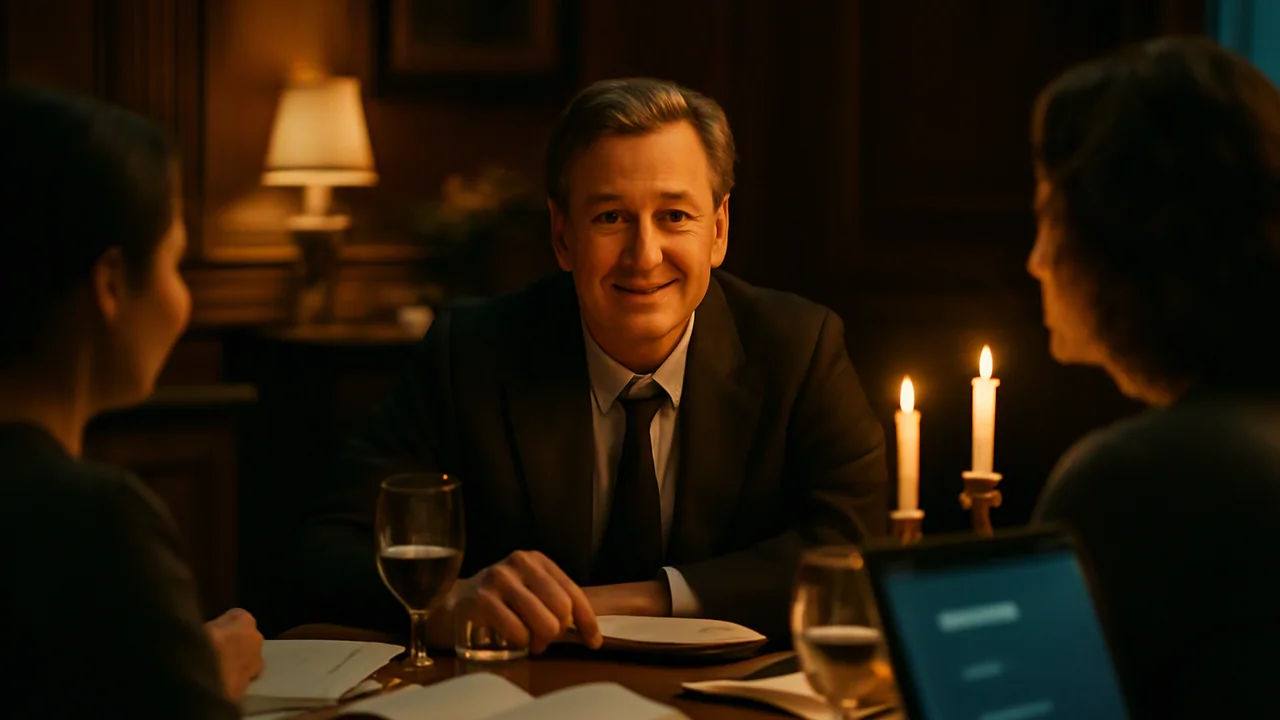
Chapter 3 ends on a note of reassurance: at a dinner with old friends, Jekyll seems himself again, “looking fully ten years younger,” and when Utterson presses him about Hyde and the will, Jekyll promises he can be rid of Hyde “the moment I choose.” It is the calmest the novella ever lets him sound, and Stevenson gives it to us deliberately, right before taking it away.
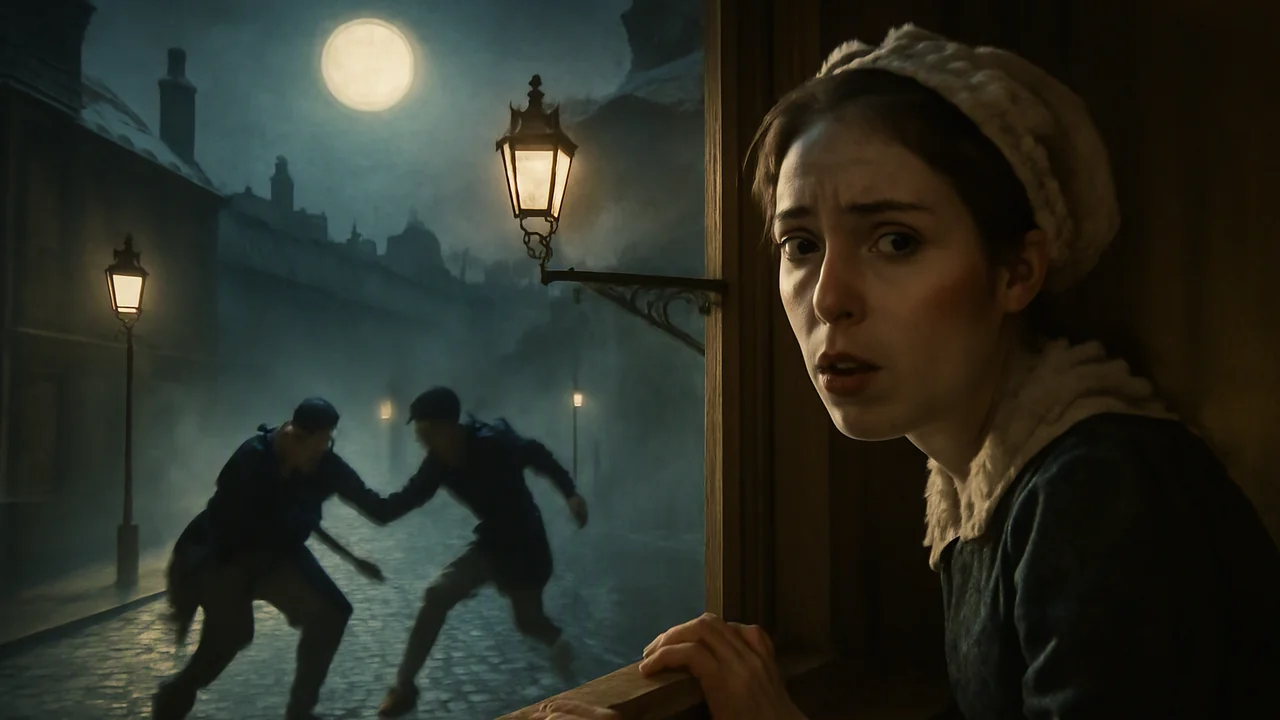
Chapter 4 breaks that calm completely, and does it in public. A maid, watching from her window by moonlight, sees Hyde beat Sir Danvers Carew, a respected and elderly gentleman, to death in the open street, for no provocation she can name — Carew had done nothing more than ask Hyde a question. This is the novella’s structural hinge: everything before it is private suspicion — a will, a locked door, a dinner-table reassurance — and everything after it is a public investigation, with police, a named witness, and physical evidence: half of a broken cane found at the scene, its other half still in Jekyll’s possession, engraved with Utterson’s own name.
Notice the change in pace, not just in content. Chapters 1 through 3 move slowly and indirectly — a lawyer’s private worry, a declined conversation, a dinner that resolves nothing. Chapter 4 is fast, specific and externally confirmed: a date, a time, a witness, a weapon. Stevenson is not only escalating the stakes; he is changing the kind of evidence the reader is given, from Utterson’s private impressions to a maid’s sworn account and a found object. That shift from interior unease to exterior, verifiable fact is itself part of the novella’s argument about what is knowable and what is not.
Notice, too, what Stevenson withholds even here, in the chapter that finally shows Hyde acting. The murder is witnessed in vivid, physical detail — the maid describes it almost as if she is watching a play unfold beneath her window — and yet nothing at all is given about its cause. Carew is a stranger to Hyde. There is no argument, no history between them, no motive offered by the narration or by any character afterward. The reader is handed the fact of Hyde’s violence in full and denied any explanation for it, which is exactly the gap the rest of the novella, and this unit’s seminar, exists to argue about: whether that violence was always latent in Jekyll, or whether it was manufactured by everything Jekyll had to suppress to remain respectable.
📖 Before this lesson, read: The Strange Case of Dr. Jekyll and Mr. Hyde, Chapters 3-4
 The reading opens over the lesson; close it to come back to exactly where you were.
Formative check
Work through these before moving on. They are not graded — they tell you, and your teacher, whether the standard below has landed yet.
What makes Chapter 4 a structural turning point rather than simply another unsettling incident?
The maid who witnesses the murder also explains why Hyde attacked Carew.
The physical evidence linking Hyde to the murder is a broken , half of which is found at the scene.
Chapter 3 ends with Jekyll’s reassurance; Chapter 4 opens the murder investigation. In two to three sentences, explain how the ordering of these two chapters affects a first-time reader’s experience of the murder.
The Strange Case of Dr. Jekyll and Mr. Hyde, Chapters 3-4
Dr. Jekyll and Mr. Hyde, Chapter 4: The Carew Murder Case
Source: Robert Louis Stevenson, The Strange Case of Dr. Jekyll and Mr. Hyde (1886), Standard Ebooks (https://standardebooks.org/ebooks/robert-louis-stevenson/the-strange-case-of-dr-jekyll-and-mr-hyde/text/single-page); all retrieved 26 Sept. 2026 (gutenberg.org) · Public domain
Nearly a year later, in the month of October, 18—, London was startled by a crime of singular ferocity and rendered all the more notable by the high position of the victim. The details were few and startling. A maid servant living alone in a house not far from the river, had gone upstairs to bed about eleven. Although a fog rolled over the city in the small hours, the early part of the night was cloudless, and the lane, which the maid’s window overlooked, was brilliantly lit by the full moon. It seems she was romantically given, for she sat down upon her box, which stood immediately under the window, and fell into a dream of musing. Never (she used to say, with streaming tears, when she narrated that experience), never had she felt more at peace with all men or thought more kindly of the world. And as she so sat she became aware of an aged beautiful gentleman with white hair, drawing near along the lane; and advancing to meet him, another and very small gentleman, to whom at first she paid less attention. When they had come within speech (which was just under the maid’s eyes) the older man bowed and accosted the other with a very pretty manner of politeness. It did not seem as if the subject of his address were of great importance; indeed, from his pointing, it sometimes appeared as if he were only inquiring his way; but the moon shone on his face as he spoke, and the girl was pleased to watch it, it seemed to breathe such an innocent and old-world kindness of disposition, yet with something high too, as of a well-founded self-content. Presently her eye wandered to the other, and she was surprised to recognise in him a certain Mr. Hyde, who had once visited her master and for whom she had conceived a dislike. He had in his hand a heavy cane, with which he was trifling; but he answered never a word, and seemed to listen with an ill-contained impatience. And then all of a sudden he broke out in a great flame of anger, stamping with his foot, brandishing the cane, and carrying on (as the maid described it) like a madman. The old gentleman took a step back, with the air of one very much surprised and a trifle hurt; and at that Mr. Hyde broke out of all bounds and clubbed him to the earth. And next moment, with ape-like fury, he was trampling his victim under foot and hailing down a storm of blows, under which the bones were audibly shattered and the body jumped upon the roadway. At the horror of these sights and sounds, the maid fainted.
It was two o’clock when she came to herself and called for the police. The murderer was gone long ago; but there lay his victim in the middle of the lane, incredibly mangled. The stick with which the deed had been done, although it was of some rare and very tough and heavy wood, had broken in the middle under the stress of this insensate cruelty; and one splintered half had rolled in the neighbouring gutter—the other, without doubt, had been carried away by the murderer. A purse and gold watch were found upon the victim: but no cards or papers, except a sealed and stamped envelope, which he had been probably carrying to the post, and which bore the name and address of Mr. Utterson.
This was brought to the lawyer the next morning, before he was out of bed; and he had no sooner seen it and been told the circumstances, than he shot out a solemn lip. “I shall say nothing till I have seen the body,” said he; “this may be very serious. Have the kindness to wait while I dress.” And with the same grave countenance he hurried through his breakfast and drove to the police station, whither the body had been carried. As soon as he came into the cell, he nodded.
“Yes,” said he, “I recognise him. I am sorry to say that this is Sir Danvers Carew.”
“Good God, sir,” exclaimed the officer, “is it possible?” And the next moment his eye lighted up with professional ambition. “This will make a deal of noise,” he said. “And perhaps you can help us to the man.” And he briefly narrated what the maid had seen, and showed the broken stick.
Mr. Utterson had already quailed at the name of Hyde; but when the stick was laid before him, he could doubt no longer; broken and battered as it was, he recognised it for one that he had himself presented many years before to Henry Jekyll.
“Is this Mr. Hyde a person of small stature?” he inquired.
“Particularly small and particularly wicked-looking, is what the maid calls him,” said the officer.
Mr. Utterson reflected; and then, raising his head, “If you will come with me in my cab,” he said, “I think I can take you to his house.”
It was by this time about nine in the morning, and the first fog of the season. A great chocolate-coloured pall lowered over heaven, but the wind was continually charging and routing these embattled vapours; so that as the cab crawled from street to street, Mr. Utterson beheld a marvelous number of degrees and hues of twilight; for here it would be dark like the back-end of evening; and there would be a glow of a rich, lurid brown, like the light of some strange conflagration; and here, for a moment, the fog would be quite broken up, and a haggard shaft of daylight would glance in between the swirling wreaths. The dismal quarter of Soho seen under these changing glimpses, with its muddy ways, and slatternly passengers, and its lamps, which had never been extinguished or had been kindled afresh to combat this mournful reinvasion of darkness, seemed, in the lawyer’s eyes, like a district of some city in a nightmare. The thoughts of his mind, besides, were of the gloomiest dye; and when he glanced at the companion of his drive, he was conscious of some touch of that terror of the law and the law’s officers, which may at times assail the most honest.
As the cab drew up before the address indicated, the fog lifted a little and showed him a dingy street, a gin palace, a low French eating house, a shop for the retail of penny numbers and twopenny salads, many ragged children huddled in the doorways, and many women of many different nationalities passing out, key in hand, to have a morning glass; and the next moment the fog settled down again upon that part, as brown as umber, and cut him off from his blackguardly surroundings. This was the home of Henry Jekyll’s favourite; of a man who was heir to a quarter of a million sterling.
An ivory-faced and silvery-haired old woman opened the door. She had an evil face, smoothed by hypocrisy: but her manners were excellent. Yes, she said, this was Mr. Hyde’s, but he was not at home; he had been in that night very late, but he had gone away again in less than an hour; there was nothing strange in that; his habits were very irregular, and he was often absent; for instance, it was nearly two months since she had seen him till yesterday.
“Very well, then, we wish to see his rooms,” said the lawyer; and when the woman began to declare it was impossible, “I had better tell you who this person is,” he added. “This is Inspector Newcomen of Scotland Yard.”
A flash of odious joy appeared upon the woman’s face. “Ah!” said she, “he is in trouble! What has he done?”
Mr. Utterson and the inspector exchanged glances. “He don’t seem a very popular character,” observed the latter. “And now, my good woman, just let me and this gentleman have a look about us.”
In the whole extent of the house, which but for the old woman remained otherwise empty, Mr. Hyde had only used a couple of rooms; but these were furnished with luxury and good taste. A closet was filled with wine; the plate was of silver, the napery elegant; a good picture hung upon the walls, a gift (as Utterson supposed) from Henry Jekyll, who was much of a connoisseur; and the carpets were of many piles and agreeable in colour. At this moment, however, the rooms bore every mark of having been recently and hurriedly ransacked; clothes lay about the floor, with their pockets inside out; lock-fast drawers stood open; and on the hearth there lay a pile of grey ashes, as though many papers had been burned. From these embers the inspector disinterred the butt end of a green cheque book, which had resisted the action of the fire; the other half of the stick was found behind the door; and as this clinched his suspicions, the officer declared himself delighted. A visit to the bank, where several thousand pounds were found to be lying to the murderer’s credit, completed his gratification.
“You may depend upon it, sir,” he told Mr. Utterson: “I have him in my hand. He must have lost his head, or he never would have left the stick or, above all, burned the cheque book. Why, money’s life to the man. We have nothing to do but wait for him at the bank, and get out the handbills.”
This last, however, was not so easy of accomplishment; for Mr. Hyde had numbered few familiars—even the master of the servant maid had only seen him twice; his family could nowhere be traced; he had never been photographed; and the few who could describe him differed widely, as common observers will. Only on one point were they agreed; and that was the haunting sense of unexpressed deformity with which the fugitive impressed his beholders.
Dr. Jekyll and Mr. Hyde, Chapter 3: Dr. Jekyll Was Quite at Ease Bridge summary — not the primary text
This is a short recap written for this course, not Homer’s or Stevenson’s own words, so you can follow the story between close-reading lessons.
Jekyll hosts a dinner for old friends and seems himself again; when Utterson raises the subject of his will and of Hyde, Jekyll grows pale, asks him to drop the subject, and assures him that he can be rid of Hyde the moment he chooses — a promise Utterson leaves unconvinced by.