state and defend a position on the source of Hyde using evidence from both Stevenson and Emerson, summarize where I agree and disagree with a classmate, and qualify my own view when the text warrants it.
Workbook: page 9 of your Unit 2 Student Workbook. Draft on paper first; anything scored is submitted online in this lesson.
Instruction
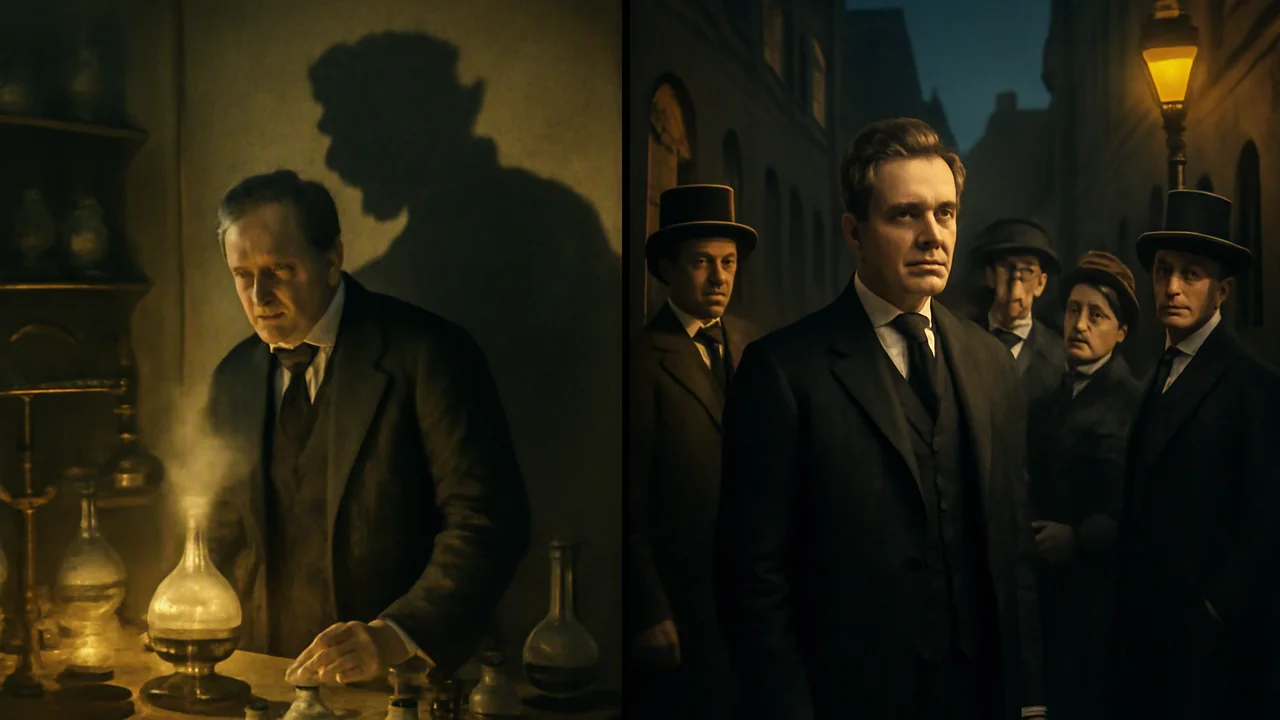
Chapter 4, the Carew murder, is the novella’s structural turning point: everything before it is suspicion and unease, and everything after it is a manhunt. It is also the moment the question this seminar asks becomes unavoidable, because an act of unprovoked, gratuitous violence demands an explanation, and the novella offers two incompatible ones.
The novella asks a question it refuses to answer, and the question is not “who is Hyde.” It is: where does Hyde come from?
Two readings are available, and both are supportable from the text.
The biological reading. Jekyll’s own statement says that “man is not truly one, but truly two,” and describes the draft as separating components that were always there. On this reading Hyde is not created; he is released. The evil is constitutional, present in every person, and Jekyll’s only distinction is that he found the chemistry. This is the reading the confession invites — and Lesson 2.2 gave you a reason to hold it loosely, because the confession is the account of a man with an obvious interest in describing his worst acts as something that happened to him.
The repression reading. Jekyll also tells us why he built the laboratory in the first place: he “concealed his pleasures” because of “a certain impatient gaiety of disposition” that his standing would not permit, and he came “to stand already committed to a profound duplicity of life” — before any chemistry. On this reading, Hyde is not human nature. Hyde is what a specific society does to a man who must appear seamless. The evil is manufactured by the demand for respectability, and it is significant that Hyde’s earliest crimes are witnessed by neighbors who accept a check and say nothing.
Where Emerson comes in. Self-Reliance (1841) argues the opposite side of the same problem from forty years earlier and an ocean away. Emerson’s target is conformity: “Society everywhere is in conspiracy against the manhood of every one of its members.” He argues that a person who governs himself by external approval becomes incoherent — that consistency enforced from outside produces not virtue but a performance. Notice how Emerson builds that case: he states the conspiracy, then names the mechanism (“the virtue in most request is conformity”), then moves to the consequence for the individual. Tracking the order of his points is the informational-reading skill this lesson assesses; an argument’s sequence is part of its claim.
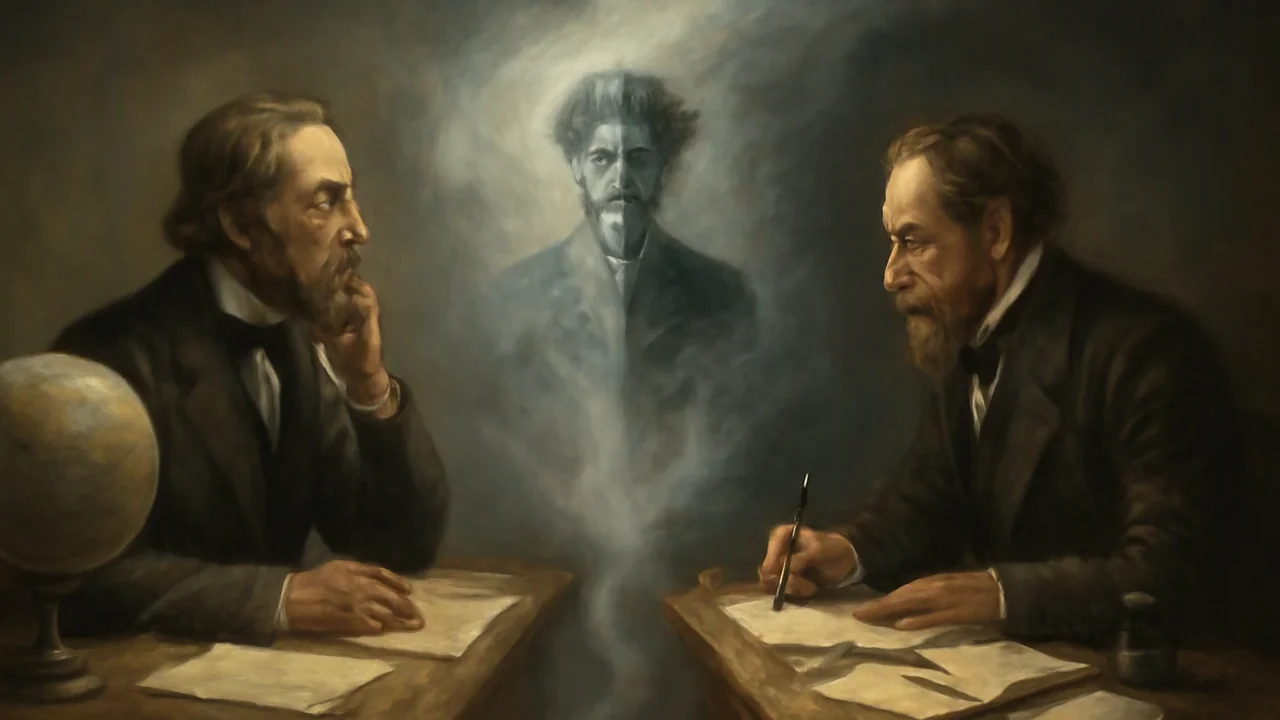
Emerson does not resolve Stevenson. He sharpens the question. If Emerson is right that conformity hollows a person out, then Jekyll’s chemistry is not the cause of anything — it is a symptom, and Hyde is what the hollow fills with.
How this seminar runs. Record a ninety-second position. Then reply to two classmates. In this unit a reply has a required shape, because SL.9-10.1.d asks for more than disagreement: summarize where you agree, state precisely where you diverge, and then either qualify your own view or justify holding it. A reply that skips the summary does not earn credit, even if the disagreement is sharp. A typed transcript is an equal-credit alternative to the recording.
📖 Before this lesson, read: The Strange Case of Dr. Jekyll and Mr. Hyde, Chapters 1-4
 The reading opens over the lesson; close it to come back to exactly where you were.
Reading: Seminar readings: the source of Hyde, from Stevenson (1886) and Emerson (1841)
Robert Louis Stevenson, The Strange Case of Dr. Jekyll and Mr. Hyde (1886), Standard Ebooks (https://standardebooks.org/ebooks/robert-louis-stevenson/the-strange-case-of-dr-jekyll-and-mr-hyde/text/single-page); Ralph Waldo Emerson, Essays: First Series (1841), Project Gutenberg 2944; all retrieved 26 Sept. 2026 · SLS original; quoted passages are public domain (Stevenson, 1886; Emerson, 1841)
Read the three positions, weigh the speakers, then draft your ninety-second position.
Sources. Stevenson, The Strange Case of Dr. Jekyll and Mr. Hyde (1886), Project Gutenberg #43, https://www.gutenberg.org/ebooks/43; Emerson, “Self-Reliance,” Essays: First Series (1841), Project Gutenberg #2944, https://www.gutenberg.org/ebooks/2944; both retrieved 2026-09-26. Passages are cited by chapter (Stevenson) and by essay (Emerson). The protocol, stems and models are SLS original.
The question
Where does Hyde come from? The novella gives two answers. The first is that the evil is in everyone and Jekyll only found the chemistry to release it. The second is that it is manufactured by a society that demands respectability from a man who is not allowed to look like anything else. Both are supported by Jekyll’s own statement. Emerson, writing forty years earlier and a continent away, is the second voice.
Position 1: released, not made (Jekyll, Chapter 10)
With every day, and from both sides of my intelligence, the moral and the intellectual, I thus drew steadily nearer to that truth, by whose partial discovery I have been doomed to such a dreadful shipwreck: that man is not truly one, but truly two.
It was on the moral side, and in my own person, that I learned to recognise the thorough and primitive duality of man; I saw that, of the two natures that contended in the field of my consciousness, even if I could rightly be said to be either, it was only because I was radically both;
Position 2: made by the demand for respectability (Jekyll, Chapter 10)
And indeed the worst of my faults was a certain impatient gaiety of disposition, such as has made the happiness of many, but such as I found it hard to reconcile with my imperious desire to carry my head high, and wear a more than commonly grave countenance before the public.
Hence it came about that I concealed my pleasures; and that when I reached years of reflection, and began to look round me and take stock of my progress and position in the world, I stood already committed to a profound duplicity of life. Many a man would have even blazoned such irregularities as I was guilty of; but from the high views that I had set before me, I regarded and hid them with an almost morbid sense of shame.
It was thus rather the exacting nature of my aspirations than any particular degradation in my faults, that made me what I was, and, with even a deeper trench than in the majority of men, severed in me those provinces of good and ill which divide and compound man’s dual nature.
Evidence from the story of Hyde’s first crime (Enfield, Chapter 1)
The witnesses to the trampling of a child are a respectable circle. Read what they do after they catch him.
Well, we screwed him up to a hundred pounds for the child’s family; he would have clearly liked to stick out; but there was something about the lot of us that meant mischief, and at last he struck. The next thing was to get the money; and where do you think he carried us but to that place with the door?—whipped out a key, went in, and presently came back with the matter of ten pounds in gold and a cheque for the balance on Coutts’s, drawn payable to bearer and signed with a name that I can’t mention, though it’s one of the points of my story, but it was a name at least very well known and often printed. The figure was stiff; but the signature was good for more than that if it was only genuine. I took the liberty of pointing out to my gentleman that the whole business looked apocryphal, and that a man does not, in real life, walk into a cellar door at four in the morning and come out of it with another man’s cheque for close upon a hundred pounds. But he was quite easy and sneering. ‘Set your mind at rest,’ says he, ‘I will stay with you till the banks open and cash the cheque myself.’ So we all set off, the doctor, and the child’s father, and our friend and myself, and passed the rest of the night in my chambers; and next day, when we had breakfasted, went in a body to the bank. I gave in the cheque myself, and said I had every reason to believe it was a forgery. Not a bit of it. The cheque was genuine.”
Position 3: society demands conformity (Emerson, 1841)
Society everywhere is in conspiracy against the manhood of every one of its members. Society is a joint-stock company, in which the members agree, for the better securing of his bread to each shareholder, to surrender the liberty and culture of the eater. The virtue in most request is conformity. Self-reliance is its aversion. It loves not realities and creators, but names and customs.
Whoso would be a man, must be a nonconformist. He who would gather immortal palms must not be hindered by the name of goodness, but must explore if it be goodness. Nothing is at last sacred but the integrity of your own mind. Absolve you to yourself, and you shall have the suffrage of the world. I remember an answer which when quite young I was prompted to make to a valued adviser who was wont to importune me with the dear old doctrines of the church. On my saying, “What have I to do with the sacredness of traditions, if I live wholly from within?” my friend suggested,—“But these impulses may be from below, not from above.” I replied, “They do not seem to me to be such; but if I am the Devil’s child, I will live then from the Devil.”
Meantime nature is not slow to equip us in the prison-uniform of the party to which we adhere. We come to wear one cut of face and figure, and acquire by degrees the gentlest asinine expression. There is a mortifying experience in particular, which does not fail to wreak itself also in the general history; I mean “the foolish face of praise,” the forced smile which we put on in company where we do not feel at ease in answer to conversation which does not interest us. The muscles, not spontaneously moved but moved by a low usurping wilfulness, grow tight about the outline of the face with the most disagreeable sensation.
Weighing the speakers
Jekyll wrote Chapter 10 as a confession he will not have to defend, so it is the account of a man with an interest in how his worst acts are described. Emerson wrote to persuade, so the paragraphs above are an argument, not evidence about people. Neither fact settles the question. It does mean that each quotation should be used for what it shows about the speaker’s aim as well as for what it says.
Protocol (SLS original)
- Claim (about 90 seconds, recorded). One sentence that states your position on where Hyde comes from. One quotation from Stevenson and one from Emerson, cited (Stevenson, ch. 10) and (Emerson, “Self-Reliance”). Then the single strongest point on the other side and what you do with it.
- Reply (in writing, about 100 words, two of them). Sentence one: summarize where you and your classmate agree. Sentence two: name exactly where you diverge. Then qualify or justify your own view.
Question stems
- Which of Jekyll’s sentences is a claim, and which is a report of something he did?
- How would Emerson read the line you quoted?
- What in the text would have to be different for the opposite position to be right?
- Does your evidence come from a narrator who wanted something? What?
Model claim and model reply (SLS original; not a real student’s work)
Model claim. “I think Hyde is made by repression. In Chapter 10 Jekyll tells us that he was already ‘committed to a profound duplicity of life’ before the first draft, because he ‘concealed’ his pleasures to keep up a grave face. Emerson explains why he would: ‘The virtue in most request is conformity.’ The strongest point against me is Jekyll’s own sentence that ‘man is not truly one, but truly two.’ I keep it, but I read it as a description of the material, not the cause. A few sentences before it, in the same paragraph, he says it was ‘the exacting nature of my aspirations’ that ‘made me what I was.’ So the evil was in a man, but the splitting was done by the demand that he look seamless. My question: if that is right, why does Hyde only appear after the drug?
Model reply. “We agree that Chapter 10 is the key evidence and that Jekyll is not a neutral narrator. We diverge on the weight of ‘man is not truly one, but truly two.’ You treat it as the finding; I treat it as the shape of the problem. I would qualify my own view on one point: Enfield’s story in Chapter 1 supports you, because the child’s family and the doctor take the money and go home. That is the circle Emerson describes, but it can also be read as ordinary human fear of scandal, which would make the pressure biological after all.”
Formative check
Work through these before moving on. They are not graded — they tell you, and your teacher, whether the standard below has landed yet.
Emerson claims society is “in conspiracy against the manhood of every one of its members” before he names conformity as “the virtue in most request.” Why does that order matter to his argument?
Jekyll’s confession settles the question of where Hyde comes from, because Jekyll is the only character with direct knowledge.
Having read Chapters 3-4, including the Carew murder, draft your ninety-second position. State your claim in one sentence; quote one line from Stevenson and one from Emerson; then name the single strongest point on the other side and say what you do with it. Paste the draft here before recording.
How confident are you that you can reply to a classmate by summarizing our agreement first, then naming exactly where we diverge, and then qualifying or justifying my own view?
The Strange Case of Dr. Jekyll and Mr. Hyde, Chapters 1-4
The Strange Case of Dr. Jekyll and Mr. Hyde, Chapters 1-4 so far Bridge summary — not the primary text
A recap of what you have already read, written for this course, so the reading check below does not require re-opening every earlier popover.
Mr. Hyde is introduced through Enfield’s account of him trampling a child and, with chilling calm, paying off the family (Chapter 1); Utterson, disturbed, reviews Jekyll’s will, which leaves everything to Hyde, and fails to get Jekyll to discuss him (Chapter 2); Jekyll assures Utterson at a dinner that he can rid himself of Hyde whenever he chooses (Chapter 3); and Hyde beats the respectable Sir Danvers Carew to death in the street, watched by a maid, leaving behind a broken cane that Utterson recognizes (Chapter 4).