compare accounts of the same subject in two mediums, determine which details each emphasizes and which it must omit, and evaluate the credibility of each account for a specific purpose.
Workbook: page 9 of your Unit 4 Student Workbook. Draft on paper first; anything scored is submitted online in this lesson.
Instruction
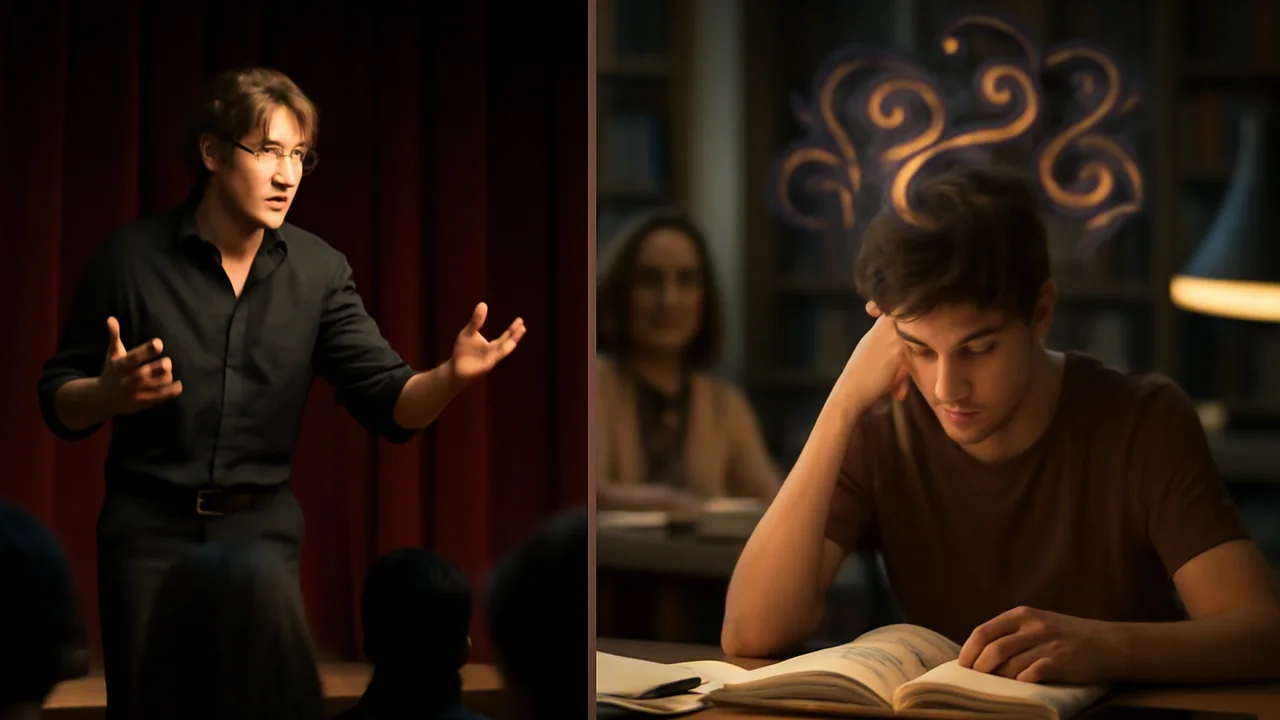
Every medium is a set of constraints, and constraints decide what gets emphasized. That is the whole of RI.9-10.7, and it is a more useful idea than “the film was not as good as the book.”
What each medium must do.
- Print narrative can report interior states directly. It can also withhold them — Stevenson’s eight chapters of Utterson withhold Jekyll’s interior entirely, and the withholding is the design.
- Audio performance must supply a voice. A reader of the Cyclops episode has to decide, out loud, whether Odysseus’s shout is triumph, rage or panic. The text does not say. The performance cannot avoid saying.
- Film must supply a face, a body and a place, continuously, for every second the character is present. It cannot leave Hyde’s appearance unspecified — and Stevenson’s most famous effect is that no witness in the novella can say what is wrong with Hyde’s face.
- Stage works in continuous real time with an audience present, which makes the interior monologue a convention the audience accepts and the film mostly cannot.
The analytical move. Do not ask which version is better. Ask three questions in order: what does this medium emphasize; what did it have to add that the source left open; what did it have to drop? The second question is the one students skip, and it is usually where the interesting answer is, because an addition is always an interpretation. When a 1931 film gives Hyde a specific simian make-up, it has not merely illustrated the book — it has answered a question the book deliberately refused, and it has answered it with the racial pseudo-science of its own moment. That is worth saying precisely, and it is a claim you can evidence.
Credibility across media, which is the SL.9-10.2 half. An adaptation is evidence of how a work was received at the time the adaptation was made, not evidence of what the work says. A documentary narrator’s confident voice-over is a rhetorical instrument as much as a printed claim is. When you integrate a media source into your paper, say what it is evidence of.
This lesson’s work. Choose one scene — the Cyclops escape, or the first transformation. Find two treatments of it in different mediums from the open-access material linked in the course archive: a print text, a public-domain audio recording, a public-domain film or a stage adaptation’s script. Build the three-column chart. Then record a ninety-second finding: name the scene, name the two mediums, and state the single most consequential difference and what it changed about the meaning. Reply to two classmates using the Unit 2 structure — summarize the agreement, name the divergence, qualify or justify. A typed transcript earns equal credit for the recording.
Reading: Media Lab material: the Cyclops and Hyde scenes, two translations, two positions, and a worked chart
Homer, The Odyssey, tr. Samuel Butler (1900), Project Gutenberg 1727 (includes Butcher and Lang, 1879, in Butler’s preface); R. L. Stevenson, The Strange Case of Dr. Jekyll and Mr. Hyde (1886), Standard Ebooks, https://standardebooks.org/ebooks/robert-louis-stevenson/the-strange-case-of-dr-jekyll-and-mr-hyde/text/single-page ; R. L. Stevenson, A Chapter on Dreams, in Across the Plains (1892), Project Gutenberg 614; all retrieved 26 Sept. 2026 · SLS original; quoted passages are public domain (Homer, tr. Butler, 1900; Butcher and Lang, 1879; Stevenson, 1886 and 1892)
Read the passages before the chart. The chart shows the method; the finding you record must be about your own pair of treatments.
What is hosted. The seminar compares treatments of one subject across mediums, and its task tells you to find treatments in the course archive. What was missing here was the material to argue from: the two scenes the lesson names, in print; a pair of translations of the same lines; two attributed positions on what a medium changes; a seminar protocol with a bank of question stems; and a worked chart and model finding. Editions: Homer, The Odyssey, tr. Samuel Butler (1900), Project Gutenberg 1727, https://www.gutenberg.org/ebooks/1727 (which also prints the Butcher and Lang translation of the opening lines, 1879, in Butler’s first preface); Stevenson, The Strange Case of Dr. Jekyll and Mr. Hyde (1886), Standard Ebooks, https://standardebooks.org/ebooks/robert-louis-stevenson/the-strange-case-of-dr-jekyll-and-mr-hyde/text/single-page; Stevenson, “A Chapter on Dreams,” in Across the Plains (1892), Project Gutenberg 614, https://www.gutenberg.org/ebooks/614. All retrieved 26 Sept. 2026. Wording is the editions’. Everything else is SLS original. Recordings, films and stage productions from the archive are not hosted here, because most are not in the public domain; the chart method below works on any of them.
1. Scene one: the Cyclops episode (Butler, Book 9)
The lesson says the text does not tell you whether Odysseus’s shout is triumph, rage or panic. Read the two passages and decide what the print actually says. The narrator, Ulysses himself, supplies one phrase of his own about his state, in my rage, and everything else is in what he says.
Book 9: the name Noman
Cyclops, you ask my name and I will tell it you; give me, therefore, the present you promised me; my name is Noman; this is what my father and mother and my friends have always called me.’
“But the cruel wretch said, ‘Then I will eat all Noman’s comrades before Noman himself, and will keep Noman for the last. This is the present that I will make him.
Book 9: the shout from the ship, and the Cyclops’s answer
But I would not listen to them, and shouted out to him in my rage, ‘Cyclops, if any one asks you who it was that put your eye out and spoiled your beauty, say it was the valiant warrior Ulysses, son of Laertes, who lives in Ithaca.’
“On this he groaned, and cried out, ‘Alas, alas, then the old prophecy about me is coming true. There was a prophet here, at one time, a man both brave and of great stature, Telemus son of Eurymus, who was an excellent seer, and did all the prophesying for the Cyclopes till he grew old; he told me that all this would happen to me some day, and said I should lose my sight by the hand of Ulysses. I have been all along expecting some one of imposing presence and superhuman strength, whereas he turns out to be a little insignificant weakling, who has managed to blind my eye by taking advantage of me in my drink; come here, then, Ulysses, that I may make you presents to show my hospitality, and urge Neptune to help you forward on your journey—for Neptune and I are father and son. He, if he so will, shall heal me, which no one else neither god nor man can do.’
“Then I said, ‘I wish I could be as sure of killing you outright and sending you down to the house of Hades, as I am that it will take more than Neptune to cure that eye of yours.
2. Scene two: Hyde’s appearance and the first transformation (Stevenson)
In the first passage a witness, Enfield, is asked to describe Hyde. In the second, Jekyll, writing his own statement, describes what he saw in the mirror. The lesson says no witness can name what is wrong with Hyde’s face. Compare what each passage can and cannot say.
Chapter 1, Story of the Door: Enfield
He is not easy to describe. There is something wrong with his appearance; something displeasing, something down-right detestable. I never saw a man I so disliked, and yet I scarce know why. He must be deformed somewhere; he gives a strong feeling of deformity, although I couldn’t specify the point. He’s an extraordinary looking man, and yet I really can name nothing out of the way. No, sir; I can make no hand of it; I can’t describe him. And it’s not want of memory; for I declare I can see him this moment.
Chapter 10, Henry Jekyll’s Full Statement of the Case: the first transformation
The most racking pangs succeeded: a grinding in the bones, deadly nausea, and a horror of the spirit that cannot be exceeded at the hour of birth or death. Then these agonies began swiftly to subside, and I came to myself as if out of a great sickness. There was something strange in my sensations, something indescribably new and, from its very novelty, incredibly sweet. I felt younger, lighter, happier in body; within I was conscious of a heady recklessness, a current of disordered sensual images running like a millrace in my fancy, a solution of the bonds of obligation, an unknown but not an innocent freedom of the soul. I knew myself, at the first breath of this new life, to be more wicked, tenfold more wicked, sold a slave to my original evil; and the thought, in that moment, braced and delighted me like wine. I stretched out my hands, exulting in the freshness of these sensations; and in the act, I was suddenly aware that I had lost in stature.
There was no mirror, at that date, in my room; that which stands beside me as I write, was brought there later on and for the very purpose of these transformations. The night however, was far gone into the morning—the morning, black as it was, was nearly ripe for the conception of the day—the inmates of my house were locked in the most rigorous hours of slumber; and I determined, flushed as I was with hope and triumph, to venture in my new shape as far as to my bedroom. I crossed the yard, wherein the constellations looked down upon me, I could have thought, with wonder, the first creature of that sort that their unsleeping vigilance had yet disclosed to them; I stole through the corridors, a stranger in my own house; and coming to my room, I saw for the first time the appearance of Edward Hyde.
I must here speak by theory alone, saying not that which I know, but that which I suppose to be most probable. The evil side of my nature, to which I had now transferred the stamping efficacy, was less robust and less developed than the good which I had just deposed. Again, in the course of my life, which had been, after all, nine tenths a life of effort, virtue and control, it had been much less exercised and much less exhausted. And hence, as I think, it came about that Edward Hyde was so much smaller, slighter and younger than Henry Jekyll. Even as good shone upon the countenance of the one, evil was written broadly and plainly on the face of the other.
3. Stevenson on where the scene came from
Stevenson says the scene at the window and the transformation in front of the pursuers came to him as a dream. That makes the scene, in his account, an image before it was a sentence.
Stevenson, A Chapter on Dreams
on the second night I dreamed the scene at the window, and a scene afterward split in two, in which Hyde, pursued for some crime, took the powder and underwent the change in the presence of his pursuers.
4. The same lines in two translations
Butler prints the Butcher and Lang version of the opening of the Odyssey in his own preface so that readers can see how far he departs from it. Here are both, followed by Butler’s explanation. Two translators are treating one text in one medium, print, and still differ; that is the bare version of the lesson’s question.
Butler (1900), Book 1, the opening
Tell me, O Muse, of that ingenious hero who travelled far and wide after he had sacked the famous town of Troy. Many cities did he visit, and many were the nations with whose manners and customs he was acquainted; moreover he suffered much by sea while trying to save his own life and bring his men safely home; but do what he might he could not save his men, for they perished through their own sheer folly in eating the cattle of the Sun-god Hyperion; so the god prevented them from ever reaching home. Tell me, too, about all these things, oh daughter of Jove, from whatsoever source you may know them.
Butcher and Lang (1879), as printed in Butler’s preface
Tell me, Muse, of that man, so ready at need, who wandered far and wide, after he had sacked the sacred citadel of Troy, and many were the men whose towns he saw and whose mind he learnt, yea, and many the woes he suffered in his heart on the deep, striving to win his own life and the return of his company. Nay, but even so he saved not his company, though he desired it sore. For through the blindness of their own hearts they perished, fools, who devoured the oxen of Helios Hyperion: but the god took from them their day of returning. Of these things, goddess, daughter of Zeus, whencesoever thou hast heard thereof, declare thou even unto us.
5. Two positions on what a medium changes (attributed)
Samuel Butler, preface to the Odyssey (1900), on prose
the initial liberty of translating poetry into prose involves the continual taking of more or less liberty throughout the translation; for much that is right in poetry is wrong in prose, and the exigencies of readable prose are the first things to be considered in a prose translation.
R. L. Stevenson, A Chapter on Dreams (1892), on the mind as a theatre
THE past is all of one texture—whether feigned or suffered—whether acted out in three dimensions, or only witnessed in that small theatre of the brain which we keep brightly lighted all night long, after the jets are down, and darkness and sleep reign undisturbed in the remainder of the body.
Butler argues that moving from poetry to prose forces a translator to take liberties, and that prose has its own demands. Stevenson describes the mind at night as a small theater in which experience is staged for one viewer, and says that you cannot tell which parts of the past are true and which dreamed. Neither is writing about film. Both are claims about what the form of a text does to its material, which is what the lesson calls a medium. Use them as questions to put to your own pair of treatments: is the difference a liberty forced by the form (Butler), or a staging that fills in what the text left open (Stevenson)?
6. Seminar protocol (SLS original)
- Prepare (10 minutes, alone). Choose one scene from sections 1 or 2 and one treatment in a second medium from the archive, or use two of the hosted translations. Fill the three-column chart (below) for each treatment before you speak.
- Speak (90 seconds). Name the scene and the two mediums. State the one difference that changed the meaning most. Give one quotation from the hosted text as evidence.
- Reply (two replies per finding, 30 seconds each). The first replier restates the finding in one sentence, then adds one piece of evidence or one objection. The second replier changes the subject only if the first reply did not leave anything to build on.
- Credibility check (SL.9-10.2). Before the group leaves the finding, the speaker says what the second-medium treatment is evidence of: how the work was received when it was made, not what the original means.
7. Question stems (SLS original)
| Purpose | Stems |
|---|---|
| To find what a medium emphasizes | What does this version put first? What does it hold back until later? Which sentence in the text does this version spend the most time on? |
| To find what it had to add | What does the text leave open here? What did this version have to decide? Who decided it, and what did they assume? |
| To find what it had to drop | What could the text do that this version cannot? What does the audience lose when that is gone? |
| To test credibility | What is this version evidence of? Would a viewer in the year it was made have understood it the way I do? What would I need to know to claim it shows what the original means? |
| To build on someone | You said the difference was ___. Which line in the passage supports that? I agree about the addition, but I would say the omission matters more, because ___. |
8. Worked chart (SLS original)
The chart applies the three questions to the two hosted scenes. In the second column, a performed version (audio, stage or film) is described by what any performance of that kind must do. It does not describe a particular production.
| Scene | Print (the hosted text) | A performed version must… | Emphasis, addition, omission |
|---|---|---|---|
| Cyclops: the shout | Ulysses tells us he shouted in his rage, and gives the words. The men beg him to be quiet, so the print also gives the danger. Nothing more is said about his tone. | Choose a voice: triumph, fury, or something less certain. The words can be read all three ways, so the choice is an interpretation. | Emphasis: the boast and the curse. Addition: tone and volume. Omission: the narrator’s later hindsight, if the performer stays in the moment. |
| Hyde: the face | Enfield cannot name the deformity, and says so. Jekyll says evil was written on the face and left an imprint of deformity and decay, and that Hyde was smaller, slighter and younger. Neither says what the face looks like. | Show a face, at once, every time Hyde appears. The print can say that no one can describe it; a performance cannot leave the face blank. | Addition: every specific feature. Omission: the refusal to specify, which is the source of the effect in print. |
| The transformation | Jekyll reports pain, then a sensation of being younger, lighter and happier, and then a loss of height. The mirror comes later, in words. | Show pain and a change of body in a few seconds, and show it from the outside. | Emphasis: the body. Omission: the interior. Jekyll’s delight, which is the moral center of the passage, is hard to stage. |
9. A model 90-second finding and two replies (SLS original)
Finding. My scene is Hyde’s face. My two mediums are Stevenson’s print text and any performed version. In print, Enfield says of Hyde that he cannot name the deformity, and Jekyll says only that evil was written on the face. The print leaves the face unspecified. A performance cannot. So the most consequential difference is that the performance must answer a question the book refuses to answer, and any answer it gives is an interpretation. That changes what Hyde means. In print, the horror is that nobody can say why he is horrible, so the reader supplies it. On a stage or screen, the horror becomes whatever the makers chose to show. Evidence of that choice belongs to the year the version was made, so it tells us how its makers pictured evil, and it does not tell us what Stevenson meant.
Reply 1. You said the print refuses to specify. I would add that Jekyll does give one fact, that Hyde is smaller, slighter and younger, so the refusal is partial. A performance can follow that fact and still leave the face open.
Reply 2. Building on that: a version that follows the one fact and shows nothing else stays closer to the book than a version that invents a specific feature, so I would ask what each version had to add to make Hyde frightening.
10. Answers to the lesson’s quick items (SLS original)
- The film’s answer about Hyde’s face. The best statement is that the film had to answer a question the novella deliberately left open, so its answer is an interpretation and is evidence of its own period’s assumptions. In the hosted text, Enfield’s inability to name the deformity is the evidence that the question was left open.
- Adaptation as evidence of the novella’s meaning. False. An adaptation is evidence of how the work was received when the adaptation was made.
Formative check
Work through these before moving on. They are not graded — they tell you, and your teacher, whether the standard below has landed yet.
No witness in the novella can say what is specifically wrong with Hyde’s face. A film adaptation must show one. What is the best analytical statement about that difference?
A film adaptation is good evidence for a claim about what the original novella means.
Complete the comparison for your chosen scene: for each of the two mediums, list what it emphasizes, what it had to add, and what it had to drop. Then draft your ninety-second finding — the single most consequential difference and what it changed about the meaning.
How confident are you that you can explain what a medium had to add that its source left open, and why that addition is an interpretation?