distinguish the material an author inherited from the use the author made of it, and frame a research question that both anchor texts can answer.
Workbook: page 7 of your Unit 4 Student Workbook. Draft on paper first; anything scored is submitted online in this lesson.
Instruction
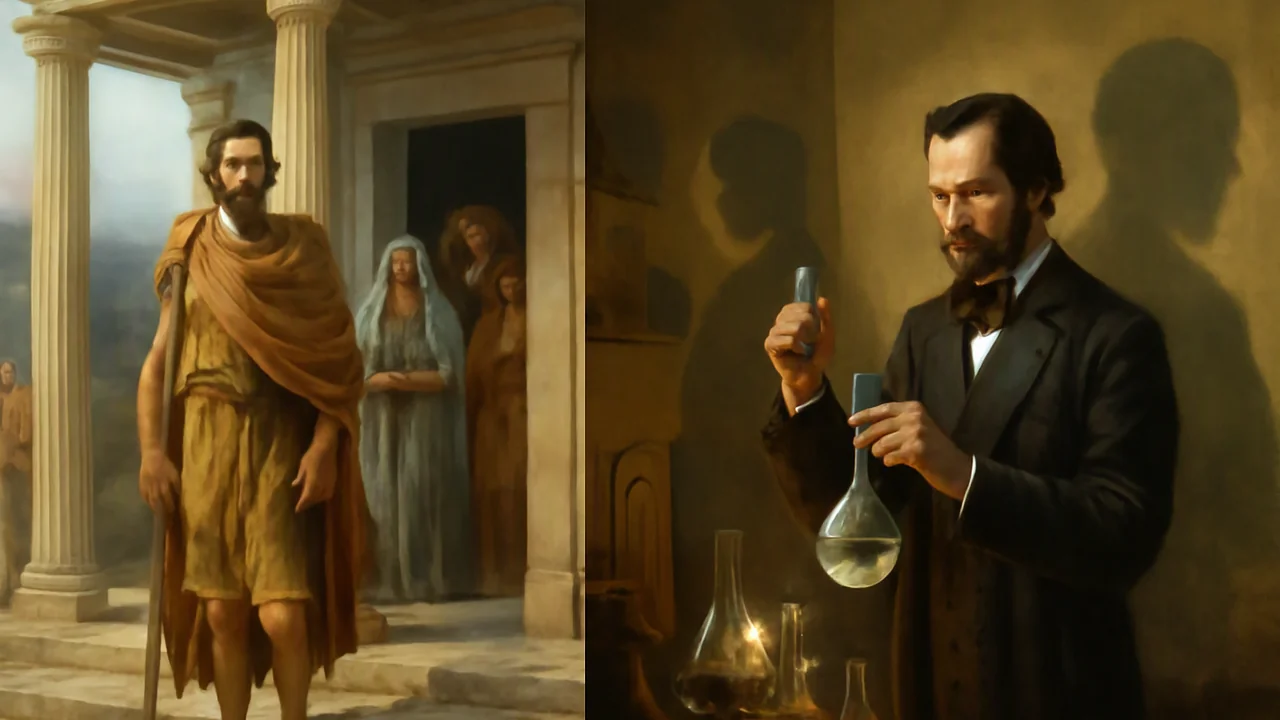
Neither of this semester’s anchor texts invented its own premise, and noticing that is the beginning of the unit’s analytical work.
Homer inherited the nostos. The homecoming story — the warrior returning from Troy to a household that has changed without him — was a whole genre before Homer. Agamemnon’s return, murdered by his wife and her lover, was the famous one, and the poem knows it: Agamemnon’s story is told inside The Odyssey three separate times. Homer is not being repetitive. He is holding up the version the audience expects so that his own version can be measured against it. Odysseus returns to a wife who did not betray him and a son who did not side against him — and he still enters his own house disguised as a beggar and kills a hundred men. The inheritance is the plot. The argument is what Homer does with a hero who is safe and behaves as though he is not.
Stevenson inherited the double. The divided self was standing Gothic equipment by 1886 — Hogg’s Confessions of a Justified Sinner, Poe’s “William Wilson”, Frankenstein and his creature. What Stevenson changed is the location. His double is not a supernatural visitant or a doppelgänger encountered in the street; it is a chemical procedure undertaken deliberately by a respectable professional man with a laboratory and a will. He moved the Gothic from the castle to the consulting room. The inheritance is the doubled self. The argument is that respectability, not the supernatural, is what produces it.
Why this matters for research, and not only for reading. RL.9-10.9 is a standard about the difference between a convention and a choice. Students writing about literature routinely credit an author for something the genre supplied, or blame an author for something the genre required. Once you can separate the two, you can ask a real question: not “what happens in these books” but “what does each author do with material he did not invent, and do the two answers agree?”
Framing the question. The semester’s essential question is: to what extent does a person’s community determine the ethical boundaries they will observe in a moment of crisis? Both texts answer it and they do not obviously agree. Odysseus’s limits are set by xenia, a code his whole society enforces and whose violation licenses his slaughter of the suitors — and the poem asks whether a code that permits that is a limit at all. Jekyll’s limits are set by a professional class that enforces appearance and asks nothing else, and the novella asks whether such a code produces morality or merely produces Hyde.
A workable research question for this paper is narrow, arguable, and answerable from both texts. “How are the books similar?” fails all three. “Do Homer and Stevenson locate moral restraint in the individual or in the community, and what does each text show happening when the community’s code is the only restraint present?” passes.
Today you draft that question. It will change. Expect it to.
Reading: The inherited story and the author’s choice: passages from the Odyssey, Poe and Jekyll, with a worked chart
Homer, The Odyssey, tr. Samuel Butler (1900), Project Gutenberg 1727; R. L. Stevenson, The Strange Case of Dr. Jekyll and Mr. Hyde (1886), Standard Ebooks, https://standardebooks.org/ebooks/robert-louis-stevenson/the-strange-case-of-dr-jekyll-and-mr-hyde/text/single-page ; E. A. Poe, William Wilson, Works vol. 2, Project Gutenberg 2148; retrieved 26 Sept. 2026 · SLS original; quoted passages are public domain (Homer, tr. Butler, 1900; Stevenson, 1886; Poe)
Read the passages first, then use the chart to separate convention from choice before you draft your research question.
What is hosted. The lesson asks you to separate what each anchor text inherited from what its author did with it, and to test a research question against a passage from each text. This reading supplies those passages, a worked inheritance chart, and a worked test of a research question. Editions: Homer, The Odyssey, rendered into English prose by Samuel Butler (1900), Project Gutenberg eBook #1727, https://www.gutenberg.org/ebooks/1727; Robert Louis Stevenson, The Strange Case of Dr. Jekyll and Mr. Hyde (1886), Project Gutenberg eBook #43, https://www.gutenberg.org/ebooks/43; Edgar Allan Poe, “William Wilson,” in The Works of Edgar Allan Poe, vol. 2, Project Gutenberg eBook #2148, https://www.gutenberg.org/ebooks/2148. All retrieved 2026-09-26. Wording and spelling are the editions’. The chart, the tests and the model question are SLS original.
A note on numbering. Butler’s translation is prose and has no line numbers, so this course cites the Odyssey by book (Book 1, Book 11, Book 22, Book 24). Jekyll and Hyde is cited by chapter title. In Butler’s text the name of Aegisthus, Agamemnon’s killer, appears in Books 1, 3, 4, 11 and 24, so the story is told or recalled in more places than the three passages hosted here. Butler’s Agamemnon says he was killed at a feast in Aegisthus’s house (Book 11, hosted below), not in a bath; the bath belongs to later Greek tragedy, and a claim in the lesson text that the poem gives the bath does not match the passage supplied.
1. The Odyssey’s inheritance: the homecoming that goes wrong
Three passages, in the order the poem gives them. The first is Zeus in Book 1, speaking to the gods about the man who killed Agamemnon. The second and third are Agamemnon’s own words, met in the house of the dead.
Book 1: Zeus on Aegisthus
See now, how men lay blame upon us gods for what is after all nothing but their own folly. Look at Aegisthus; he must needs make love to Agamemnon’s wife unrighteously and then kill Agamemnon, though he knew it would be the death of him; for I sent Mercury to warn him not to do either of these things, inasmuch as Orestes would be sure to take his revenge when he grew up and wanted to return home. Mercury told him this in all good will but he would not listen, and now he has paid for everything in full.
Book 11: Agamemnon tells Ulysses how he died
He asked me to his house, feasted me, and then butchered me most miserably as though I were a fat beast in a slaughter house, while all around me my comrades were slain like sheep or pigs for the wedding breakfast, or picnic, or gorgeous banquet of some great nobleman. You must have seen numbers of men killed either in a general engagement, or in single combat, but you never saw anything so truly pitiable as the way in which we fell in that cloister, with the mixing bowl and the loaded tables lying all about, and the ground reeking with our blood. I heard Priam’s daughter Cassandra scream as Clytemnestra killed her close beside me. I lay dying upon the earth with the sword in my body, and raised my hands to kill the slut of a murderess, but she slipped away from me; she would not even close my lips nor my eyes when I was dying, for there is nothing in this world so cruel and so shameless as a woman when she has fallen into such guilt as hers was. Fancy murdering her own husband! I thought I was going to be welcomed home by my children and my servants, but her abominable crime has brought disgrace on herself and all women who shall come after—even on the good ones.
Book 24: Agamemnon on Penelope
Happy Ulysses, son of Laertes,” replied the ghost of Agamemnon, “you are indeed blessed in the possession of a wife endowed with such rare excellence of understanding, and so faithful to her wedded lord as Penelope the daughter of Icarius. The fame, therefore, of her virtue shall never die, and the immortals shall compose a song that shall be welcome to all mankind in honour of the constancy of Penelope. How far otherwise was the wickedness of the daughter of Tyndareus who killed her lawful husband; her song shall be hateful among men, for she has brought disgrace on all womankind even on the good ones.
2. What Homer does with it: Book 22
The inherited story has a wife who betrays and a returning king who dies. Homer’s version has a wife who did not betray and a king who comes home and kills. In the passage below, the household is being sorted into guilty and innocent after the suitors are dead.
Book 22: the women of the house
There are fifty women in the house whom we teach to do things, such as carding wool, and all kinds of household work. Of these, twelve in all[177] have misbehaved, and have been wanting in respect to me, and also to Penelope. They showed no disrespect to Telemachus, for he has only lately grown and his mother never permitted him to give orders to the female servants; but let me go upstairs and tell your wife all that has happened, for some god has been sending her to sleep.”
“Do not wake her yet,” answered Ulysses, “but tell the women who have misconducted themselves to come to me.”
Euryclea left the cloister to tell the women, and make them come to Ulysses; in the meantime he called Telemachus, the stockman, and the swineherd. “Begin,” said he, “to remove the dead, and make the women help you. Then, get sponges and clean water to swill down the tables and seats. When you have thoroughly cleansed the whole cloisters, take the women into the space between the domed room and the wall of the outer court, and run them through with your swords till they are quite dead, and have forgotten all about love and the way in which they used to lie in secret with the suitors.”
On this the women came down in a body, weeping and wailing bitterly. First they carried the dead bodies out, and propped them up against one another in the gatehouse. Ulysses ordered them about and made them do their work quickly, so they had to carry the bodies out. When they had done this, they cleaned all the tables and seats with sponges and water, while Telemachus and the two others shovelled up the blood and dirt from the ground, and the women carried it all away and put it out of doors. Then when they had made the whole place quite clean and orderly, they took the women out and hemmed them in the narrow space between the wall of the domed room and that of the yard, so that they could not get away: and Telemachus said to the other two, “I shall not let these women die a clean death, for they were insolent to me and my mother, and used to sleep with the suitors.”
So saying he made a ship’s cable fast to one of the bearing-posts that supported the roof of the domed room, and secured it all around the building, at a good height, lest any of the women’s feet should touch the ground; and as thrushes or doves beat against a net that has been set for them in a thicket just as they were getting to their nest, and a terrible fate awaits them, even so did the women have to put their heads in nooses one after the other and die most miserably.[178] Their feet moved convulsively for a while, but not for very long.
3. The Gothic double: what Stevenson inherited
The first passage is by Poe: a man who is followed through his school days by a second person with the same name, who copies his dress, his gait and even his voice. The second is Jekyll, from his own statement at the end of Stevenson’s book.
Poe, “William Wilson”: the double who copies
My dress it was an easy matter to copy; my gait and general manner were, without difficulty, appropriated; in spite of his constitutional defect, even my voice did not escape him. My louder tones were, of course, unattempted, but then the key—it was identical; and his singular whisper, it grew the very echo of my own.
How greatly this most exquisite portraiture harassed me, (for it could not justly be termed a caricature,) I will not now venture to describe. I had but one consolation—in the fact that the imitation, apparently, was noticed by myself alone, and that I had to endure only the knowing and strangely sarcastic smiles of my namesake himself.
Jekyll’s statement: the double as a chosen procedure
Hence it came about that I concealed my pleasures; and that when I reached years of reflection, and began to look round me and take stock of my progress and position in the world, I stood already committed to a profound duplicity of life. Many a man would have even blazoned such irregularities as I was guilty of; but from the high views that I had set before me, I regarded and hid them with an almost morbid sense of shame. It was thus rather the exacting nature of my aspirations than any particular degradation in my faults, that made me what I was, and, with even a deeper trench than in the majority of men, severed in me those provinces of good and ill which divide and compound man’s dual nature. In this case, I was driven to reflect deeply and inveterately on that hard law of life, which lies at the root of religion and is one of the most plentiful springs of distress. Though so profound a double-dealer, I was in no sense a hypocrite; both sides of me were in dead earnest; I was no more myself when I laid aside restraint and plunged in shame, than when I laboured, in the eye of day, at the furtherance of knowledge or the relief of sorrow and suffering. And it chanced that the direction of my scientific studies, which led wholly towards the mystic and the transcendental, reacted and shed a strong light on this consciousness of the perennial war among my members. With every day, and from both sides of my intelligence, the moral and the intellectual, I thus drew steadily nearer to that truth, by whose partial discovery I have been doomed to such a dreadful shipwreck: that man is not truly one, but truly two.
4. The worked inheritance chart (SLS original)
Each row separates a convention (what the story or genre supplied) from a choice (what the author did with it), and says what in the hosted text shows the difference.
| Inherited feature | Where it shows | What the author does | Convention or choice? |
|---|---|---|---|
| A king’s homecoming that ends in murder by a wife and her lover | Book 1 (Zeus on Aegisthus); Book 11 (Agamemnon’s account) | Homer keeps it in front of the audience, through both a god and the victim, so that the audience expects it. | Convention: the story was already known. The repetition is Homer’s choice. |
| A faithful wife as the opposite case | Book 24: Agamemnon names Penelope’s constancy against Clytemnestra’s. | A character in the poem draws the contrast for the audience, so the comparison is built into the text and is not the reader’s invention. | Choice. |
| Punishment of wrongdoers in the returning hero’s house | Book 22: the maids and the hanging | The order to kill by the sword changes when Telemachus decides the women will not die a clean death, and the poem stays on the scene. | Choice: what to linger on is not required by the story of a homecoming. |
| A double who copies the hero and shadows him | Poe: the copy of voice, gait and dress | Poe’s double is a separate person, met at school. | Convention by 1886: it was standard equipment. |
| The double as a divided self | Jekyll: both sides of me were in dead earnest | Stevenson places the split inside a respectable man and makes the cause concealment, then a deliberate procedure. | Choice: the location and the cause are what he changed. |
5. Answering the prediction question
In the lesson, students are asked why Homer keeps returning to Agamemnon. Using the passages above: the story of the king who is murdered on his return is what the audience expects to hear when a king comes home from Troy. Zeus in Book 1 sets it up as a standard of comparison, and in Book 24 Agamemnon himself says that Penelope will be remembered for the opposite behavior. Homer holds up the inherited story so that his own version can be measured against it. What remains to explain, and what your research question can be about, is why a hero who returns to a loyal household still enters it in disguise and kills.
6. Testing a research question (worked, SLS original)
First draft. How does Homer use violence in the Odyssey? Test: name one passage from the Odyssey (Book 22); name one from Jekyll and Hyde; state in one sentence where they disagree. The draft fails at step 2 and 3. Nothing in Jekyll’s statement is about violence, so the two texts do not answer the same question, and no disagreement can be stated.
Revised question. To what extent does the community that a person answers to set a limit on what that person will do in a crisis, or license it?
| Step | Odyssey | Jekyll and Hyde |
|---|---|---|
| 1 and 2: a passage that answers it | Book 22, the women of the house: Ulysses sets the household’s norms, Telemachus decides the manner of death, and no one in the scene questions it. | Jekyll’s statement: Jekyll concealed his pleasures, and his sense of shame was produced by his own high standards and by the life he was expected to lead. |
| 3: where they disagree (one sentence) | In the Odyssey, the community’s code is enforced in the open and, in the passage supplied, goes unchallenged. | In Jekyll, the community demands only appearance and never sees the acts it does not want to see, so the harm is done in secret. |
The revised question passes: it names a passage from each text and ends in a sentence that a classmate could dispute. Notice that the sentence in step 3 is a claim, not a topic. If yours is a topic (“both texts have violence”), revise the question and run the test again.
Formative check
Work through these before moving on. They are not graded — they tell you, and your teacher, whether the standard below has landed yet.
Agamemnon’s murder on returning home is told three times inside The Odyssey. Before reading on — why would Homer keep returning to someone else’s homecoming?
What did Stevenson change about the inherited Gothic double?
If a feature of a text is a genre convention, analyzing it tells you nothing about the author’s argument.
Draft your research question. Then test it in writing: (1) name one passage from The Odyssey that answers it; (2) name one from Jekyll and Hyde; (3) state in one sentence where the two texts disagree. If you cannot complete step 3, the question is not yet arguable — revise it and try again.
How confident are you that you can separate what a genre supplied from what an author chose to do with it?
Printable: Unit 4 Student Workbook
Every organizer for this unit in one booklet — the reading schedule, the vocabulary pages, every lesson organizer (each lesson names its page), the peer review sheet and the scoring rubric. Print it before the unit starts and bring the page to each lesson.