Why are deep learning processors rapidly changing how AI models are trained, tested, and deployed — and what makes them so much faster and more efficient than traditional CPUs or GPUs?
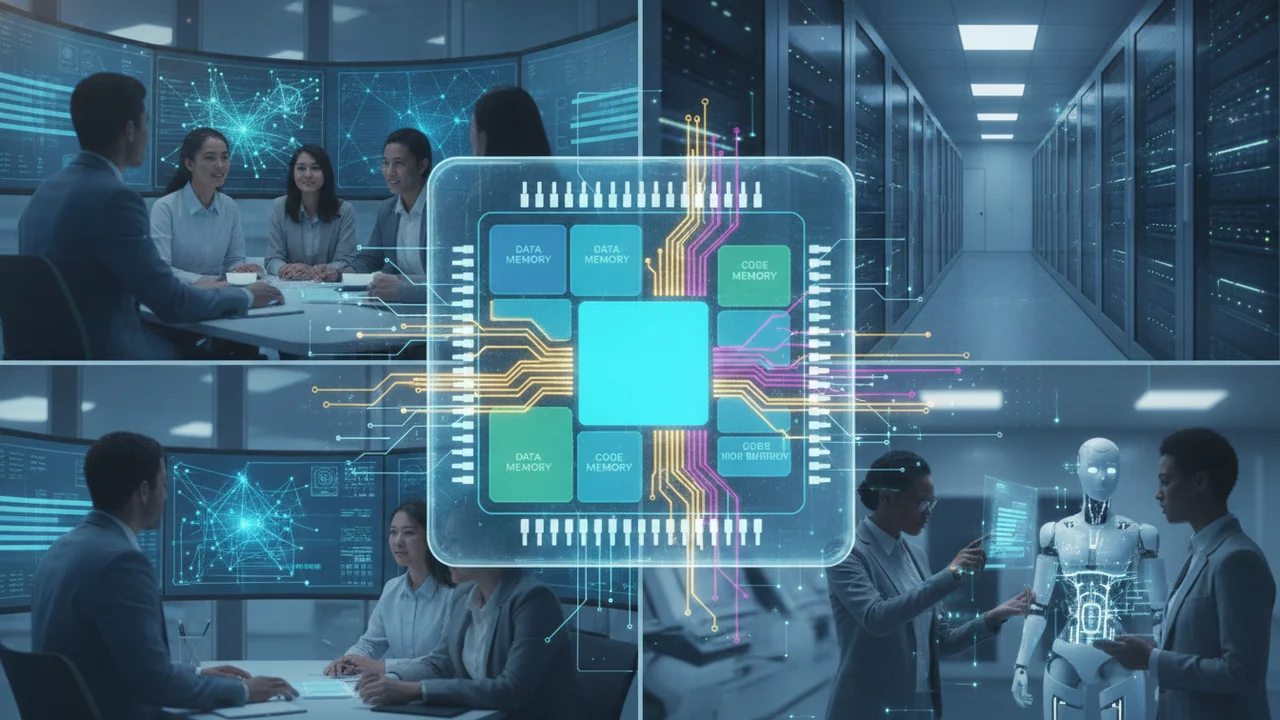
AI applications demand ever more powerful hardware to train, verify, and run complex models efficiently. But with so many processor types emerging, how do researchers move beyond general-purpose chips and unlock the true speed of deep learning?
The search for something better is ongoing, and you can find a veritable alphabet soup of processor types.
Researchers constantly struggle to discover better ways to train, verify, and test the models used to create AI applications. One of those ways is to use new computing techniques, such as throwing more processing power at the problem with GPUs. However, GPUs are beneficial mainly for massively parallel matrix manipulation, and can still introduce their own limitations. So the quest for specialized hardware continues, producing a dizzying range of processor types: CPU, GPU, APU, TPU, VPU, FPGA, QPU, and more. You can explore these on resource pages like https://primo.ai/index.php/PRIMO.ai.
Even small devices — like smartphones — now harness specialized processors to run AI tasks locally, enabling features such as real-time translation and intelligent camera functions without needing the cloud.
Want to go deeper? The science behind hardware specialization for AI
Specialized hardware like DLPs is designed around the unique workloads of AI — particularly neural network operations. Unlike traditional CPUs, which focus on general computation, DLPs optimize memory access, parallelism, and power efficiency for deep learning workflows. This enables much faster execution of AI tasks, especially on devices where traditional hardware would be too slow or power-hungry.
A specialized processor designed to accelerate deep learning tasks, providing benefits in training, verifying, testing, and running AI applications efficiently — even on smaller devices.

Defining the DLP

A deep learning processor (DLP) is simply a specialized processor that provides some benefits in training, verifying, testing, and running AI applications. They try to create an environment in which AI applications run quickly even on smaller or less capable devices. Most DLPs follow a similar pattern by providing:
- Separate data and code memory areas
- Separate data and code buses
- Specialized instruction sets
- Large on-chip memory
- Large buffers to encourage data reuse patterns
In 2014, Tianshi Chen and others proposed the first DLP, called DianNoa (Chinese for electric brain). Of course, a first attempt is never good enough, so there’s a whole family of DianNoa chips: DaDianNao, ShiDianNao, and PuDianNao (and possibly others).

Since these first experiments with DLPs, the number and types of DLPs have soared, but most of these endeavors are now part of university research efforts. The exceptions are the neural processing unit (NPU) created by Huawei and Samsung for mobile devices, and the tensor processing unit (TPU) created by Google (https://cloud.google.com/tpu/docs/intro-to-tpu) specifically for use with TensorFlow (www.tensorflow.org).
How do you think separating memory and buses for data and code makes a processor more efficient for AI tasks?
Using the Mobile Neural Processing Unit (NPU)
A number of mobile devices — notably, those by Huawei and Samsung — have a neural processing unit (NPU) in addition to a general CPU to perform AI predictive tasks using models such as artificial neural networks (ANNs) and random forests (RFs). You can’t use an NPU for general computing needs because it’s so specialized. However, an NPU characteristically performs up to ten times faster than a GPU does for the same task. An NPU is specialized in these ways:
- It accelerates the running of predefined models (as contrasted to training, verification, and testing).
- It’s designed for use with small devices.
- It consumes little power when contrasted to other processor types.
- It uses resources, such as memory, efficiently.
Because the precise boundaries between processor types are hard to define, you might see a number of NPU look-alikes or alternatives classified as NPUs. However, here’s a list of processors that you can currently classify as true NPUs:
- Ali-NPU, by Alibaba
- Ascend, by Huawei
- Neural Engine, by Apple
- Neural processing unit (NPU), by Samsung
- NNP, Myriad, EyeQ, by Intel
- NVDLA (mostly used for internet of things [IoT] devices), by NVIDIA
Mobile NPUs are transforming user experiences — allowing real-time voice translation, intelligent camera modes, and privacy-preserving AI directly on smartphones, all without draining battery life.
A highly specialized processor for running AI models (especially neural networks and random forests) on mobile and embedded devices, offering high speed and efficiency but limited to specific tasks.
What advantages might NPUs offer for edge computing and IoT devices compared to traditional CPUs or GPUs?
Accessing the Cloud-Based Tensor Processing Unit (TPU)
Google specifically designed the tensor processing unit (TPU) in 2015 to more quickly run applications built on the TensorFlow framework. It represents a true chip specialization in that you can’t use it effectively without TensorFlow. However, it’s different in another way in that it’s an application-specific integrated circuit (ASIC) rather than a full-blown CPU-type chip. The differences are important:
- An ASIC can perform only one task, and you can’t change it.
- Because of its specialization, an ASIC is typically much less expensive than a CPU.
- Most ASIC implementations are much smaller than the same implementation created with a CPU.
- Compared to a CPU implementation, an ASIC is more power efficient.
- ASICs are incredibly reliable.
TPUs are used in Google’s cloud to accelerate machine learning tasks, enabling researchers and developers to train massive neural networks in hours rather than weeks, directly powering breakthroughs in language, vision, and healthcare AI.
How does the specialization of TPUs for TensorFlow impact their use in industry and research?
- Specialized processors like DLPs, NPUs, and TPUs are revolutionizing AI performance
- Each processor type is optimized for particular tasks, devices, and frameworks
All AI processors can be used interchangeably for any computing task.
Most AI processors, such as NPUs and TPUs, are highly specialized — designed only for specific AI tasks, frameworks, or device types.
Compare the characteristics of CPUs, GPUs, NPUs, and TPUs.
- List each processor type and its main use-case.
- Identify which features make each processor type most effective for AI tasks.
Deep learning processors are tailored to accelerate AI workloads, offering massive gains in speed, efficiency, and scalability by focusing on specialized tasks and architectures.
NPUs and TPUs demonstrate how hardware specialization transforms AI capabilities on both mobile devices and in the cloud, making advanced AI accessible and practical in everyday life.
What is a Deep Learning Processor (DLP)?
Tap to revealA specialized processor designed for accelerating deep learning tasks — training, verifying, testing, and running AI applications.
What makes NPUs ideal for mobile devices?
Tap to revealNPUs are specialized for running AI models quickly and efficiently, consuming minimal power and using memory resources effectively.
What is a TPU and what is it designed for?
Tap to revealA Tensor Processing Unit (TPU) is an application-specific integrated circuit (ASIC) created by Google for accelerating TensorFlow-based AI applications.
Imagine you are designing a new AI-powered device for a specific purpose (such as a smart home sensor or a wearable health monitor). Which processor type would you choose — CPU, GPU, NPU, or TPU — and why?
Which processor is specifically designed to accelerate applications built on the TensorFlow framework?
The Shift
- Specialized processors like DLPs, NPUs, and TPUs dramatically accelerate AI tasks, making advanced applications practical for both mobile and cloud environments.
- Each processor type is uniquely optimized for specific workloads — understanding their capabilities empowers smarter hardware choices.
- Hardware innovation is a driving force behind AI’s progress, enabling new possibilities for speed, efficiency, and intelligent devices everywhere.