How are advances in specialized hardware transforming the future of artificial intelligence?
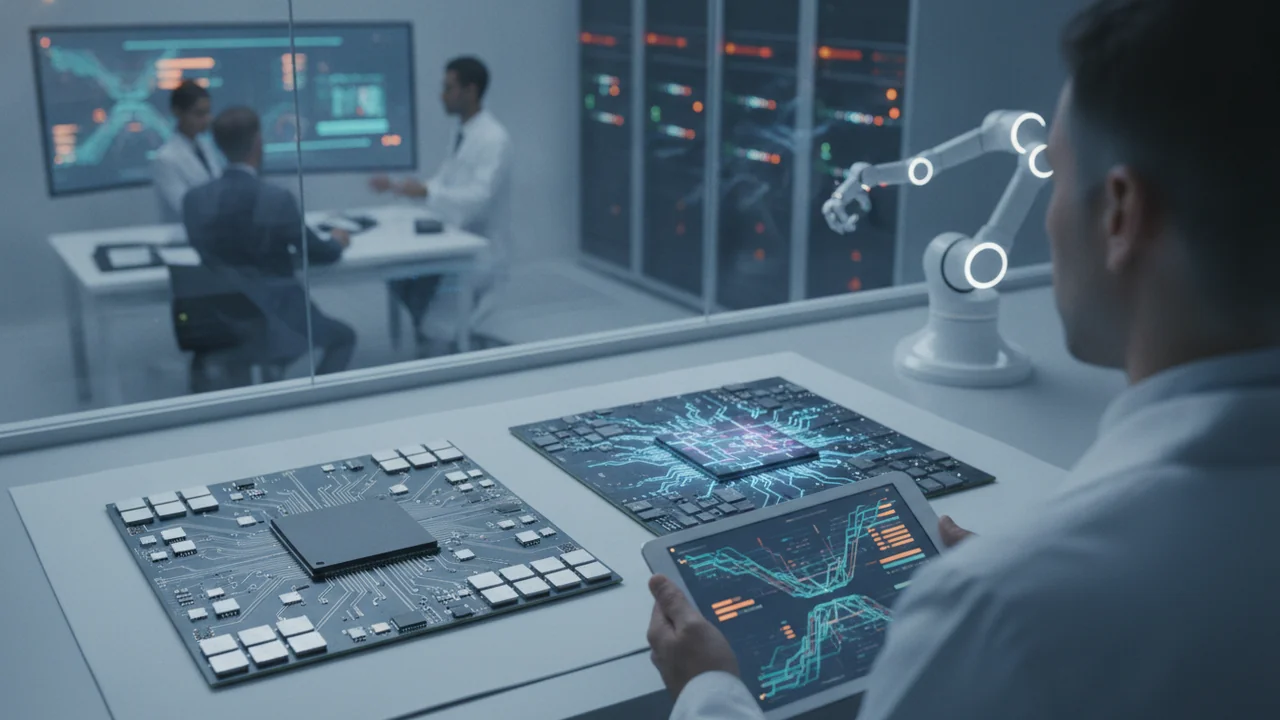
Imagine a world where computers think—and learn—more like humans. AI breakthroughs often depend on the power of the underlying hardware, and today, the race is on to build smarter, faster, and more efficient processors that push the limits of what machines can do.
The CPU still works well for business systems or in applications in which the need for general flexibility in programming outweighs pure processing power. However, GPUs are now the standard for various kinds of data science, machine learning, AI, and deep learning needs. Of course, developers are constantly looking for the next big thing in the development environment. Both CPUs and GPUs are production-level processors. In the future, you may see one of two kinds of processors used in place of these standards:
- Application-specific integrated circuits (ASICs): In contrast to general processors, a vendor creates an ASIC for a specific purpose. An ASIC solution offers extremely fast performance using very little power, but it lacks flexibility. You can find an example of an ASIC in the form of a TPU (see the earlier section “Accessing the cloud-based tensor processing unit (TPU)” for details).
- Field programmable gate arrays (FPGAs): As with an ASIC, a vendor generally crafts an FPGA for a specific purpose. However, contrary to using an ASIC, you can program an FPGA to change its underlying functionality. An example of an FPGA solution is Microsoft’s Brainwave, which is used for deep learning projects.

The battle between ASICs and FPGAs promises to heat up, with AI developers emerging as the winner. For the time being, Microsoft and FPGAs appear to have taken the lead. The point is that technology is fluid, and you should expect to see new developments.
Vendors are also working on entirely new processing types, which may or may not work as expected. For example, Graphcore is working on an intelligence processing unit (IPU). The company has developed the line of processors shown at www.graphcore.ai/products/ipu. However, you have to take the news of these new processors with a grain of salt, given the hype that has surrounded the industry in the past. When you see real-life applications from large companies such as Google and Microsoft, you can start to feel a little more certain about the future of the technology involved.
TPUs (Tensor Processing Units) are a type of ASIC developed by Google specifically for accelerating machine learning workloads. Their tailored design enables efficient neural network processing.
Looking at the future of AI hardware, we authors see two new areas of advancement in hardware capabilities: neuromorphic computing and quantum processors. These cutting-edge technologies can potentially improve processing efficiency and capability, pushing the boundaries of AI. We look at each in turn in the following sections.
A processor designed for a specific purpose, offering high speed and power efficiency, but limited flexibility.
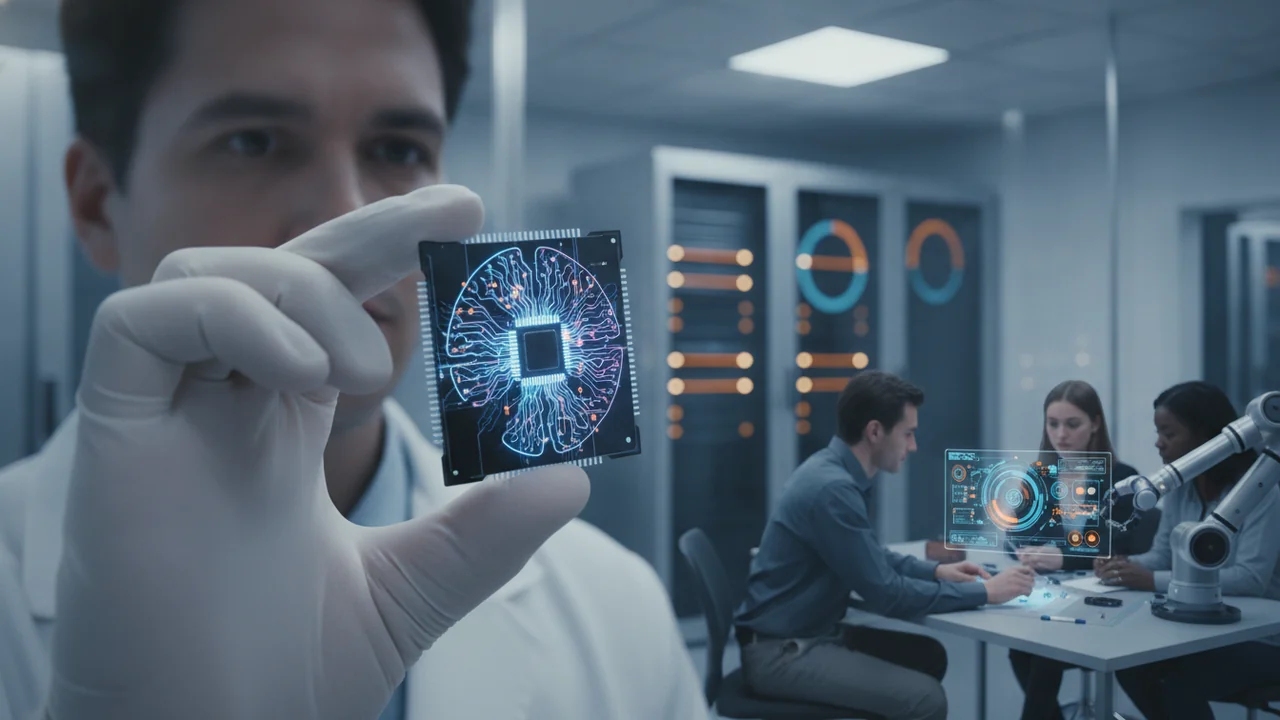
A processor that can be reprogrammed to change its functionality, balancing custom performance with adaptability.
Want to go deeper? The science behind FPGAs and ASICs
ASICs are crafted for singular tasks, meaning they can be extremely fast and efficient, but cannot be repurposed for other functions. FPGAs, on the other hand, allow developers to alter their logic circuits after manufacturing, making them highly flexible for prototyping and adapting to evolving AI workloads. FPGA-based systems like Microsoft’s Brainwave show how reconfigurable hardware supports rapid innovation in deep learning.
What are the main advantages and disadvantages of using ASICs versus FPGAs for AI applications?
Microsoft’s Brainwave uses FPGAs to accelerate deep learning models in the cloud. By reprogramming FPGAs, engineers can adapt to new AI algorithms quickly—something not possible with fixed ASICs. This flexibility is giving companies like Microsoft a competitive edge in deploying advanced AI services.
Graphcore’s IPU is being tested in leading AI research centers to evaluate its potential for large-scale deep learning. The results could influence how future AI models are trained and deployed.
- Distinguish between CPUs, GPUs, ASICs, and FPGAs as AI hardware options
- Understand how new processor types are emerging to meet AI demands
Advancing neuromorphic computing
Neuromorphic computing is the field of technology that mimics the neural structure and operation of the brain. It uses specialized hardware to create more efficient and adaptive AI systems. Recent developments in neuromorphic chips, such as Intel’s Loihi (https://open-neuromorphic.org/neuromorphic-computing/hardware/loihi-intel) and IBM’s TrueNorth (https://open-neuromorphic.org/blog/truenorth-deep-dive-ibm-neuromorphic-chip-design) have greatly improved power efficiency and processing capabilities for specific AI tasks.

These chips can handle complex tasks — like pattern recognition, sensory processing, and real-time decision-making — with significantly lower energy consumption than traditional processors.
Neuromorphic systems often utilize spiking neural networks (SNNs), which process information like the brain, through the timing of spikes (bursts of activity) rather than continuous signal transmission. This approach allows for more efficient and faster data processing, especially in applications that require real-time analysis and adaptive learning.
Autonomous drones and robots can benefit from neuromorphic chips by enhancing their ability to navigate and respond to their environments.
Industry labs are experimenting with neuromorphic chips to create edge devices that operate efficiently in remote settings, such as environmental sensors and autonomous vehicles.
Specialized hardware that emulates the structure and function of biological brains to enable efficient, adaptive AI systems.
How might neuromorphic computing change the way AI interacts with real-world environments?
Exploring quantum processors
Quantum processors represent a big leap in AI hardware capabilities. Unlike classical processors that use bits to represent data as zeros or ones, quantum processors use quantum bits (qubits), which can exist in multiple states at the same time. This unique property allows quantum processors to perform certain calculations much faster than classical computers.
Companies like Google, IBM, and D-Wave are making strides in developing quantum processors. With regard to AI, quantum processors have the potential to revolutionize optimization problems, enhance machine learning algorithms, and accelerate complex simulations.
Quantum computing is still in its infancy but has several potential applications. For instance, it could enable more sophisticated AI models to process and analyze large-scale data more efficiently. This could lead to such events as drug discovery and financial modeling breakthroughs.
A processor that uses quantum bits (qubits) capable of representing multiple states simultaneously, enabling rapid computation for select tasks.
What challenges do you think quantum processors face before becoming widely used in AI?
GPUs are always the best choice for any AI application.
While GPUs are powerful for general AI workloads, specialized processors like ASICs, FPGAs, neuromorphic, and quantum chips can outperform GPUs for specific tasks.
The battle between ASICs and FPGAs promises to heat up, with AI developers emerging as the winner.
Advances in specialized hardware—ASICs, FPGAs, neuromorphic chips, and quantum processors—are reshaping the possibilities for artificial intelligence, providing new levels of speed, flexibility, and efficiency.
Emerging technologies like neuromorphic computing and quantum processors will enable AI systems to tackle complex tasks and adapt to new challenges faster than ever before.
Explore the trade-offs between ASICs, FPGAs, neuromorphic, and quantum processors.
- List the primary benefits and limitations of each processor type in the context of AI.
- Pick one processor type and suggest a real-world AI problem it would best solve.
Imagine you are tasked with designing an AI system for real-time pattern recognition in autonomous vehicles. Which hardware technology would you choose—ASIC, FPGA, neuromorphic, or quantum processor—and why?
What is an ASIC?
Tap to revealAn Application-Specific Integrated Circuit is a processor designed for a specific task, offering high speed and low power consumption.
How does an FPGA differ from an ASIC?
Tap to revealAn FPGA can be reprogrammed to change its functionality, while an ASIC is fixed for one specific purpose.
What is neuromorphic computing?
Tap to revealNeuromorphic computing uses hardware designed to mimic the neural structure and operation of the brain for efficient AI processing.
What is a quantum processor?
Tap to revealA quantum processor uses qubits that can exist in multiple states, allowing for rapid computation of certain tasks.
Which processor type allows you to reprogram its functionality after manufacturing?
How could quantum processors change the way AI tackles complex optimization problems?
How confident are you that you can explain the differences between ASICs, FPGAs, neuromorphic, and quantum processors?
The Shift
- Specialized hardware like ASICs, FPGAs, neuromorphic, and quantum processors are crucial to advancing AI capabilities.
- Each processor type offers distinct advantages—speed, flexibility, adaptability, or computational power—depending on the AI application.
- Emerging hardware technologies will continue to reshape what AI systems can achieve, making future breakthroughs possible.