Decoding Machine and Deep Learning
Are generative AI systems truly intelligent, or are they just clever algorithms? What makes machine learning and deep learning so powerful?

When you first encounter a generative AI tool such as ChatGPT, it can seem like magic. Some people even speculate that generative AI tools are conscious and capable of thinking and having emotions. Knowing how these tools were created and how they work will quickly dispel that notion — or make you think differently about consciousness, but that’s a subject for a philosophy book, not a coding book.
Early forms of generative AI date back to the 1960s, when ELIZA, a simple text-based chatbot, could simulate conversations and even fool people into believing it was intelligent.
Defining key concepts
Before you can dip your toes into understanding how the latest AI systems are capable of generating complex responses to natural-language input, we need to present some vocabulary. People working with or writing about the systems we talk about often use the terms AI, machine learning, deep learning, and generative AI interchangeably, but these fundamental terms are different:
- Artificial intelligence (AI) is the use of computer science and data to solve problems. AI encompasses everything from expert systems and decision trees, which simulate the judgment and behavior of humans using a complex series of if-then statements, to machine learning, computer vision, and natural-language processing.
- Machine learning is a type of AI that focuses on developing and using computer systems that can learn and adapt without following explicit instructions. Machine learning can solve problems that would be prohibitively expensive to solve by programmers writing the algorithms by hand.
- Deep learning is a type of machine learning based on artificial neural networks. The word deep doesn’t indicate inherently more profound or mysterious AI, but rather refers to the use of multiple layers of algorithms (artificial neurons) in the neural network.
- Generative AI (GenAI) are AI systems that can generate new content based on the data used to train them. In recent years, the content created by GenAI is of a high enough quality to be more than a novelty, thanks to the use of deep learning.
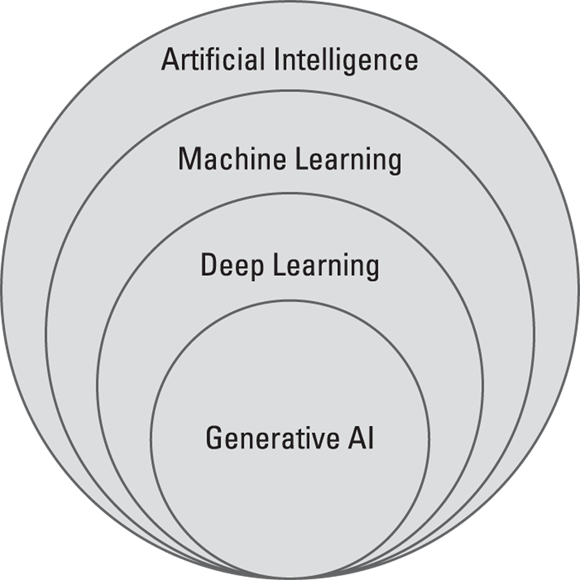
How does understanding the distinction between AI, machine learning, and deep learning help us interpret the capabilities of tools like ChatGPT?

Thinking about neural networks
The idea behind deep learning is to teach computers to process data based on how we think our brains work. In a human brain, cells called neurons form a complex and massive interconnected network. Using chemical reactions and electrical currents, neurons send signals to each other to enable us to learn and process information.
Neural networks in deep learning, also known as simulated neural networks (SNNs) or artificial neural networks (ANNs), consist of artificial neurons called nodes that form layers.
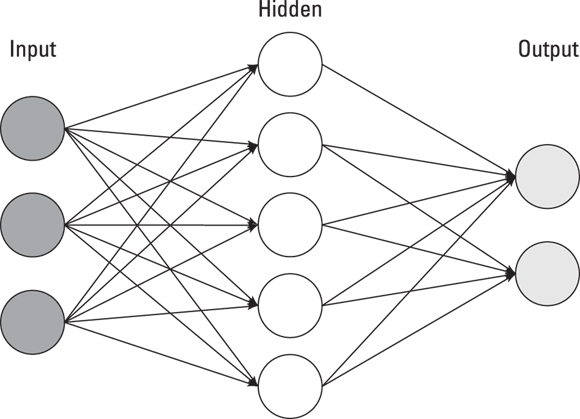
Why do you think the structure of neural networks is inspired by the human brain? What advantages might this imitation provide?
Each node is a software module that processes some input and determines whether to pass it on to the next layer of neurons for further processing. A simple neural network consists of three layers: the input layer, the hidden layer, and the output layer.
Input layer
The input layer receives data and puts it in a format that the hidden layers can use. For example, in a neural network for analyzing images, the images are first converted to the same size and dimensions. Next, the input layer takes in the pixel values (the amount of red, green, and blue) for each image and passes them along to the hidden layer.

In the preceding example, the number of neurons in the input layer is determined by the number of pixels in the image. If the neural network will be processing color images, the number of pixels is multiplied by 3 for each of the pixel values (red, green, and blue) to get the number of neurons. For example, the image shown below has a width of 56 pixels and a height of 56 pixels. An input layer for working with this image would have 56 × 56 × 3, or 9,408, neurons.

Hidden layer
A hidden layer receives data from the input layer or other hidden layers and processes it further to extract features from the image, such as color, shape, and texture. More complex tasks require more neurons in the hidden layers. A neural network can have many hidden layers.
Output layer
Neural networks must have at least one output layer, which provides the final result of the calculations from the hidden layers.
A simple artificial neural network can determine whether or not a photo contains a hot dog. This type of problem is known as a binary classification because the output from this neural network is either 1 (hot dog) or 0 (not hot dog).
Want to go deeper? The science behind neural networks
Each layer in a neural network applies transformations to the data. Input layers translate raw data into a usable format, hidden layers extract and combine features, and output layers deliver predictions or classifications. Training these networks involves adjusting the connections (weights) between nodes so the system learns to perform its task accurately.
Choose an everyday application that uses AI (such as a virtual assistant or image recognition in your phone). Identify which parts of the system could represent the input, hidden, and output layers based on your understanding.
- Pick an AI-powered tool you use.
- Describe what data it receives (input layer).
- Think about how it processes or analyzes the data (hidden layer).
- Identify what the system outputs or decides (output layer).
The use of computer science and data to solve problems, including expert systems, decision trees, machine learning, and more.
A subset of machine learning using artificial neural networks with multiple layers to process data and extract complex features.
Facial recognition on smartphones relies on deep learning neural networks to analyze and identify unique features from your face, demonstrating the practical application of these concepts.
Practitioners often choose deep learning models for tasks like image and speech recognition because they excel at discovering patterns in large and complex datasets.
- You can distinguish between AI, machine learning, and deep learning.
- You understand the structure and purpose of neural network layers.
Deep learning is inherently more profound or mysterious than other types of AI.
The term “deep” refers to the use of multiple layers in a neural network, not to an increased level of intelligence or mystery.
What is a neural network?
Tap to revealAn interconnected system of artificial neurons (nodes) arranged in layers that process data and learn patterns.
What is meant by “deep” in deep learning?
Tap to revealIt refers to the presence of multiple layers of artificial neurons within a neural network.
What are the three main layers in a simple neural network?
Tap to revealThe input layer, hidden layer, and output layer.
In a neural network used for image analysis, what determines the number of neurons in the input layer?
Consider a generative AI tool you’ve used or heard about. Reflect on how understanding its underlying structure (machine learning, deep learning, neural networks) changes your perception of its intelligence or abilities.
What are the practical implications of understanding the way neural networks process information for future AI applications?
Deep learning is a subset of machine learning that uses layered neural networks to process complex data and generate powerful AI capabilities.
Generative AI tools rely on deep learning and neural networks, but their intelligence comes from data and structure—not consciousness or emotion.
Knowing how these tools were created and how they work will quickly dispel that notion — or make you think differently about consciousness, but that’s a subject for a philosophy book, not a coding book.
The Shift
- AI, machine learning, deep learning, and generative AI are distinct but related concepts, each with specific purposes and methods.
- Neural networks, inspired by the human brain, are the foundation of deep learning and enable complex data processing.
- Understanding the inner workings of AI systems demystifies their abilities and helps set realistic expectations for their intelligence.