4.09 Sky Calendar Data: Seasonal Stars and Daylight Hours
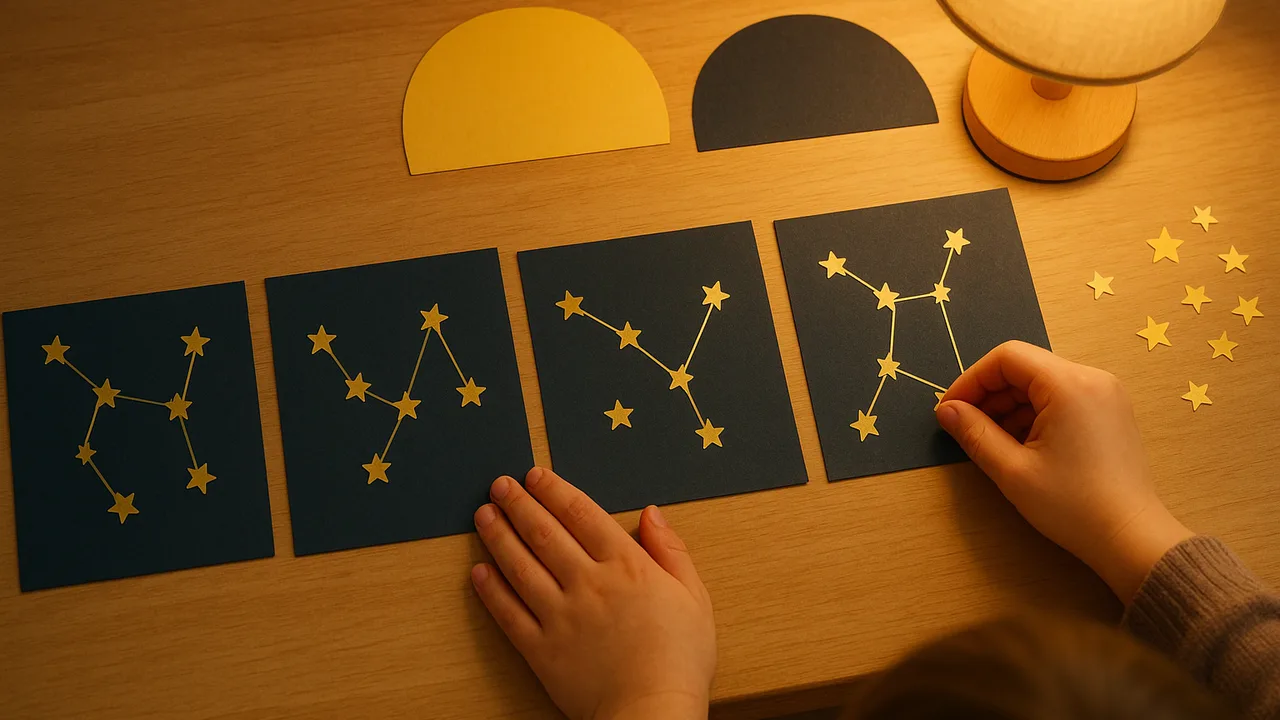
organize data about which constellations show in each season and how many hours of daylight we get each month, then describe the yearly patterns.
- I can organize data about how the length and direction of shadows change at different times during one day using graphs or charts.
- I can use graphs to show how the amount of daylight changes throughout the year by recording sunrise and sunset times.
- I can organize data to show which stars or groups of stars are visible in the night sky at different times of the year.
- I can use my data to explain how the sun’s movement across the sky causes shadows to change in length and direction during the day.
- I can use my data to describe how the length of the day changes throughout the year, with longer days in summer and shorter days in winter.
- I can use my data to explain that some stars or groups of stars can be seen all year, while others are only visible at certain times.
Phase 2: Investigate
Warm-Up ~5 min
Do Now. Think about walking home from a winter activity at 5:30 in the evening. Is it light or dark? Now think about 5:30 in June. Make a prediction.
Which month do you think has the MOST hours of daylight where we live?
Instruction ~10 min
Junior astronomers, today you are data organizers. A sky calendar needs patterns that repeat every year. Our data comes from two sources. First, star charts show which constellations are easy to see in the evening, about 9:00 p.m. Second, almanacs and weather sites list sunrise and sunset times, so we can count the hours of daylight.
Data set 1: evening constellations from our area. Put a check in each season the constellation is easy to see in the evening.
| Constellation | Winter | Spring | Summer | Fall |
|---|---|---|---|---|
| Orion (the Hunter) | ||||
| Leo (the Lion) | ||||
| Scorpius (the Scorpion) | ||||
| Pegasus (the Winged Horse) | ||||
| Cassiopeia (the W shape) | ||||
| Little Dipper (with the North Star) |
Use these star-chart notes: Orion is easy to see on winter evenings. Leo is a spring constellation. Scorpius sits low in the south on summer evenings. Pegasus rides high on fall evenings. Cassiopeia and the Little Dipper stay in our northern sky on clear nights all year.
Data set 2: hours of daylight. These are rounded values for the middle of each month in many places in the northern United States, about 40 degrees north of the equator. Your own town’s numbers may be a little different. Make a bar graph with months along the bottom and hours up the side.
| Month | Jan | Feb | Mar | Apr | May | Jun | Jul | Aug | Sep | Oct | Nov | Dec |
|---|---|---|---|---|---|---|---|---|---|---|---|---|
| Daylight (about, hours) | 9½ | 10½ | 12 | 13 | 14½ | 15 | 15 | 14 | 12½ | 11 | 10 | 9½ |
| My bar is (short / medium / tall) |
Worked example 1: a star pattern. Priya’s team checked Orion for winter only and Scorpius for summer only. Then they noticed something. Those two are never easy to see on the same evening. But Cassiopeia got checks in every season. Some star pictures show all year, and others only at certain times of year.
Worked example 2: a daylight pattern. Diego’s team graphed the daylight hours. The bars climbed from about 9½ hours in winter to about 15 hours in June, then shrank back down. Summer days are longer, and winter days are shorter. The pattern repeats every year. Today we only describe these patterns. Why seasons happen is a question for middle school.
Guided Exercises ~15 min
Use your two organized data sets to answer these with your team.
Independent Practice ~10 min
Use your organized data.
Describe the yearly pattern in daylight hours. Use at least three months from the table as evidence.
Night Sky Night is in spring. Which constellations from our table should the sky calendar tell families to look for? Explain.
Closure ~5 min
We organized two yearly patterns: seasonal star pictures and changing daylight. Our investigations are done! Next, in Make Sense, we explain what all of this evidence means.
Exit ticket: name one pattern that repeats every day and one that repeats every year. Which tool will use each one?
Teacher notes
Materials: printed data tables, graph paper, colored pencils, optional printed seasonal star charts for our latitude (free planisphere printables work well).
Setup: the daylight values are rounded to the nearest half hour for mid-month at about 40 degrees north latitude, which fits many places in the northern United States; have students check an almanac or sunrise-sunset site for your own location’s exact times. The constellation notes describe easy evening viewing around 9 p.m.; at other hours of the night the picture changes, which is fine to mention.
Listen for: “summer is warmer because Earth is closer to the Sun.” Do not teach the cause of seasons (outside 5-ESS1-2); note it on the Wonder Board. Treat seasonal constellations as a pattern only today.
Support / stretch: give a partly filled graph. Stretch: add Cygnus or Gemini from a star chart to the table and defend each check.