3.18 Roots on the Bank
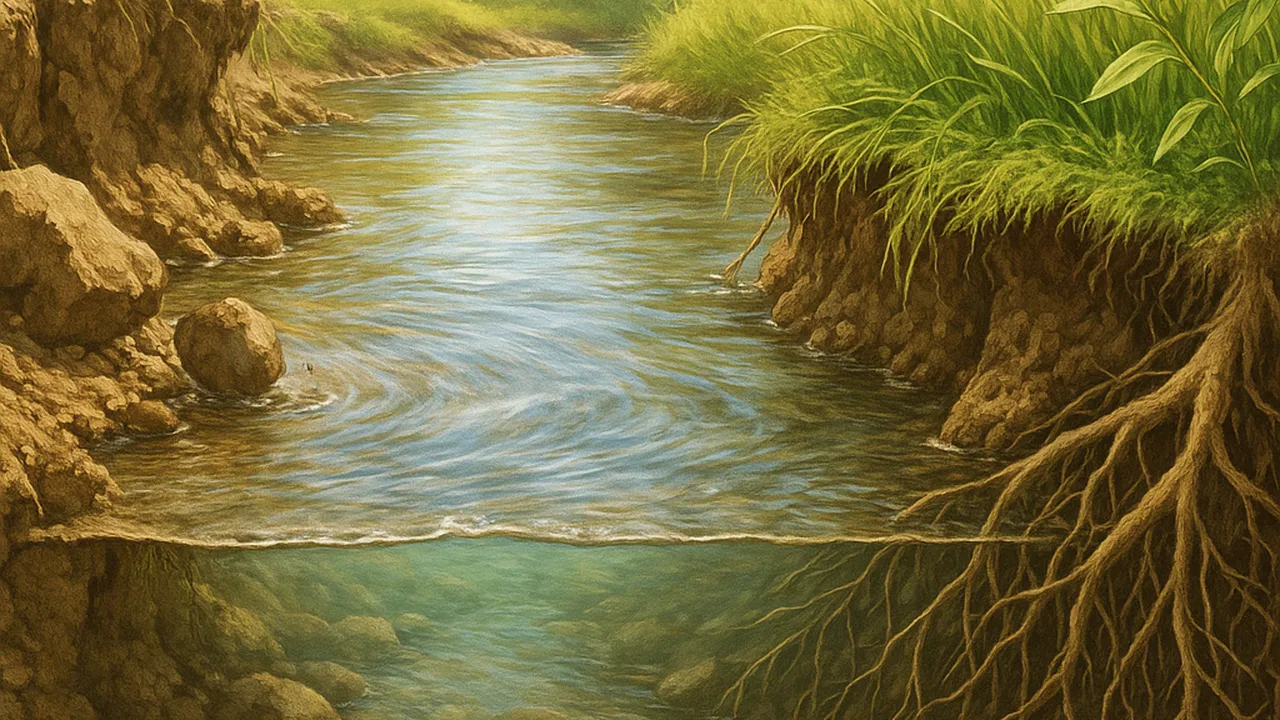
test whether plants on a stream bank reduce erosion, and explain how living things, land and water interact on the bank.
- I can use my model to explain different ways the two Earth systems in my example work together to change Earth’s surface.
- I can use my model to show how parts of one Earth system help that system work and also help the other system work.
- I can carry out my investigation and collect and record data by following my plan.
- I can describe how I will collect evidence about how well my model or prototype meets the criteria and constraints.
- I can identify and describe specific parts of my model or prototype that do not meet the criteria or constraints.
- I can explain which parts of my model or prototype could be improved to better meet the criteria and constraints.
Phase 4: Build
Warm-Up ~5 min
Do Now. Pull up a weed or look at a plant’s roots in a picture. What is stuck to the roots? Why do you think the soil hangs on?
Two model stream banks get the same water. One is bare soil. One is covered in grass. Which loses more soil?
Instruction ~10 min
Today’s fix: the stream bank. A stream bank is the land at the edge of a creek. When it rains hard, the creek rises and flows fast. Fast water can scrape soil off a bare bank. This wearing away and carrying off of soil is called erosion. The soil ends up in the creek, making the water muddy.
How plants help. This is the biosphere and the geosphere working together. Roots spread through the soil and hold it like a net. Leaves and stems slow down the water. Shade from trees keeps the creek cooler, which helps fish. Fallen leaves feed insects that fish eat.
The bank test. Each team builds two banks in foil pans or trays, tilted the same way. Bank A is bare soil. Bank B has a piece of sod or grass grown in a cup. Pour the same cup of water down each bank from the same height. Catch the runoff and compare.
Worked example 1: Jamal’s results. Bank A’s runoff was dark brown, muddiness 5. A groove was carved into the soil. Bank B’s runoff was light tan, muddiness 2. The grass bank looked almost the same as before. These are sample results.
Worked example 2: finding a failure point. Mei’s grass bank still had a muddy spot. She looked closely. Water ran around the edge of the sod where there were no roots. That edge is a failure point. Her team wrote: “Plant all the way to the edge of the bank.”
| Bank | Water poured | Muddiness (1–5) | What the bank looks like after | Failure points we noticed |
|---|---|---|---|---|
| A: bare soil | ||||
| B: with plants |
Guided Exercises ~15 min
Run the bank test with your team. Use the arrows to move through each step.
Independent Practice ~10 min
On your own, use your model to explain a change to Earth’s surface.
Use your bank results to explain two ways the biosphere and the geosphere work together to change, or protect, the land along a creek.
🔎 Mini case study: Planting Buffers Along Streams ~6 min
Across many states, farmers, towns and volunteers plant trees, shrubs and grasses along streams. These strips of plants are called stream-side buffers. Conservation groups and government agencies help pay for plants and show people how to plant them.
Scientists have studied buffers for many years. Roots hold stream banks together, so less soil washes into the water. The plants also catch some of the mud and fertilizer running off fields and lawns before it reaches the stream. Tree shade keeps the water cooler, which helps fish like trout.
Buffers take time. Young trees need protection from deer and need several years to grow big roots. So groups often use tree tubes and come back to check on the plants. Like engineers, they look for what is not working and fix it.
Think about it: How is a stream-side buffer like your Bank B, and what is one way a real buffer is harder to build than your model?
Closure ~5 min
You saw living things and land work together to protect water. Next time, a mid-build checkpoint to see what is sticking.
Exit ticket: in one or two sentences, tell the watershed group why plants belong on the creek bank. Use your data.
Teacher notes
Materials: foil pans or trays (two per team); potting soil; sod pieces or grass grown in cups since 3.15; books to tilt trays; measuring cups; clear cups to catch runoff; muddiness color card.
Setup: Pour the same 250 mL down each bank from the same height, from a cup with a small pinched spout. If live grass is not possible, use a paper-towel-and-yarn “root mat” pressed into the soil, and discuss how it differs from real roots.
Listen for: “plants drink up all the creek water.” Plants use some water, but their big job here is holding soil and slowing runoff. Keep the model to two systems at a time.
Support / stretch: Give a sentence frame for the independent practice. Stretch: test a bank with mulch only and compare it to grass.