4.04 Globe Gravity: Down on the Other Side of the World
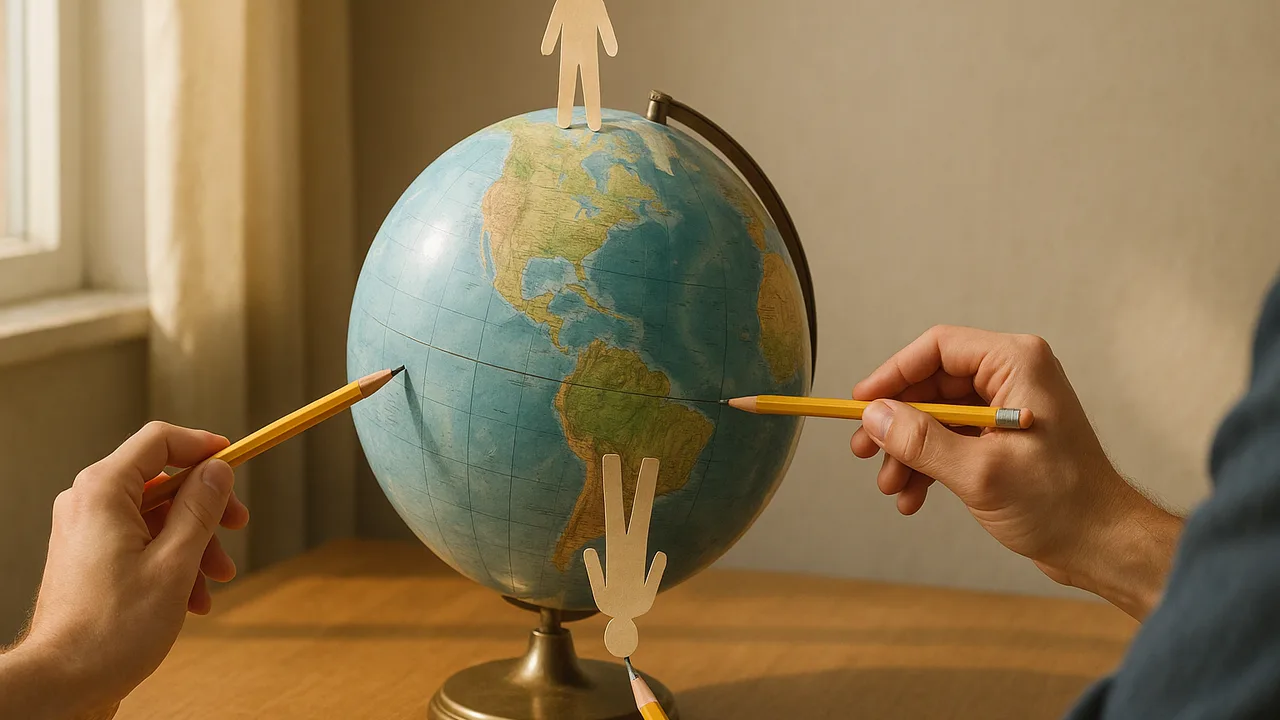
use a globe and paper figures to model which way is down around the world and judge whether our evidence about Earth’s shape is strong enough.
- I can describe evidence that shows Earth is shaped like a sphere, such as ships disappearing over the horizon, the shape of Earth’s shadow on the moon, and the changing height of the North Star.
- I can explain that objects dropped anywhere on Earth appear to fall straight down.
- I can describe that people all around the world see objects fall straight down, no matter where they live.
- I can evaluate whether the evidence about Earth’s shape and objects falling down is enough and relevant to support the claim about gravity.
- I can describe if more evidence is needed to support the claim that Earth’s gravity pulls objects down.
Phase 2: Investigate
Warm-Up ~5 min
Do Now. Look at the globe. Find where we live. Now find Australia. If a kid in each place drops a ball, which way does each ball go? Point with both hands before we test it.
On the globe, where do the two dropped balls end up going?
Instruction ~10 min
Junior scientists, today you build a model. Each team tapes four small paper figures to a globe or a large ball. Put one where we live, one in Australia, one in Brazil and one near the North Pole. Each figure stands with its feet on the ground. Give each figure a paper arrow that shows which way its dropped ball would fall: from its hand toward its feet.
Follow the arrows. Now imagine each arrow keeps going, right through the ground. Use a string from each figure’s feet, stretched straight along its arrow. Where do the strings head? Record what you find.
| Figure’s location | Which way its arrow points on the globe | Does the arrow head toward the globe’s center? (yes / no) | What the figure sees when it drops a ball |
|---|---|---|---|
| Where we live | |||
| Australia | |||
| Brazil | |||
| Near the North Pole |
Worked example 1: is Earth really a ball? Our model only works if Earth is round like a ball. Scientists call that shape a sphere. Here is some evidence. Ships sailing away disappear from the bottom up, as if going over a hill. During an eclipse of the Moon, Earth’s shadow on the Moon has a curved edge. And travelers see the North Star sit lower in the sky as they go south, and higher as they go north.
Worked example 2: is the evidence enough? Priya’s team asked two questions about each clue. Is it relevant, which means does it really connect to our question? Is it enough, or do we need more? They decided the ship clue is relevant to Earth’s shape. But one clue alone is not enough. The eclipse and North Star clues together made the case much stronger. They also wanted more evidence about falling objects in faraway places.
Define the problem. Add one criterion to our chart. The shadow clock’s stick must stand straight up, along the same line a plumb line hangs. Why might that matter for a clock that families will trust?
Guided Exercises ~15 min
Use your globe model and your table to answer these with your team.
Independent Practice ~10 min
Draw a simple model in your notebook.
Draw a circle for Earth with four people standing around it. Add an arrow for each person's dropped ball. Then write one sentence about what all the arrows have in common.
Pick one clue about Earth's shape. Is it relevant? Is it enough by itself? Explain.
Closure ~5 min
Our figures all agreed: down points toward the middle of the globe. We also judged our evidence about Earth’s shape. Next time, we turn off the lights and explore how distance changes brightness.
Exit ticket: explain why a person in Australia does not fall off Earth. Use the words down and center.
Teacher notes
Materials (per team): a globe or large ball (a playground ball with our home spot drawn on by hand works), four small paper figures, tape, paper arrows, string. Optional: a photo of a lunar eclipse and a toy boat moving away over a large ball for the ship clue.
Setup: pre-cut figures and arrows. Mark our home, Australia and Brazil on plain balls ahead of time.
Listen for: “down means toward the bottom of the globe” (down means toward Earth’s center from wherever you stand). Keep the North Star clue simple: it appears lower as you travel south. Do not introduce orbits or the strength of gravity; 5-PS2-1 is about direction.
Support / stretch: give a frame: “Every arrow points toward ___.” Stretch: ask what a figure standing exactly at the South Pole would see when dropping a ball.