4.23 Peer Critique and Iteration: Version 2
give and use peer critique to evaluate evidence and improve our grow lab and garden-to-body exhibit.
- I can evaluate the evidence I use to support my claim by identifying the types of sources, checking if the evidence is valid and reliable, and considering other possible explanations.
- I can use oral or written arguments to support or challenge an explanation or model about how the body is a system of interacting subsystems.
- I can describe how the data from my model, along with the criteria and constraints, can help me improve my design through testing and making changes.
Phase 4: Build
Warm-Up ~5 min
Do Now. Think of a time someone gave you advice that made your work better. What made that advice useful instead of hurtful?
Which piece of feedback is most useful to a design team?
Instruction ~10 min
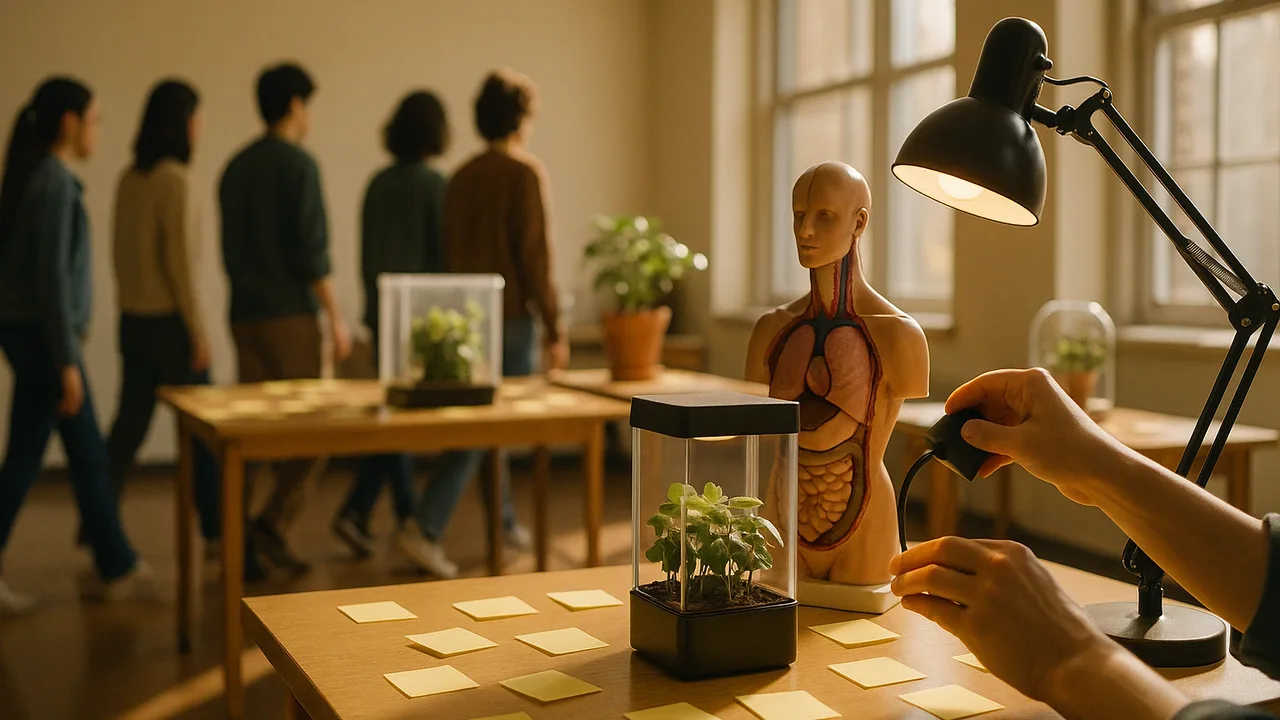
Grow-lab engineers, today is gallery critique. Each team posts its grow lab data, its model and its exhibit draft. Visitors leave sticky notes using three stems: I like…, I wonder…, What if…
Critique the evidence, not only the design. Ask: Where does this evidence come from? Is it our own measurement, a trusted website, or someone’s guess? Is it enough? Could something else explain it?
Worked example 1: critiquing an exhibit claim. One exhibit panel said, “The heart digests your food.” Diego wrote, “I wonder if you mixed up two systems? The digestive system breaks food down; the circulatory system, with the heart, carries it.” The team fixed the panel and added a source, their health textbook.
Worked example 2: iterating the grow lab. Priya’s team got the note, “What if the plants at the tray edges are shorter because they get less light?” Their data showed edge plants averaged 6 cm and center plants 9 cm (sample data). Their model had assumed even light, which was a limitation. Version 2 lowered the lamp and added foil walls. They will retest before harvest.
| Feedback we got | Evidence it is right or wrong | Change for version 2 | How we will check it |
|---|---|---|---|
Guided Exercises ~15 min
Practice critique on sample work before the gallery walk.
Independent Practice ~10 min
Gallery walk, then plan version 2.
Leave at least three notes on other teams' work: one I like, one I wonder and one What if. Each must point to a piece of evidence.
Back at your station: choose the two most useful notes you got. Fill in the version 2 table and explain how your data will show whether each change worked.
Closure ~5 min
Version 2 is ready, grow-lab engineers. Next comes harvest day: the real test against our criteria.
Exit ticket: which piece of feedback changed your thinking most, and what evidence convinced you?
How confident are you that you can I can use critique and data to improve a design and a model.
Teacher notes
Materials: sticky notes in three colors, team posters, grow-lab data logs, the version 2 table.
Setup: model one kind and one unkind critique first. Allow 12 minutes of gallery walk and 15 for revising. Edge-versus-center data is sample data; many classrooms really do see it.
Listen for: notes with no evidence; teams that dismiss every note; mixing up which system does which job.
Support / stretch: give a sentence-stem card. Stretch: ask teams to write an alternative explanation for their own best result and a test to rule it out.