3.11 The Cell as a System: Building a Cell Model
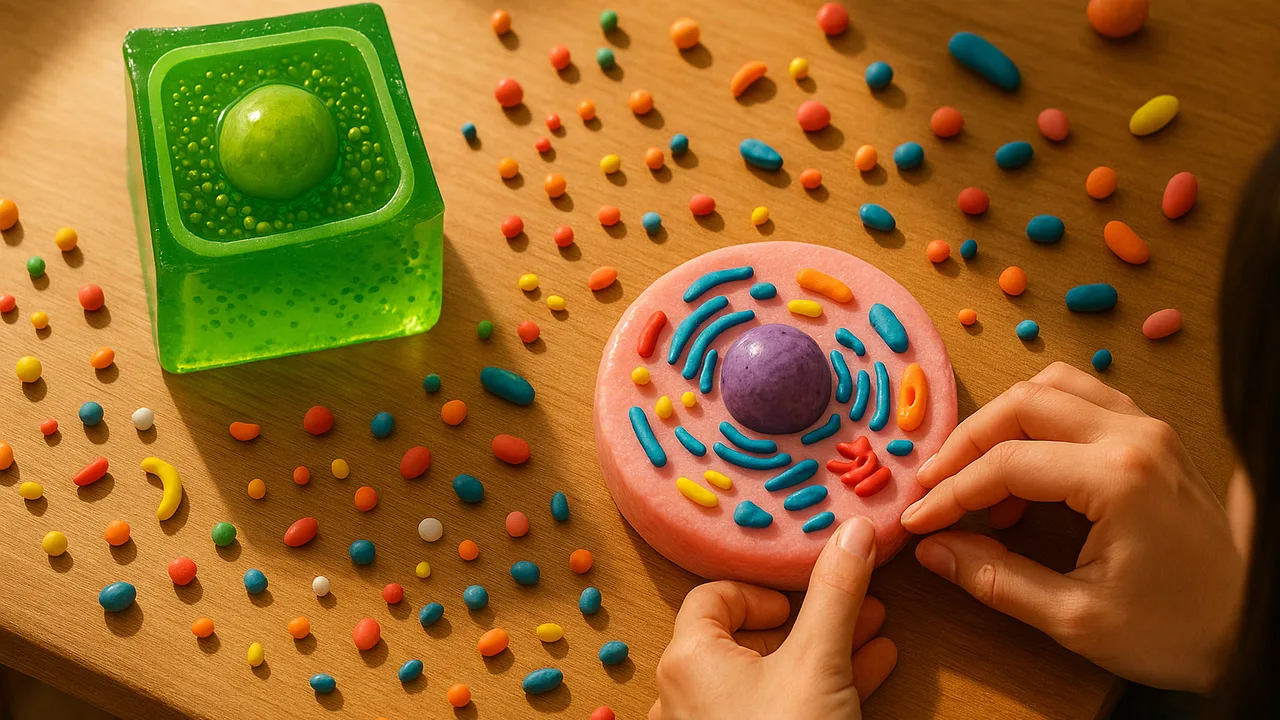
build a model of a plant cell and an animal cell and use it to explain how the nucleus, chloroplasts, mitochondria, cell membrane and cell wall help the whole cell work.
- I can develop a model of a cell and identify the main parts, including the nucleus, chloroplasts, mitochondria, cell membrane, and cell wall, and show how the cell works as a whole.
- I can use my model to describe how each part of the cell, like the nucleus, chloroplasts, mitochondria, cell membrane, and cell wall, helps the cell do its job.
- I can explain how the structure of the cell membrane or cell wall relates to their function and affects how the cell and its parts work together.
- I can use my model to explain how different parts of a cell, both alone and together, help the cell get energy and keep its internal processes going.
- I can describe how the cell membrane and cell wall help the cell keep its shape and control what enters and leaves the cell.
- I can show how all the parts of a cell work together as a system to make the cell function.
Phase 3: Make Sense
Warm-Up ~5 min
Do Now. Look at your elodea and animal tissue sketches. List every cell part you saw. Then predict.
Elodea cells are full of chloroplasts. Do they also need mitochondria?
Instruction ~10 min
The cell as a system. In 3.02 we mapped the microscope station as a system. A cell is a system too. Each part has a job, and the parts depend on each other. If one part fails, the whole cell is in trouble.
- Cell membrane: a thin, flexible boundary around every cell. It controls what enters and leaves, such as water, food and wastes.
- Cell wall (plants): a stiff layer outside the membrane. It supports the cell and keeps its box shape. Water and small materials can pass through it.
- Nucleus: holds the cell’s instructions and directs its activities, such as growing and dividing.
- Chloroplasts (plants): capture light energy and use it to make food (sugar) from water and carbon dioxide.
- Mitochondria: release the energy stored in food so the cell can use it.
Worked example 1: the cell as a health clinic. Jamal compared a plant cell to our client’s clinic. The nucleus is the director’s office with the instruction binders. The membrane is the front desk, deciding who comes in and goes out. The cell wall is the building’s sturdy frame. Chloroplasts are solar panels on the roof. Mitochondria are the generator that turns fuel into usable power. He also wrote one limit: a real cell has no walls between rooms, and its parts float in a jelly-like fluid.
Worked example 2: a hands-on model. Mei’s team used a sealed zip-top bag of clear gel for the membrane and placed it inside a small clear plastic box for the wall. A grape was the nucleus, green peas were chloroplasts and raisins were mitochondria. For the animal cell, they used the bag without the box and without peas. Squeezing both models showed how the wall keeps a plant cell’s shape, while the animal cell bends.
| Part | Plant cell? | Animal cell? | Model material | Job | What happens to the whole cell without it? |
|---|---|---|---|---|---|
| Cell membrane | |||||
| Cell wall | |||||
| Nucleus | |||||
| Chloroplast | |||||
| Mitochondrion |
Guided Exercises ~15 min
Use your model to answer each card.
Independent Practice ~10 min
Finish your model and table.
Draw and label your plant and animal cell models. In three or four sentences, explain how the parts work together so the cell gets energy and stays alive.
How confident are you that you can I can use a model to explain how cell parts work together as a system.
Closure ~5 min
Cells are tiny systems that do everything life needs. Next time, we use all our evidence to argue that every living thing is made of cells.
Exit ticket: compare a plant cell and an animal cell. Name two parts they share, two parts only plant cells have, and the job of one of those plant-only parts.
Teacher notes
Materials (per team): zip-top sandwich bag, clear gel (hair gel or unflavored gelatin made ahead), small clear plastic box, a grape, green peas, raisins, paper towels. Check allergies; beads or clay work as substitutes.
Setup: 15 minutes of building, 10 minutes of table and analogy. Remind students that mitochondria were not visible on our slides; we rely on scientists’ stronger microscopes for that evidence.
Listen for: “plants have chloroplasts instead of mitochondria” and “the cell wall controls what enters.” Keep functions at the whole-cell level, with no biochemical steps (MS-LS1-2 boundary).
Support / stretch: provide a labeled model diagram to copy. Stretch: explain why a one-celled pond organism must have every one of these jobs covered inside a single cell.