2.06 Why the Truck Runs Away and How Gravel Stops It: Model Revision and Ideate
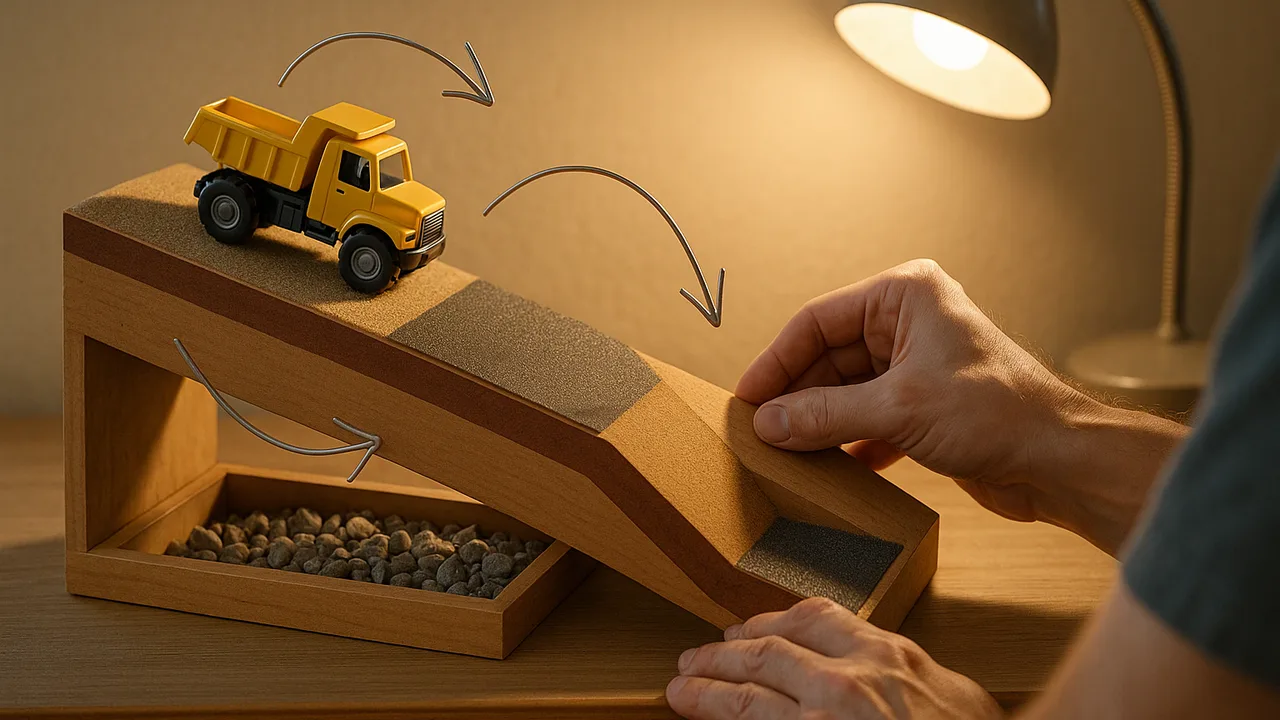
revise the runaway-truck model into one force explanation, support it with data from the unit, and brainstorm escape-ramp concepts for each sub-problem.
- I can use tools, technologies, or models to analyze data and identify that a more massive object has a smaller acceleration than a less massive object when the same net force is applied.
- I can analyze data to show that a larger net force on a given object produces a larger acceleration.
- I can use data to show that gravitational force causes a constant acceleration on macroscopic objects, as seen when the ratio of net force to mass stays the same.
- I can use analyzed data as evidence to describe how the relationship between net force, mass, and acceleration is accurately modeled by the formula a = Fnet/m.
- I can explain how solving the sub-problems helps address the larger problem and describe how the solutions to the sub-problems are connected.
Phase 3: Make Sense
Warm-Up ~5 min
Do Now. Look at your first explanation of the runaway truck from 2.01. Cross out one idea that the labs have shown is wrong or incomplete, and write what replaces it.
On a downgrade, a 10,000 kg truck and a 30,000 kg truck coast with no braking or drag. Which is true?
Instruction ~10 min
Revising the model. In 2.01 most teams wrote something like “the truck is heavy, so it goes fast.” The labs replace that with a force model in three parts:
- The runaway. Along the downgrade, the unbalanced force is mg sin θ, so a = g sin θ, the same for every mass. Brakes must supply an equal backward force for the whole descent, and when they overheat they cannot.
- The gravel. The bed pushes back with a friction-like force μmg cos θ. The friction lab showed this force grows with the normal force, and so with mass, not with contact area.
- The upgrade. On the ramp, the weight component now points backward, adding to the gravel’s force: a = g(sin θ + μ cos θ).
Worked example 1: evidence for each link. Jamal’s team builds a table: a ∝ Fnet (cart lab slope, r2 = 0.9985); a smaller a for a larger mass at the same pull (cart extension); friction ∝ FN (friction lab slope 0.32, area effect smaller than the spread); a = g sin θ on a slope (Unit 1 ramp, within 7%). Every arrow in their model now points to data.
Worked example 2: a quantitative check. A loaded truck of 36,300 kg on a 5% gravel upgrade with μ = 0.25 (illustrative): the backward forces are mg sin 2.86° = 17,770 N and μmg cos 2.86° = 88,830 N, together 106,600 N. Then a = 106,600/36,300 = 2.94 m/s2, the same as g(sin θ + μ cos θ). The model and Newton’s second law agree exactly, which is a good sign we set up the forces correctly.
CER sentence starters. I claim … / Evidence from the cart and friction labs shows … / This happens because Fnet = ma … / A limit of this model is …
Ideate: ramp concepts for the client. Real escape ramps come in a few broad types. A gravity ramp is a long, steep paved or packed upgrade that relies mostly on the slope; its weakness is that a stopped truck can roll back. An ascending arrester bed combines an upgrade with deep loose gravel. A level or sand-pile bed relies mostly on the loose material. Some sites add steel-net arresting barriers at the end of a bed. Brainstorm at least one solution for each sub-problem (design speed, deceleration, length, site), then link them: the deceleration you choose sets the length, and the length must fit the site.
Guided Exercises ~15 min
Revise the model with your team.
Independent Practice ~10 min
Ideate for the client.
For each of the four sub-problems, list at least two possible solutions. Then draw arrows that show how the solutions connect (for example, a steeper grade shortens the length, which helps the site fit). Circle the three ramp concepts your team will compare in the Build phase.
Closure ~5 min
Model revised and ideas on the board. Next: prototype, test and choose.
Exit ticket: explain how solving the “deceleration” sub-problem changes the “length” and “site” sub-problems.
Teacher notes
Materials: chart paper, the class data from 2.03 and 2.04, sticky notes for the brainstorm.
Setup: post the original 2.01 explanations so students can see the revision. All truck numbers are illustrative.
Listen for: “heavier trucks need longer ramps” (not in this model, though heavier trucks may sink deeper in reality); forgetting that the weight component reverses direction on the upgrade.
Support / stretch: give a three-box model organizer (runaway, gravel, upgrade). Stretch: add air drag qualitatively and explain why it cannot stop a runaway on its own.