1.01 The Melting Lunch Mystery
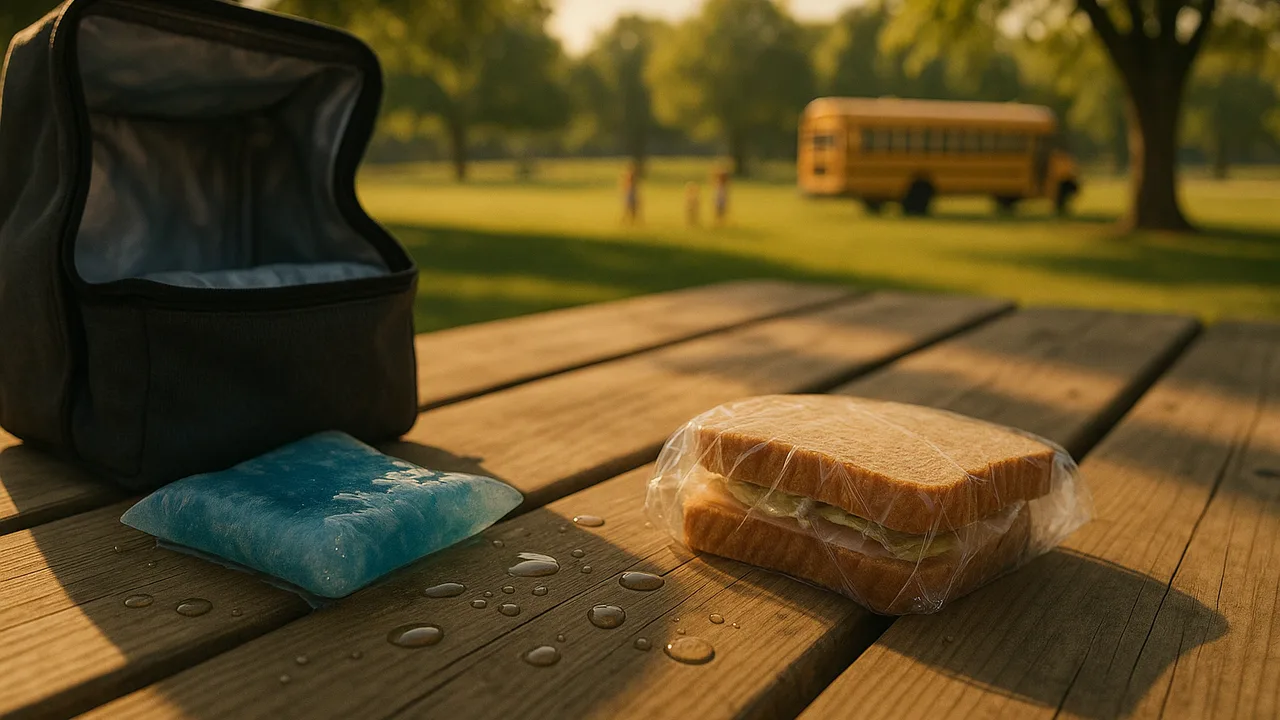
The Field Trip Lunch Cooler
How can we design a lunch cooler that keeps food cold and safe all day without electricity?
The mystery: An ice cube melts in minutes on a sunny bench, but ice stays frozen for hours inside a good cooler. A hand warmer gets hot just by being opened. What is happening to the particles?
Questions we will figure out together in this unit:
- Why does ice melt faster in the sun than in the shade?
- Does a cooler keep cold in, or keep heat out?
- What is ice made of, if we could zoom in really far?
- Why does a hand warmer get hot just by opening it?
- Which materials make the best walls for a cooler?
- Why is a foam cooler so light?
- Where does plastic come from?
- Does salt on ice make it colder or warmer?
describe the field trip team’s lunch problem as one that engineers could solve with a new object, tool or system.
- I can describe a problem that could be solved by creating an object, tool, process, or system.
Phase 1: Spark
Warm-Up ~5 min
Do Now. Your teacher sets one ice cube on a dark plate near a sunny window. A second, matching ice cube goes into a small closed cooler. We will check both at the end of class. Make your prediction before anything else.
After 45 minutes, what will the two ice cubes look like?
Instruction ~10 min
A request from our client. The 6th-grade field trip team has a problem. This spring, the whole grade spends a long day at an outdoor nature park. The buses leave in the morning and return in the afternoon. There is no refrigerator, no outlet and no store nearby.
Why does it matter? Many lunches include yogurt, milk, cheese or a turkey sandwich. Food safety experts at the U.S. Department of Agriculture say cold food should stay at 4°C (40°F) or colder. Between about 4°C and 60°C, bacteria can multiply quickly. Food left warm for more than two hours should be thrown away.
Cooler engineers, here is your mission. Design a lunch cooler that keeps food cold and safe all day, without electricity. To do that well, you first need to understand what matter is made of and how thermal energy moves.
Worked example 1: object, tool, process or system? Engineers solve problems by creating something new. A cooler is an object. A plan for packing it in a certain order is a process. The cooler, the ice, the food and the packing plan together form a system. Our solution may include all three.
Worked example 2: a clear problem statement. Mei wrote, “Coolers are cool.” That names no person and no need. Jamal wrote, “The field trip team needs a way to keep 6th-grade lunches at 4°C or colder for a full day without electricity, so no one gets sick.” Jamal’s statement names who, what and why, and it includes a number we can test.
Our teams. Teams of four rotate roles every lesson. The Materials Manager gets and returns supplies. The Recorder keeps the data table. The Tester runs procedures and reads instruments. The Reporter and Safety Lead checks goggles and shares the team’s ideas.
Guided Exercises ~15 min
Work through these with your team. Use the arrows to move between cards. Talk it over before you lock in an answer.
Independent Practice ~10 min
Start our class Wonder Board on your own.
Write two questions you wonder about: one about why ice melts, and one about how a cooler slows it down. Put each on a sticky note.
How confident are you that you can I can describe our client's problem as one engineers could solve.
Closure ~5 min
Check the two ice cubes now. Record what you see. Next time, we map every part of the cooler system and decide which parts matter most.
Exit ticket: write a problem statement for the field trip cooler. Name who needs it, what they need and why it matters.
Teacher notes
Materials: 2 matching ice cubes, a dark plate, a small closed cooler or insulated lunch bag, sticky notes, chart paper for the Wonder Board, a roles chart. If you can, have a field trip chaperone or the trip coordinator deliver the request in person or by letter.
Setup: start the ice demo before students enter. Post the driving question and the 4°C (40°F) food safety rule; both stay up all unit.
Listen for: “the cooler makes cold” or “cold gets into the food.” Do not correct yet. Lessons 1.05–1.07 give the evidence that thermal energy moves from warmer to cooler matter. The food safety numbers come from USDA guidance; do not add other statistics.
Support / stretch: give a frame: “The ___ needs ___ so that ___.” Stretch: ask students to write one problem statement for a different client, such as a family on a long car trip.