2.02 Where Does the Garden’s Waste Go?
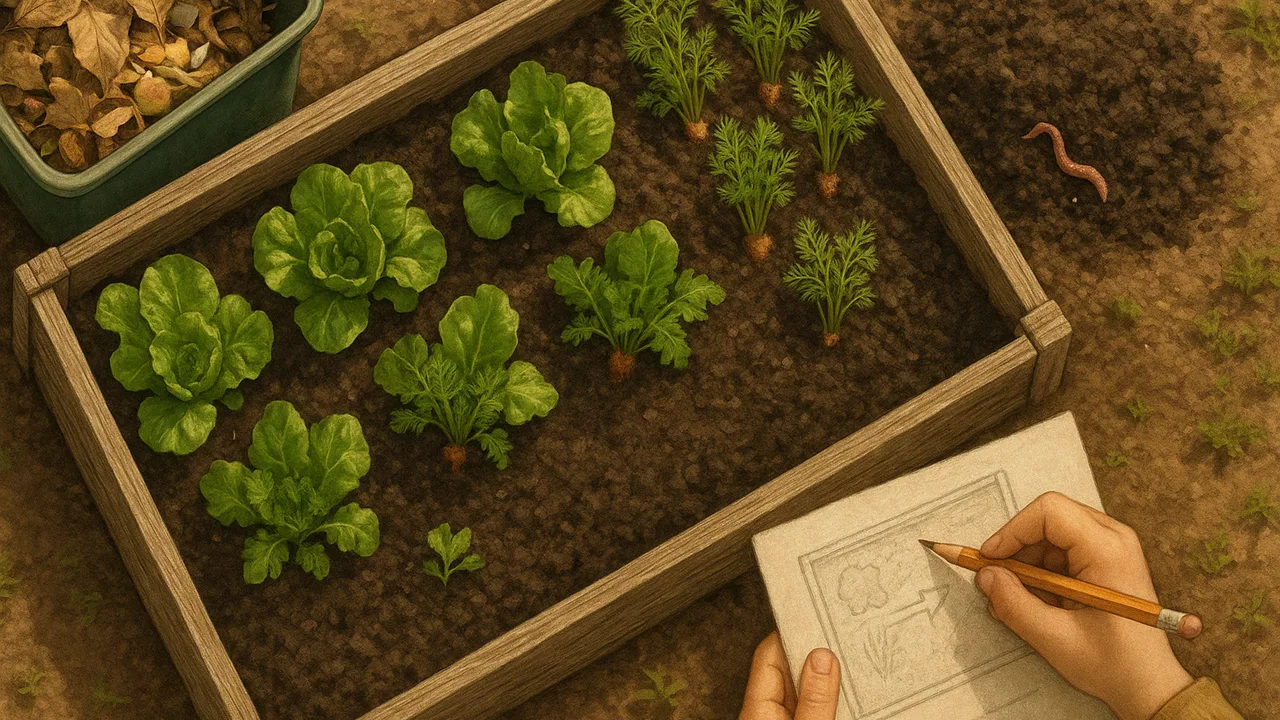
The Zero-Waste School Garden
Where does a plant’s food come from, and how can we design a garden where nothing goes to waste?
The mystery: A pumpkin seed weighs less than a paper clip, yet it can grow into a pumpkin heavier than a fifth grader. Where does all that mass come from?
draw a first model of how food, scraps and soil move through our school garden, sort our Wonder Board, and set up my team.
- I can make a model that shows how matter moves between plants, animals, decomposers, and the environment in an ecosystem.
- I can identify the claim that plants get most of the materials they need to grow from air and water.
Phase 1: Spark
Warm-Up ~5 min
Garden walk. Picture the school garden on a fall morning. You see tomato vines, fallen leaves, a few worms and a trash can full of lunch scraps. Where does each thing go next? Try the question below.
A pile of fallen leaves sits in the corner of the garden all winter. What will it look like in spring?
Instruction ~10 min
A garden is a system. A system is a group of parts that work together. In our garden, the parts include the Sun, the air, water, soil, plants, animals like worms and birds, and people. Matter moves between these parts all the time. Right now, some of it leaves the system as trash.
Worked example 1: following a tomato. Mei follows one tomato. The tomato plant grows in the garden bed. A student eats the tomato at lunch. The stem and core go in the trash. A truck takes the trash away. Mei draws boxes for each part and arrows for each move. Her arrows show where the matter goes. The last arrow leaves the garden, so that matter is wasted.
Worked example 2: closing the loop. Diego redraws Mei’s model. He sends the core to a compost bin instead of the trash. Then he draws an arrow from the compost back to the soil, and from the soil back to the plant. Now the arrows make a loop. This loop is the big idea behind the garden club’s dream.
Sorting our wonders. Today we sort the Wonder Board into three groups. How plants grow covers seeds, soil, light and water. Energy in food covers where our food energy comes from. Who eats whom covers food chains, decomposers and compost.
| How plants grow | Energy in food | Who eats whom |
|---|---|---|
Team norms. Your team will write three norms, such as “We record what we see, not what we hoped to see.”
Guided Exercises ~15 min
With your team, use the garden model to answer each one. The Reporter shares one answer with the class.
Independent Practice ~10 min
Build your first model and set up your team for the unit.
Draw a model of the school garden as it works today. Use boxes for the Sun, air, water, soil, plants, people and trash. Use arrows to show where matter goes. Circle any arrow where matter is wasted.
Write your team's three norms and the role you will take first.
Closure ~5 min
A garden is a system, and matter moves between its parts. Right now some of it leaves as trash. Next, we start investigating, beginning with what plants need to grow.
Exit ticket: describe one change that would turn a “wasted” arrow in your model into part of a loop.
Teacher notes
Materials: chart paper with three columns (How plants grow, Energy in food, Who eats whom), sticky notes, markers, a photo or walk-through of the school garden or a nearby green space, team role cards.
Setup: if possible, walk the class past the garden or the cafeteria trash area for five minutes. Move the 2.01 Wonder Board notes to the sorting chart. Keep student models; they will revise them in 2.12 and 2.13.
Listen for: “the leaves just disappear” (matter goes back to soil and air); “worms eat the dirt” (they eat dead plant matter mixed in the soil). Do not resolve every question; this is a launch.
Support / stretch: provide pre-cut picture cards for the boxes. Stretch: ask where the garden gets its energy, and add the Sun to the model with a different color of arrow.