1.08 Properties Lab: Scratch, Shine, Stick and Spark
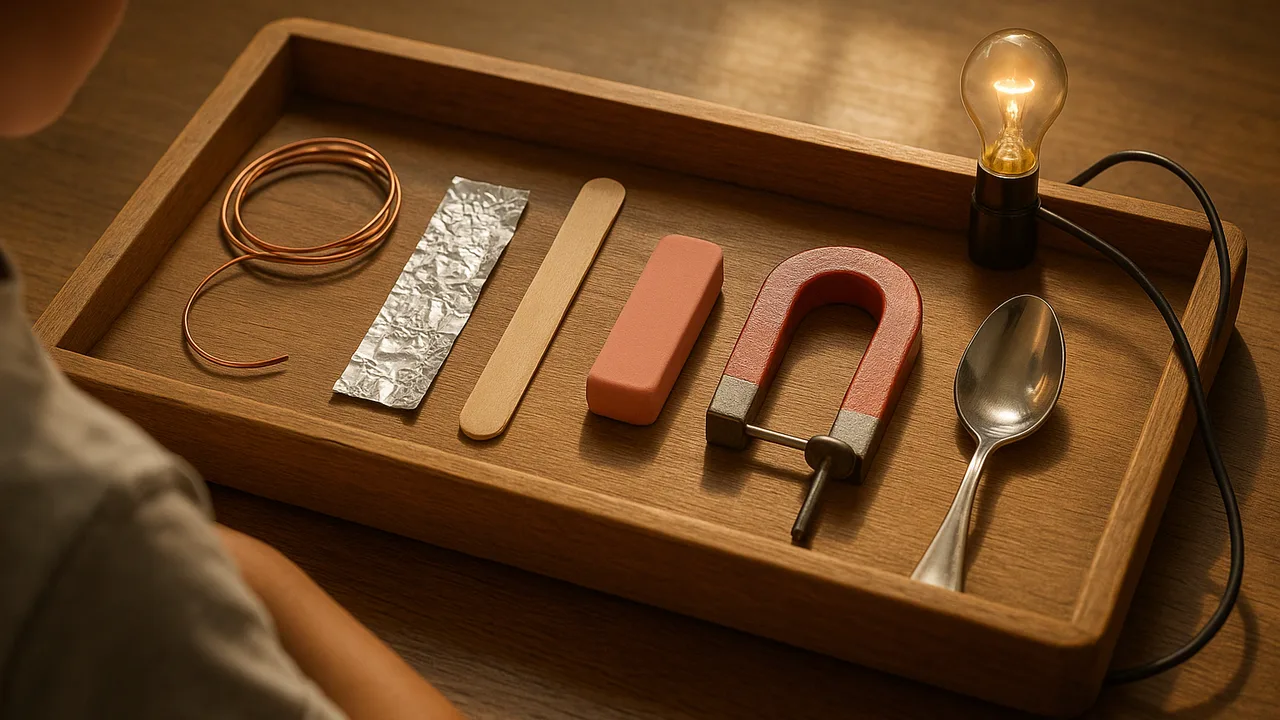
plan and run tests of color, hardness, reflectivity, conductivity and magnetism, and list the criteria and constraints for our test kit.
- I can describe the evidence I will collect, including observations and measurements of properties like color, hardness, reflectivity, conductivity, response to magnets, and solubility.
- I can describe how I will collect data, including measuring properties in standard units, observing properties like color and conductivity, and figuring out if materials are conductors or magnetic.
- I can describe the limits on my design, such as how much it costs, what materials I can use, or how much time I have.
Phase 2: Investigate
Warm-Up ~5 min
Do Now. A pantry volunteer found more mystery items in the kitchen drawer: a gray strip, a shiny coin, a small stick and a white chunk. Your team gets a tray of six objects. Sort them into two groups any way you like.
Which object on your tray will a magnet pick up?
Instruction ~10 min
Pantry detectives, every material has a set of properties. Today you test six solid objects with five tests. Your tray holds aluminum foil, an uncoated steel paper clip, a penny, a wooden craft stick, a plastic spoon, and a piece of chalk.
- Color: describe it in daylight.
- Hardness: try to scratch it with your fingernail, then with the end of the paper clip. Rank from softest to hardest.
- Reflectivity: shine a flashlight on it in a darkened corner. Does it bounce a bright spot onto a white card?
- Conductivity: touch the two bare wire ends of the class circuit tester to the object. Does the bulb light? A material that lets electricity flow is a conductor.
- Magnetism: touch a magnet to it. Does it stick?
| Object | Color | Hardness rank (1 = softest) | Reflects light? (yes / a little / no) | Bulb lights? (conductor / not) | Magnet sticks? (yes / no) |
|---|---|---|---|---|---|
| Aluminum foil | |||||
| Steel paper clip | |||||
| Penny | |||||
| Wooden craft stick | |||||
| Plastic spoon | |||||
| Chalk |
Worked example 1: what are we investigating, and why? Ava’s team wrote their plan first. “We are testing five properties of six objects. We will collect yes/no observations and hardness ranks. We want to show that each material has its own set of properties.”
Worked example 2: one test is not enough. Malik found that foil, the paper clip and the penny all lit the bulb. So conductivity alone could not tell them apart. The magnet test could, because only the paper clip stuck. Using several tests together narrows the choices.
Define our kit. Engineers list criteria, what a design must do, and constraints, the limits it must stay within. Our kit’s criteria: it identifies all five powders correctly, with no tasting. A volunteer can follow the steps from one card. Our constraints: it uses cheap, common materials, with a budget your teacher will set. Each test uses less than half a teaspoon of powder, so most food can still go to families. The whole kit fits in a shoebox. These limits fit what the pantry needs right now.
Guided Exercises ~15 min
Use your table to answer these. The Tester checks any result the team disagrees on.
Independent Practice ~10 min
Plan ahead for the powders.
Which of today's five tests do you think will help with WHITE POWDERS, and which will not? Explain what evidence each useful test would give you.
Add one more criterion or constraint the pantry might want. Is it something the kit must DO, or a LIMIT?
Closure ~5 min
You measured five properties and defined our kit. Next time, we test the five powders themselves with water, vinegar and more.
Exit ticket: name one criterion and one constraint for our test kit, and one property that told two objects apart today.
Teacher notes
Materials (per team): aluminum foil strip, uncoated steel paper clip, penny, wooden craft stick, plastic spoon, chalk, a magnet, a flashlight, a white index card. Class circuit tester: one AA or D battery in a holder, a small bulb or LED in a holder, and three wires with a gap for testing.
Setup: test every object with the tester first; plastic-coated paper clips will not conduct, so use bare steel ones. Set the kit budget now (for example, “$15 or less”) and post the criteria and constraints chart for the rest of the unit.
Listen for: “all metals are magnetic” (only iron, steel and a few others are); “shiny means magnetic.” Pennies are copper-colored but not magnetic.
Support / stretch: let some students record with check marks. Stretch: add thermal conductivity by holding each object for 10 seconds; which feel cool and why?