Theory course. This demo course is online theory education. It is not a cosmetology license, it does not count as California Board of Barbering and Cosmetology training hours, and it does not authorize anyone to perform regulated services. All tool demonstrations are for viewing only.
explain what a school certificate is and is not, and map where I want to go in the beauty industry.
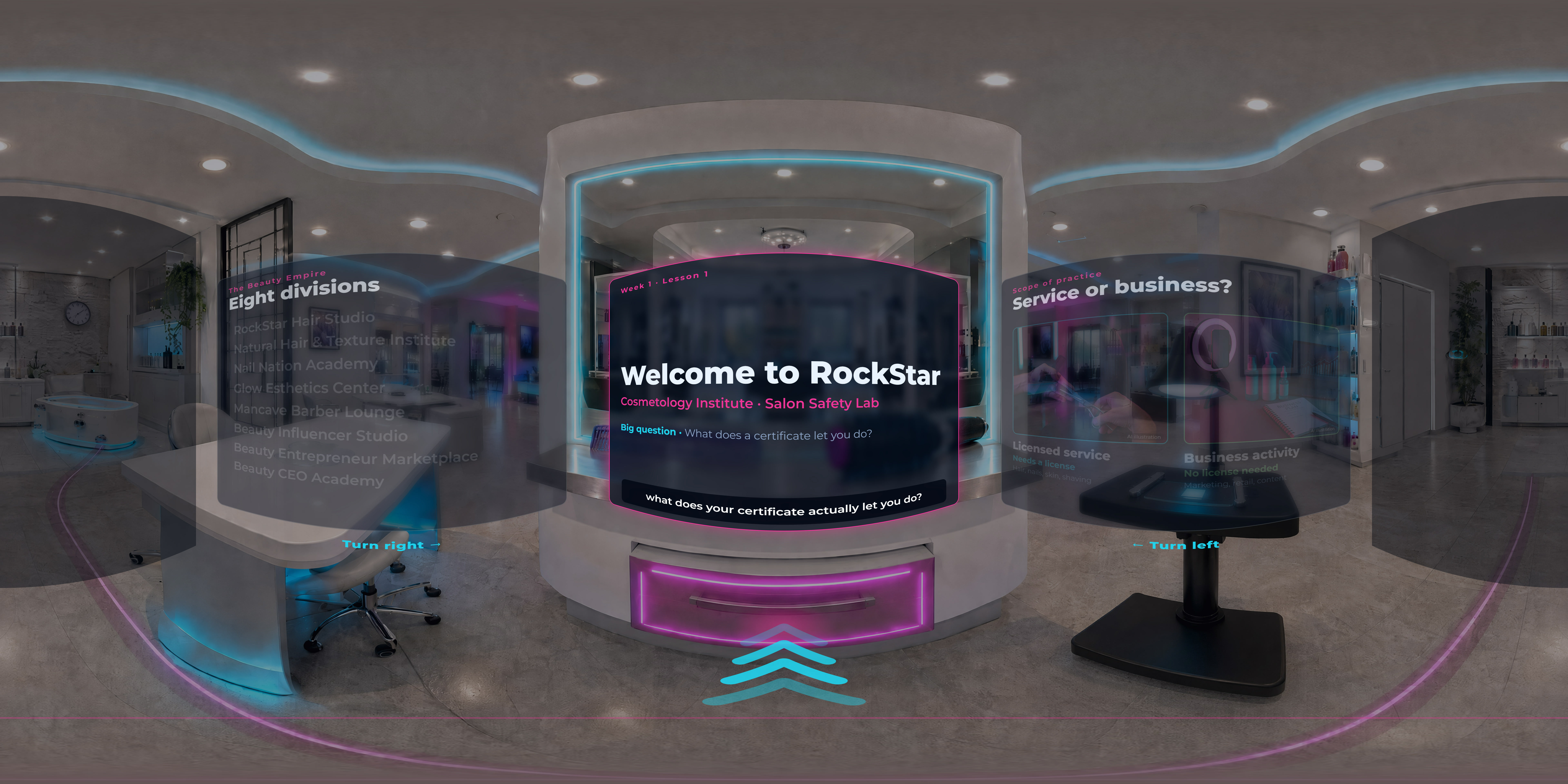
Step into the atrium. Start with the 360° welcome room below. Drag (or move your phone) to look around. The narrator will tell you when to turn. When the vote comes up, pick your answer before the room explains it.
You finish a 36-week online cosmetology theory program and earn its certificate. What can you legally do the next day in California?
Two different pieces of paper. In California, the Board of Barbering and Cosmetology (the Board) protects consumers by licensing the people and the shops that provide hair, nail and skin services. A license comes from the Board. You earn it by completing the required training at a Board-approved school (1,000 hours for cosmetology under current law) and passing the Board’s written examination. A certificate comes from a school. It proves you completed that school’s program and met its academic standard. It does not give you permission to work on clients.
Where this course fits. RockStar’s online programs teach theory: infection control, California law, hair, skin and nail science, client safety, exam preparation, and the business of beauty. That knowledge is real and useful. It prepares you for qualifying training, for the written exam, and for running a beauty business. But online study time is not Board-qualifying training time, and no online certificate is a license.
Scope of practice. Each license has a scope of practice: the services that license allows. A cosmetologist’s scope includes hair, skin and nail services. A manicurist’s covers nails, an esthetician’s covers skin care. Performing or advertising a regulated service for pay without the right license is against the law. That rule protects consumers from infections, burns and chemical injuries, which is exactly what the rest of this week is about.
Licensed service or business activity? Cutting, coloring, chemically texturing or styling hair for a client, manicures and pedicures, facials and hair removal, and shaving are regulated services. Filming and editing content, writing product reviews, marketing, retail sales, pricing, bookkeeping and managing a business are not licensed services. Watch the gray zone, though: performing a regulated service on someone else can still require a license even when it is filmed for social media.
These two pieces start your career portfolio. Your instructor scores the pathway map.
Career pathway map. Pick one or two RockStar divisions that excite you. For each, list (1) a job you could hold, (2) whether that job requires a Board license and which one, (3) the training you would need next, and (4) one business skill you will need.
Mission statement (about 300 words). Write the mission statement for the beauty business you want to build one day: who you serve, what you offer, how clients should feel, and how you will keep them safe.
A license is permission; a certificate is preparation. Next, you will shrink down to microscopic size to see why the Board cares so much about how tools are cleaned.
Exit ticket: in two sentences, explain to a future client why your RockStar certificate is not the same as a license.
Week 1, Track A objectives 1 and 5 and Track B objectives (founding catalog sec. 6). Track B is scored by the instructor (career map rubric: accuracy of license requirements, realistic next steps, business skill named).
Listen for: “the certificate is basically a license”; “I can do it if it’s free”; “filming it makes it legal.” Do not state or imply that any online hours qualify for licensure.