2.02 Project Brief and Wonder Board: The Food Bank’s Cold-Carrier Challenge
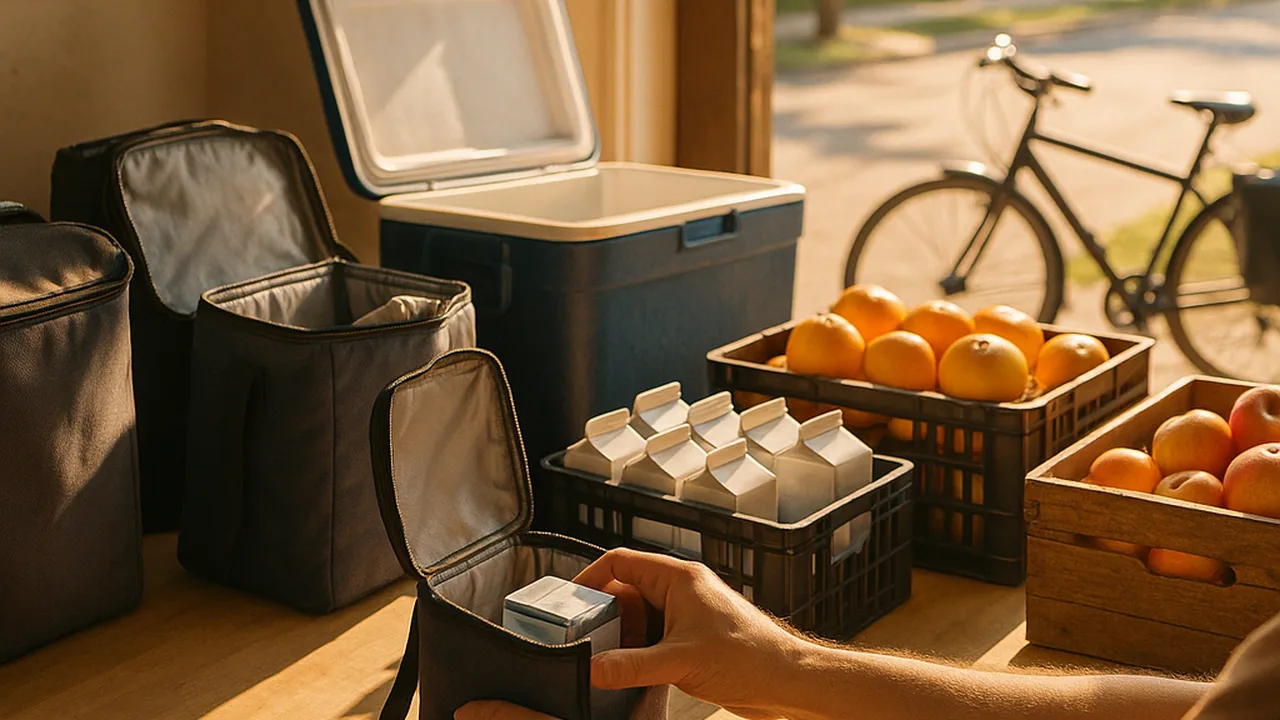
The Cool Carrier: Keeping Food Cold Without a Plug
How can we design a low-cost carrier that keeps food cold on a hot day without electricity, using what we know about how thermal energy moves and why it always flows from hot to cold?
The mystery: On a hot summer afternoon in a hot agricultural valley, a dark roof gets much hotter than a light-colored cool roof right beside it, even though both sit in the same sun and the same air. Why, and where does the extra energy go?
Questions we will figure out together in this unit:
- Why does a dark roof get so much hotter than a white one in the same sun?
- What is the difference between temperature, thermal energy and heat?
- Why does ice keep things cold for so long?
- Why does heat always flow from hot to cold?
- Why is foam a better insulator than solid plastic?
- Where does most of the heat sneak into a cooler: the walls, the lid or the seams?
- Can a cheap carrier keep food safe for a 90-minute route?
- How do we prove our model’s prediction matches a real test?
describe the cold-food problem as a global challenge with evidence, define the carrier as a system, and identify what the food bank and its clients need and want.
- I can describe a major global problem and explain why it is a significant challenge for society or the environment.
- I can use both qualitative and quantitative information to explain how serious the problem is and what could happen locally and globally if it is not solved.
- I can find and document background research about the problem from at least two sources, including research journals.
- I can identify the physical system where the problem exists, including its main parts, how they interact, and what is inside or outside the system boundaries.
- I can describe the needs and wants of society that relate to the problem.
Phase 1: Spark
Warm-Up ~5 min
Do Now. Think about a hot day when you carried food or a cold drink for a long time. What happened to it? List two things that would have kept it cold longer.
A cooler keeps food cold by putting “cold” into the food.
Instruction ~10 min
Meet the client. A community food bank runs a summer home-delivery program. Volunteers drive or walk food to older adults and families who cannot easily reach a pantry. Many routes last more than an hour, and some volunteers deliver on foot or by bike. The program coordinator has written to our class: chilled items such as milk, yogurt and cut fruit warm up during long routes, and the program cannot afford powered coolers. They need a low-cost, reusable carrier that keeps food cold without electricity.
Why this matters beyond one town. Keeping food and medicine cold all the way from where it is made to where it is used is called the cold chain. Food-safety agencies such as the U.S. Department of Agriculture describe a “danger zone” from about 4 °C to 60 °C (40–140 °F), where bacteria grow fastest, and advise that perishable food should not sit out for more than 2 hours, or 1 hour when the air is above about 32 °C (90 °F). Many vaccines must be stored between 2 °C and 8 °C. International agencies such as the Food and Agriculture Organization report that large amounts of food are lost or wasted worldwide, and gaps in cold storage are one cause. Your research task this week is to find at least two sources, including one research article, on cold-chain gaps.
Class criteria and constraints for the Cool Carrier (set in 2.02, ranked in 2.07). Criteria: (1) a 355 mL can of water starting at 5 °C stays below 10 °C for at least 90 minutes in a lamp-heated test box at 35–40 °C; (2) it is reusable: five test runs with no more than 10 minutes lost from the hold time; (3) a volunteer can carry it in one hand and open it in under 5 seconds. Constraints: empty mass no more than 400 g; fits inside a 25 cm cube; materials cost no more than $5 at the sample class prices; no electricity; at most 200 g of ice, sealed in a bag; no dry ice and no chemical cold packs that must be opened.
Worked example 1: defining the system. Diego drew the carrier as a system: the can of food (inside), the ice bag, the insulating walls, the lid and its seal, and the air trapped inside. Outside the boundary: the hot air, the sunlight or lamp, and the volunteer’s hands. Energy crosses the boundary by conduction through the walls, convection through gaps at the lid, and radiation onto the outer surface.
Worked example 2: needs and wants. Priya interviewed a volunteer (role-played by a classmate) and sorted the answers. Needs: food stays below 10 °C for the whole route; the carrier can be cleaned. Wants: light, cheap, fits in a bike basket, looks friendly. Needs become criteria with numbers; wants help choose between designs that meet the needs.
Team roles. Teams of three or four rotate weekly: Project Manager, Data Lead (thermometers, timing, graphs), Build Lead (materials, tools, safety), and Communications Lead (design log and client presentation).
Guided Exercises ~15 min
Work as a new team. Discuss each card before answering.
Independent Practice ~10 min
Start your Cool Carrier design log.
Write a problem statement of 4–6 sentences. Describe the cold-food problem locally (the delivery routes) and globally (the cold chain), using at least one number and one qualitative detail, and say what could happen if it is not solved.
Draw the carrier as a system with its boundary. Label every part inside, two things outside, and arrows for conduction, convection and radiation.
Closure ~5 min
We have a client, a problem and a system. Next phase we investigate how thermal energy moves, starting in the calorimetry lab.
Exit ticket: which energy path into the carrier do you think will be the biggest, and why?
How confident are you that you can I can describe a global problem with evidence, define its system, and separate the client's needs from their wants.
Teacher notes
Materials: a printed client letter (a generic food bank’s summer delivery coordinator), Wonder Board chart paper, role cards, an example cooler or lunch bag to examine.
Setup: the client is fictional and generic. If a local food bank will join by video, adapt the letter. The food-safety and vaccine temperature ranges are published guidance; avoid adding statistics students cannot source.
Listen for: problems with no numbers; wants written as needs; “cold gets out”.
Support / stretch: provide a problem-statement frame (“___ need ___ because ___; we will know it works when ___”). Stretch: compare the carrier problem with a vaccine carrier for a remote clinic and list what changes.