THE VR SCHOOL
  • Schools & Districts
    • License the academy
    • Free program for your students
    • Request a demo
  • Catalog
    • AI & Data
    • Cybersecurity & Web
    • Programming
    • Health Science
    • All Guilds
    • All courses
  • Families
  • Accreditation
  • Log In
  • Request a demo
  • Home
  • Courses

Metagenomics Mini-Course

Curriculum

  • 12 Sections
  • 1 Lesson
  • 10 Minutes
Expand all sectionsCollapse all sections
  • Course Overview
    1
    • The Invisible World
      2
      • Lab Foundations
        3
        • DNA and Genomic DNA
          4
          • 4.4
            360Β° Tour: The DNA Workshop
            15 mins
        • Site Selection & Field Sampling
          3
          • DNA Extraction from Soil
            3
            • Quantitation and Nanodrop Analysis
              3
              • PCR: Testing DNA Purity
                3
                • Agarose Gel Electrophoresis
                  3
                  • Oxford Nanopore Library Prep
                    3
                    • Final Quantification
                      3
                      • Bioinformatics
                        3

                        What Is DNA? β€” Quick Review

                        Metagenomics Mini-Course

                        Quick Review

                        πŸ• 7 min read
                        The Big Question

                        How does a microscopic molecule hold the blueprint for all life, and what does its study reveal about entire ecosystems?

                        Learning Outcomes

                        • Describe DNA as information-carrying material.
                        • Identify the double helix structure conceptually.
                        • Explain base pairing.
                        • Distinguish DNA from genomic DNA.

                        In the vast and unseen world of metagenomics, every sample holds a secret code β€” a molecular blueprint that tells the story of life within. This code is DNA, the fundamental evidence we collect, prepare, and read to understand the microbial universe.

                        WHAT IS DNA?
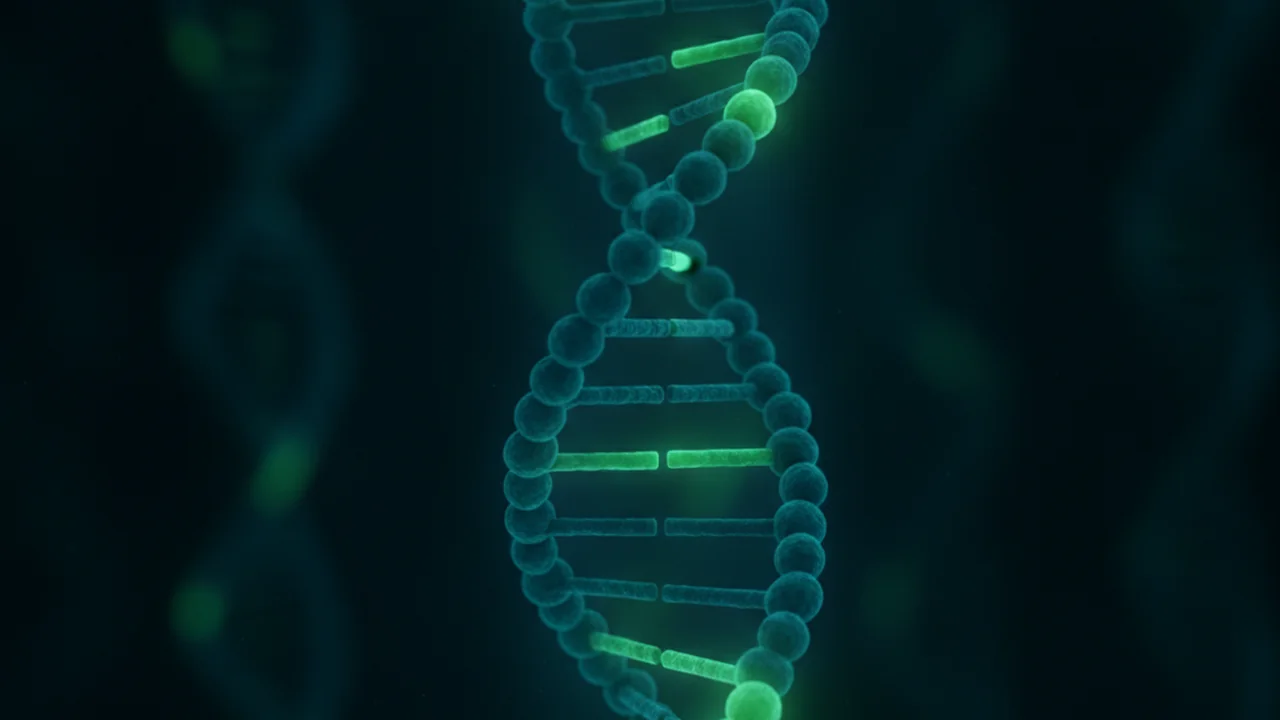
                        A DNA double helix showing two strands with a sugar-phosphate backbone.
                        DNA is a double helix: two strands, each with a sugar-phosphate backbone, wound around each other.

                        DNA (Deoxyribonucleic acid) is the molecule that carries genetic information for the development and functioning of an organism. DNA is made of two linked strands that wind around each other to form a double helix. Each strand has a backbone made of alternating sugar (deoxyribose) and phosphate groups.

                        DNA (Deoxyribonucleic acid)

                        The fundamental molecule that carries the genetic instructions used in the growth, development, functioning, and reproduction of all known living organisms and many viruses.

                        πŸ’‘ Did You Know?

                        The discovery of the double helix structure by James Watson and Francis Crick, based on Rosalind Franklin’s X-ray diffraction images, was a monumental achievement in biology. It immediately suggested how DNA could carry genetic information and how it could be replicated.

                        Base Pairing:

                        Each sugar carries one of four bases: adenine (A), cytosine (C), guanine (G), or thymine (T).

                        • Adenine bonds with Thymine (A-T)
                        • Cytosine bonds with Guanine (C-G)
                        Want to go deeper? The science behind base pairing…

                        The specific pairing of bases (A with T, C with G) is crucial for DNA’s function. These pairs are held together by hydrogen bonds: two between A and T, and three between C and G. This complementary pairing ensures that when DNA replicates, an exact copy can be made, preserving the genetic information.

                        The sequence of bases encodes biological information, including instructions for making proteins and RNA.

                        The sequence of bases encodes biological information, including instructions for making proteins and RNA.

                        Consider the elegance of the double helix structure and the specificity of base pairing. How does this precise arrangement allow DNA to function as a stable yet highly versatile information storage system?

                        ⏱ 5 minutes
                        Activity: Complementary Strand Challenge

                        Understanding base pairing is fundamental. For each sequence of DNA below, write out its complementary strand, remembering that A pairs with T, and C pairs with G.

                        1. Original Sequence 1: ATTGCAG
                        2. Original Sequence 2: GCTAGCT
                        3. Original Sequence 3: TACCGTA
                        • DNA is the core information-carrying molecule for life.
                        • It has a double helix structure with a sugar-phosphate backbone.
                        • Specific base pairing (A-T, C-G) forms the “rungs” of the ladder and encodes biological information.

                        What is Genomic DNA?
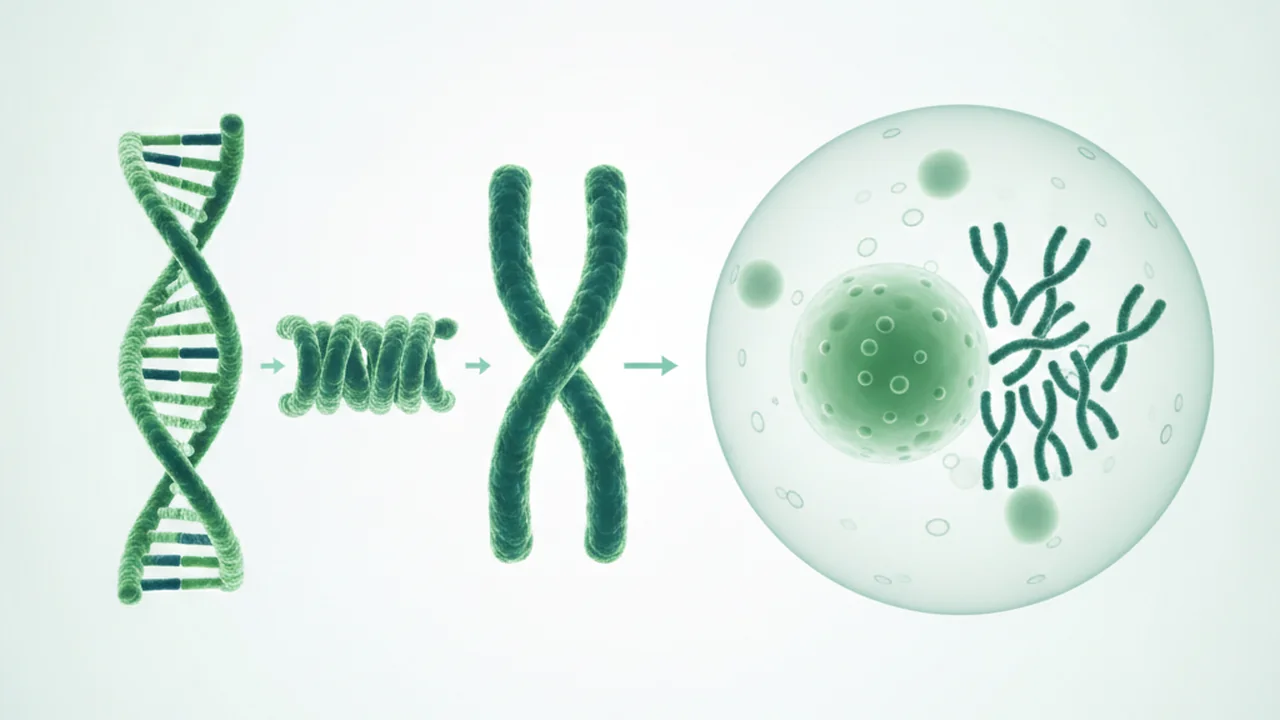
                        DNA coiling into a chromosome and the full set of chromosomes inside a cell nucleus.
                        The genome is the complete set of DNA in a cell: DNA condenses into chromosomes housed in the nucleus.

                        The genome is the entire set of DNA instructions found in a cell. In humans, the genome consists of 23 pairs of chromosomes in the cell nucleus, plus a small chromosome in the mitochondria. A genome contains all information needed for an individual to develop and function.

                        Genome

                        The complete set of DNA instructions, including all of its genes, found in a cell or organism.

                        ❌ Common Misconception

                        The terms “DNA” and “genomic DNA” are interchangeable; they refer to the exact same thing in all contexts.

                        βœ… The Reality

                        While DNA is the molecule itself, “genomic DNA” specifically refers to the entire, complete set of an organism’s DNA instructions, organized into chromosomes within a cell. It’s the whole instruction manual, not just a single word or sentence from it.

                        In metagenomics, when we analyze an environmental sample (like soil or water), we’re not just looking for “DNA.” We’re extracting and sequencing the genomic DNA from all the different organisms present, allowing us to identify species and understand community composition without needing to culture them.

                        How does the concept of a “genome” elevate our understanding of DNA from a simple molecule to a complete instruction manual for life, and what are the implications for studying complex ecosystems?

                        +50 XP

                        Which statement accurately describes the basic structure of a DNA molecule?

                        Review the “WHAT IS DNA?” section above to find the answer.
                        +50 XP

                        What is the primary distinction between “DNA” and “genomic DNA”?

                        Review the “What is Genomic DNA?” section above to find the answer.

                        Reflect on the power of DNA as an information-carrying molecule. How does its intricate structure allow for both remarkable stability and the vast diversity of life we observe around us? Consider its role as the fundamental evidence in metagenomic studies.

                        0 words Take your time β€” depth matters more than length
                        Key Takeaway

                        DNA is the fundamental information-carrying molecule, organized into a double helix with specific base pairing rules, and the complete set of an organism’s DNA is known as its genome, which serves as the core evidence in metagenomic analysis.

                        SHIFT

                        The Shift

                        • DNA is the universal information molecule of life, structured as a double helix with a sugar-phosphate backbone and complementary base pairs (A-T, C-G).
                        • The specific sequence of these bases encodes all biological instructions for an organism’s development and function.
                        • Genomic DNA refers to the entire, complete set of DNA instructions found within a cell, representing the full blueprint for an organism, which is crucial for understanding biodiversity in metagenomics.
                        End of lesson Ready for the next lesson?
                        Continue to next lesson Β β†’
                        DNA & Genomic DNA: The Code Behind the Sample
                        Prev
                        The Code Behind the Sample (Video)
                        Next

                        Β© 2026 The VR School | Career content by Wiley | Powered by Sejal Learning Systems.

                        Join free Β· Accreditation Β· Privacy Policy Β· Terms of Service

                        Modal title

                        Main Content