analyze how an illustration adds to the meaning and tone of a story, using details from both the picture and the text.
Phase 2: Investigate
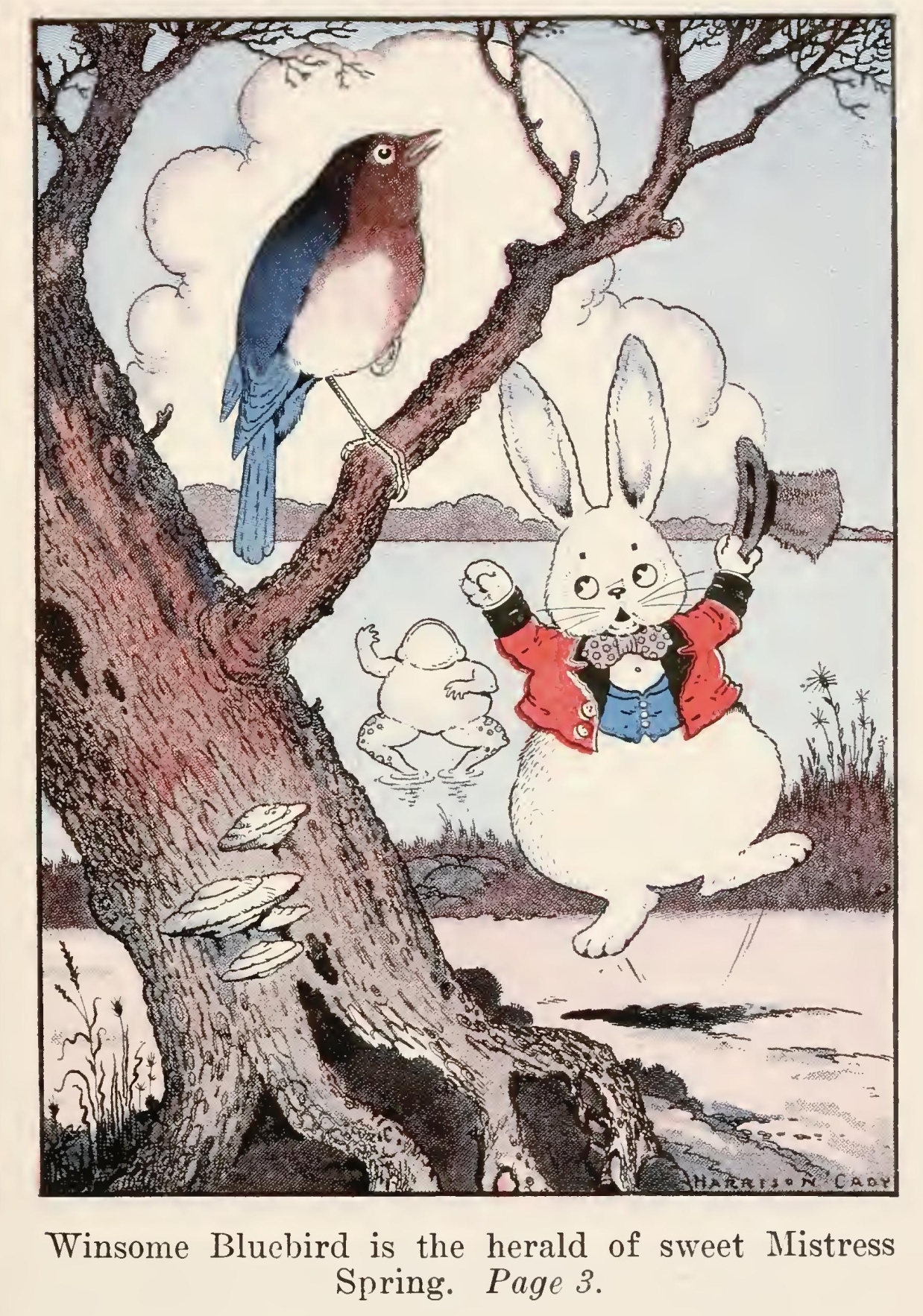
Do Now: picture first. Look at the color plate Harrison Cady painted for this chapter: “Winsome Bluebird is the herald of sweet Mistress Spring” (1917). Before you read, list three things you see and one feeling the picture gives you.
The caption says the bluebird is a “herald.” Using the picture, what do you predict a herald does?
The reading opens over the lesson; close it to come back to exactly where you were.
Pictures do work. In a picture book or an illustrated story, the pictures are not decoration only. An illustrator chooses what moment to show, what colors to use and what details to add. Those choices can show meaning, set a tone or add beauty.
Three questions for any illustration. (1) Match: which words does the picture show? (2) Add: what does the picture show that the words do not? (3) Feel: what tone do the colors, faces and movement create?
Worked example 1: match. Rosa reads that Peter “always jumps up in the air, kicks his long heels together, and does a funny little dance of pure joy.” In Cady’s picture, Peter is caught in mid-dance with one foot up and his hat raised high. Rosa writes: “The picture shows Peter’s dance of joy at the exact moment it happens.”
Worked example 2: add. Kwame notices that Peter wears a red jacket and a bow tie and waves a hat, and a frog seems to dance behind him. None of that is in the text. Kwame writes: “Cady adds clothes and a dancing frog, which makes the scene funny and cheerful. It shows the whole meadow is glad spring is coming.”
Feel: color and tone. The bluebird’s back is a deep blue, “the blue of the sky,” while the tree is still bare. That contrast suggests the end of winter and the start of spring, the same turn the text calls “the end of the shivery, sad time.”
Why this matters for the Expo. Your slide or poster will be a picture that works with your words. Choose images that match your point and add something your words cannot.
Use the passage and Cady’s plate.
Write your first media analysis.
How does Harrison Cady's picture add to the opening of this story? Write 4-5 sentences. Checklist: (1) a claim, (2) a quotation from the text the picture matches, (3) one detail the picture adds, (4) the tone it creates.
Sketch a quick picture you could put on an Expo slide about bluebirds. Label one detail that would add to your words.
Pictures and voices both add to words. Next we begin real research by reading about the animals of a Pennsylvania park.
Exit ticket: finish the sentence. “A good picture on a slide should ___ my words and ___ something new.”
Pacing (40 min): picture Do Now 5, reading 8, mini lesson 8, guided practice 10, media analysis 9.
The plate (image 0019 in the Gutenberg HTML): captioned “Winsome Bluebird is the herald of sweet Mistress Spring. Page 3.” A bluebird with a blue back and rusty breast perches on a bare branch at upper left; Peter Rabbit, in a red jacket, bow tie and blue vest, dances with a hat raised in one paw; a pale frog seems to dance behind him; a lake and spring sky are in the background. Project it large; the full-size file is linked in the warm-up.
Context: the cut part of the chapter is Grandfather Frog’s tale: the plain gray bird volunteered to carry the news of spring north through the cold when bigger birds slipped away. Tell students this so the ending makes sense.
Likely misconceptions: that pictures only repeat the text; that “tone” means color only (it is the feeling the colors, faces and actions create).
Supports: a three-column chart (match / add / feel). Stretch: what moment would you have chosen to illustrate, and why?
Sample response: Cady’s picture makes the opening joyful. The text says Peter “does a funny little dance of pure joy,” and the picture shows him in mid-dance with his hat in the air. Cady adds a red jacket and a frog dancing too, which makes it funny and shows the whole meadow celebrating. The bright blue bird against bare branches shows winter ending and spring beginning.
Thornton W. Burgess, Mother West Wind "When" Stories (Little, Brown, 1917), illustrations in color by Harrison Cady, Project Gutenberg eBook #46988 · Public domain in the U.S. (published before 1931); Project Gutenberg eBook #46988
About the story. In 1917 Thornton W. Burgess published another book of Mother West Wind stories, with color pictures by the artist Harrison Cady. In this chapter, Grandfather Frog tells Peter Rabbit an old tale of how the bluebird got its blue coat. Long ago, the bluebird was plain gray. He bravely flew north through the cold to announce that spring was coming. As a reward, Old Mother Nature made his coat blue.
What to notice. Find the sentences the picture shows. Then find something in the picture that the words never mention. What does the picture add?
Words to know. A herald is a messenger who announces news. Sober here means plain and dull in color. To rejoice is to feel or show great joy. To-day is an older spelling of today.
Read the passage under “The text” once for the big idea and once with a pencil.
OF all the joyous sounds of all the year there is none more loved by Peter Rabbit, and the rest of us for that matter, than the soft whistle of Winsome Bluebird in the spring. The first time Peter hears it he always jumps up in the air, kicks his long heels together, and does a funny little dance of pure joy, for he knows that Winsome Bluebird is the herald of sweet Mistress Spring, and that she is not far behind him. It is the end of the shivery, sad time and the beginning of the happy, glad time, and Peter rejoices when he hears that sweet, soft voice which is sometimes so hard to locate, seeming to come from everywhere and nowhere.
So Peter loves Winsome Bluebird and never tires of seeing him about. You know he wears a very, very beautiful coat of blue, the blue of the sky when it is softest, and you love to lie on your back and look up into it and dream and dream.
[…]
She reached out and touched Mr. Bluebird, and sure enough his sober gray coat turned the most wonderful blue. Then once more he started on his long journey and he whistled his message more joyously than before. And because his whistle brought joy and gladness, and because he was beautiful to see, it came about just as Old Mother Nature had said it would, that he was one of the most loved of all the birds, even as his great-great-ever-so-great-grandson is to-day.”
Peter drew a long breath. “Thank you, Grandfather Frog,” said he. “I have always loved Winsome Bluebird and now I shall love him more.”
Source: Thornton W. Burgess, Mother West Wind "When" Stories (Little, Brown, 1917), illustrations in color by Harrison Cady, Project Gutenberg eBook #46988 (gutenberg.pglaf.org)