How does a precise DNA amplification technique serve as a crucial quality control step, ensuring the reliability of complex metagenomic sequencing projects?
Learning Outcomes
By the end of this lesson, you will be able to:
- Define PCR as amplification of a DNA segment.
- Explain why PCR is used before library prep.
- Identify the 16S V4 region as the target.
- Describe denaturation, annealing, and extension.
Consider why understanding the foundational steps like PCR is essential, even in advanced fields like metagenomics. What problems could arise if these initial checks are skipped?
PCR — TESTING DNA PURITY
A laboratory technique for rapidly amplifying millions to billions of copies of a specific DNA segment, using short synthetic DNA fragments (primers) to select a genomic region, followed by multiple rounds of DNA synthesis.
PCR, or Polymerase Chain Reaction, is a cornerstone technique in molecular biology. It’s like a molecular photocopy machine, capable of creating an exponential number of copies from even a minuscule amount of DNA. This powerful amplification allows scientists to study specific genes or regions of interest in detail, even when they are part of a much larger and more complex genome.
Polymerase Chain Reaction (PCR) is a laboratory technique for rapidly amplifying millions to billions of copies of a specific DNA segment.
The invention of PCR in 1983 by Kary Mullis revolutionized molecular biology, earning him a Nobel Prize in Chemistry in 1993. Its simplicity and power made it indispensable for DNA sequencing, genetic disease diagnosis, forensics, and countless research applications.
Purpose of this PCR:
Before proceeding to Library Prep, we confirm that extracted DNA is free of chemical inhibitors. We amplify the V4 region (variable region 4) of the 16S rRNA gene. A ~300 base pair product indicates clean, amplifiable DNA.
Once DNA is extracted, it’s ready for any downstream application. Purity checks are optional.
Extracted DNA often contains chemical inhibitors from the sample or extraction process. These inhibitors can prevent enzymes from working correctly in subsequent steps like PCR and sequencing, leading to failed experiments and wasted resources. PCR serves as a critical quality control check.
In metagenomics, where researchers analyze DNA from entire microbial communities, ensuring DNA purity is paramount. Inhibitors can severely bias results by preventing amplification of certain DNA types, leading to an inaccurate representation of microbial diversity. This targeted PCR step helps guarantee that the DNA you’re about to sequence is truly representative and amplifiable.
Why is amplifying the 16S V4 region specifically chosen for this purity test in metagenomics? What makes it a good indicator?
- PCR is a technique for amplifying specific DNA segments.
- In metagenomics, PCR is used as a quality control step before library preparation to ensure extracted DNA is free of inhibitors.
- The target for this purity test is the 16S V4 region, which should yield a ~300 bp product from clean, amplifiable DNA.
PCR Primers:
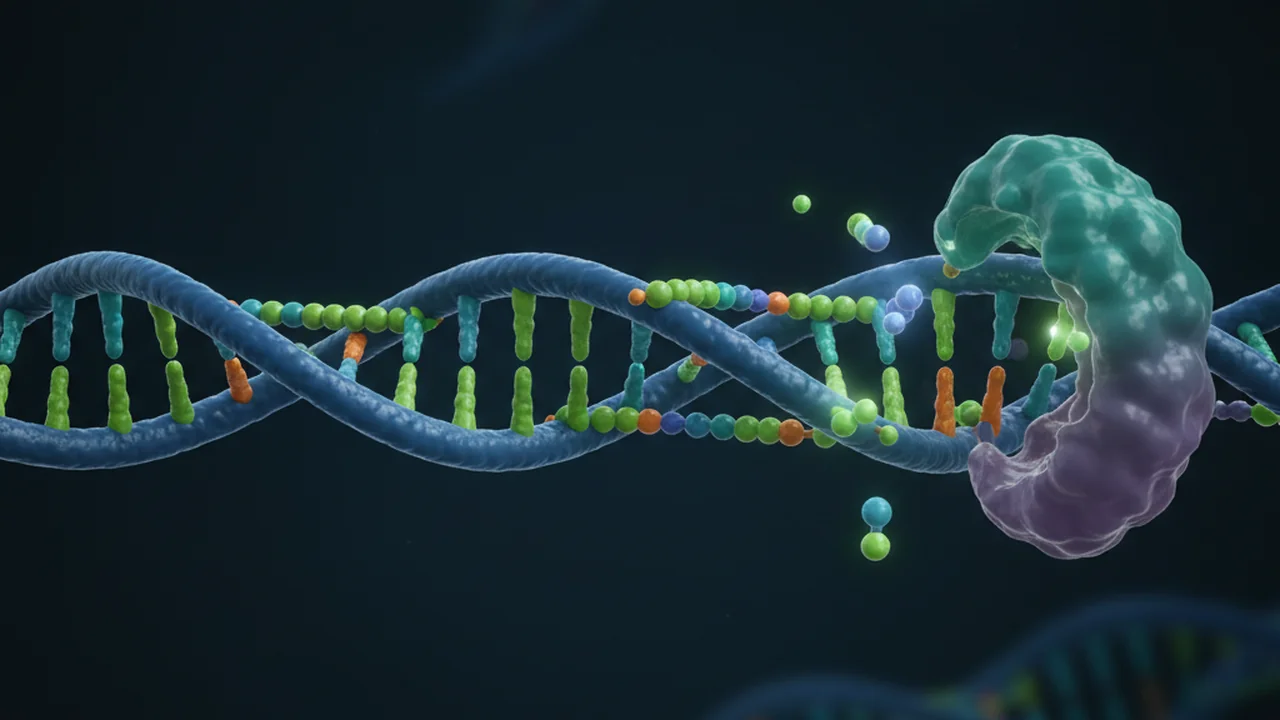
PCR relies on specific primers to target the desired DNA segment. For the 16S V4 region amplification, the following primers are commonly used:
- 515F (Parada): 5′-GTGYCAGCMGCCGCGGTAA-3′
- 806R (Apprill): 5′-GGACTACNVGGGTWTCTAAT-3′
Want to go deeper? The importance of primer design.
Primers are short, single-stranded DNA sequences that are complementary to the ends of the target DNA segment. Their design is crucial for PCR specificity and efficiency. The “F” in 515F indicates a forward primer, and “R” in 806R indicates a reverse primer. The numbers often refer to their binding position on the target gene. Degenerate bases like ‘Y’, ‘M’, ‘N’, ‘V’, ‘W’ allow the primers to bind to a wider range of sequences, which is particularly useful when targeting a conserved region across diverse bacterial species, as is the case with the 16S rRNA gene in metagenomics.
What is the primary purpose of performing PCR on the 16S V4 region before proceeding to Library Prep in a metagenomics workflow?
PCR Protocol:
The PCR process involves several key steps, repeated over many cycles to achieve exponential amplification. Here’s a typical protocol:
- Receive a 0.2 ml tube containing 9 µl of PCR Master Mix
- Label the tube with your initials
- Add 1 µl of your extracted DNA to the green master mix
- Tap the tube bottom gently to mix
- Spin 5–10 seconds in the benchtop centrifuge (no air bubbles)
- Load into PCR machine with the following cycling conditions:
- 1× 95°C — 5 minutes (initial denaturation)
- 30× 95°C — 30 seconds / 51°C — 30 seconds / 72°C — 30 seconds
- 1× 72°C — 2 minutes (final extension)
Mentally walk through a single cycle of PCR, imagining the DNA strands and primers. What happens to the DNA at each temperature step?
- Envision a double-stranded DNA molecule in the tube.
- Imagine the temperature rising to 95°C. What happens to the DNA?
- Next, the temperature drops to 51°C. What molecules are now interacting with the DNA?
- Finally, the temperature rises to 72°C. What enzyme is active, and what is it doing?
Unpacking the PCR Cycling Conditions: Denaturation, Annealing, and Extension
Each PCR cycle consists of three crucial temperature-dependent steps:
- Denaturation (95°C): At this high temperature, the double-stranded DNA melts, breaking the hydrogen bonds between complementary base pairs and separating into two single strands. This provides the templates for new DNA synthesis. The initial 5-minute denaturation ensures all DNA is fully separated.
- Annealing (51°C): The temperature is lowered, allowing the primers to bind (anneal) to their complementary sequences on the single-stranded DNA templates. This temperature is critical; it must be low enough for specific binding but high enough to prevent non-specific binding.
- Extension (72°C): The temperature is raised to the optimal working temperature for Taq polymerase, a heat-stable DNA polymerase. This enzyme synthesizes new DNA strands by extending the primers, using the single-stranded templates as guides. The final extension ensures any partially completed strands are fully extended.
These three steps are repeated for typically 25-35 cycles, leading to an exponential increase in the target DNA segment.
Imagine you’ve run this PCR, but you don’t see the expected ~300 bp product. What are three potential issues you would investigate, considering the purpose of this PCR and the protocol steps?
PCR is an indispensable quality control step in metagenomics, ensuring that extracted DNA is pure and amplifiable by specifically targeting and amplifying the 16S V4 region, thereby validating the sample’s suitability for subsequent library preparation and sequencing.
Which step of the PCR cycle involves separating double-stranded DNA into single strands at a high temperature?