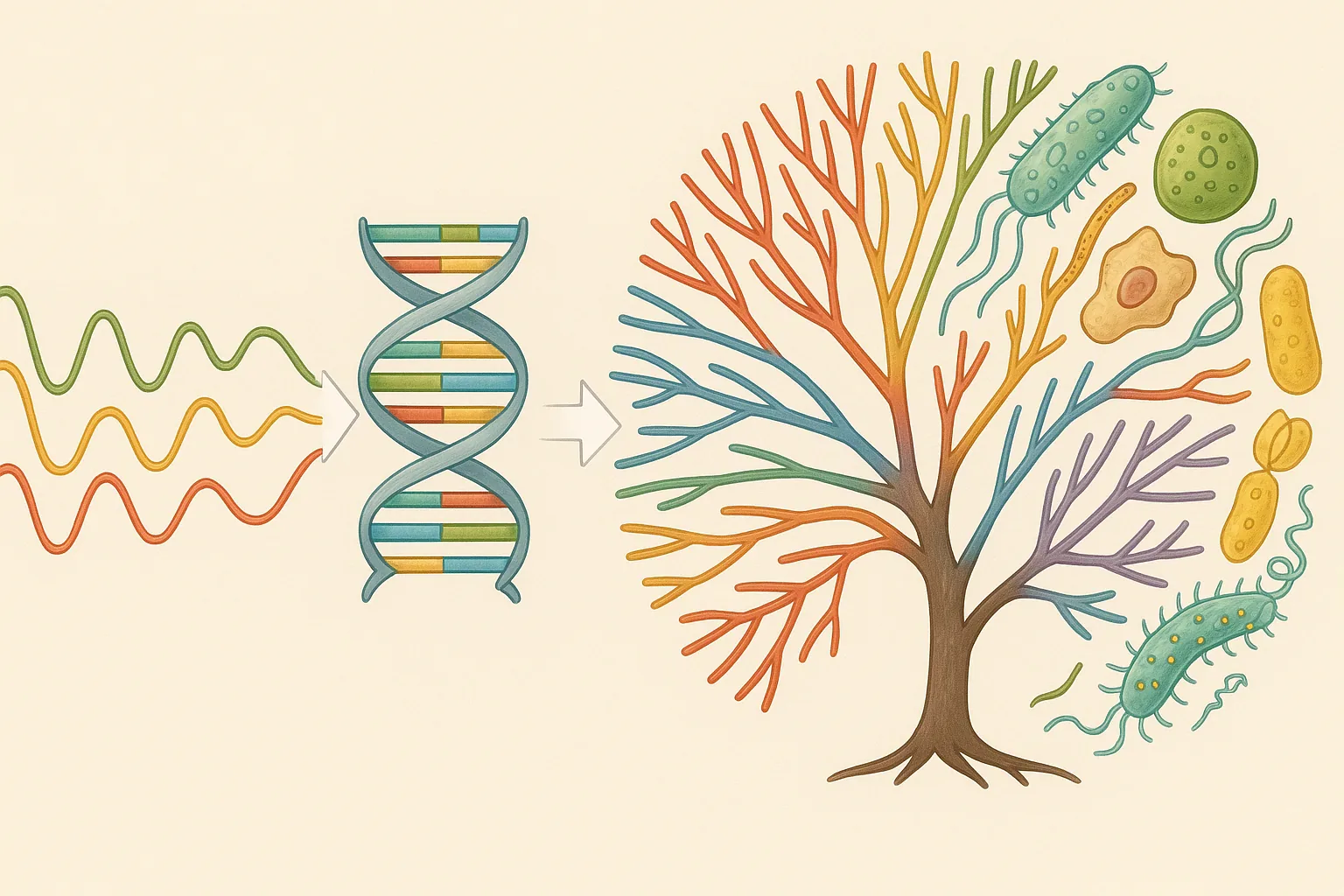
How do raw electrical signals from a sequencing machine transform into meaningful biological insights that can, for example, identify antibiotic resistance?
Welcome to the forefront of genomic analysis! This lesson introduces the critical journey of converting raw data from sequencing technologies, like Oxford Nanopore, into actionable biological knowledge. Understanding this process is fundamental to making sense of the vast genetic information around us.
LEARNING OUTCOMES
By the end of this lesson, you will be able to:
- Explain what basecalling does.
- Describe demultiplexing by barcode.
- Identify FASTQ as a common sequence-read format.
- Connect analysis tools to organism identification and interpretation.
Consider why a systematic, multi-step process is essential for converting raw data into reliable scientific conclusions.
COURSE READING
BIOINFORMATICS — From Nanopore Reads to Biological Insight
Pipeline Overview (Oxford Nanopore Technology)
The journey from raw electrical signals to biological insight is a meticulously orchestrated pipeline. Each step plays a vital role in cleaning, organizing, and interpreting the massive amounts of data generated by sequencing technologies.
1. Basecalling (Guppy)
The first critical step in any sequencing analysis pipeline is Basecalling. This process converts the raw electrical signals detected by the nanopore sequencer into a sequence of nucleotides (A, T, C, G).
The computational process of interpreting raw electrical current fluctuations from a DNA sequencer into a sequence of DNA bases (A, T, C, G).
The output of basecalling is typically in FASTQ format, which includes both the nucleotide sequence and an associated quality score for each base.
Command structure: location_of_guppy_basecaller --num_callers 6 -i input -s output -c config.cfg
Want to go deeper? The FASTQ format explained…
The FASTQ format is a text-based format for storing both a nucleotide sequence and its corresponding quality scores. Each sequence typically consists of four lines:
- A sequence identifier (e.g.,
@M02137:1:000000000-A9W7C:1:1:16035:2029) - The raw sequence letters (e.g.,
GATTTGGGGTTCAAAGCAGTATCGATCAAATAGTAAATCCATTTGTTCAACTCACAGTTT) - A plus sign (
+), optionally followed by the same sequence identifier. - A string of ASCII characters encoding quality scores for each base in the sequence (e.g.,
!''((((+))%%%++)(%%%%).1-+''))**55CCF>>>>>>CCCCCCC65)
These quality scores are Phred scores, indicating the probability of an incorrect base call. Higher scores mean higher confidence.
Why is it crucial for basecalling software to be highly accurate? What are the implications of errors at this foundational stage?
2. Demultiplexing
When multiple samples are sequenced together in a single run (a process called multiplexing), they are often tagged with unique DNA barcodes. Demultiplexing is the process of sorting these mixed reads back into their original individual samples based on these unique barcode sequences.
The computational separation of sequencing reads from a mixed pool into individual samples, based on unique short DNA sequences (barcodes or adapters) added during library preparation.
Oxford Nanopore Technology (ONT) enables real-time sequencing, meaning data can be analyzed as it’s generated. This offers a significant advantage for rapid diagnostics and field-based research, where quick turnaround times are crucial.
3. Trimming
After demultiplexing, reads often contain remnants of the adapter sequences used in library preparation, or have low-quality bases at their ends. The trimming step removes these unwanted sequences and low-quality regions to ensure that only high-quality, relevant biological sequence data remains for downstream analysis.
Raw sequencing data is immediately ready for biological interpretation.
Raw data requires extensive processing—including basecalling, demultiplexing, and trimming—to remove errors and irrelevant sequences before meaningful analysis can begin.
4. Quality Control (FastQC / MultiQC)
Quality control (QC) is a continuous process, but dedicated QC steps are essential after initial processing. Tools like FastQC and MultiQC are used to thoroughly assess the quality of the cleaned reads. They generate reports on various metrics, including:
- Read quality scores (overall distribution and per-base scores)
- Read length distributions
- GC content
- Presence of overrepresented sequences or adapter contamination
- Error rates
This step helps ensure that only high-quality data proceeds to the more complex and computationally intensive analysis stages.
- Basecalling converts electrical signals to nucleotide sequences.
- Demultiplexing sorts reads by sample using barcodes.
- Trimming removes adapter sequences and low-quality regions.
- Quality control assesses the reliability of sequencing data.
Imagine you’ve received a report from the “Quality Control” step, and it indicates a high percentage of reads still contain adapter sequences. What pipeline step might have failed or been insufficient, and what would be your first action?
- Identify the likely problematic step prior to QC.
- Propose a modification or re-run for that step.
- Explain why addressing this issue is critical before proceeding.
5. Alignment / Assembly
Once the reads are clean and of high quality, the next step is to reconstruct the original genomic information. This can be done in two main ways:
- Reference-based Alignment: Using tools like MiniMap2, reads are mapped against an existing, known reference genome. This is efficient when a closely related reference is available.
- De novo Assembly: For novel organisms or when no suitable reference genome exists, assemblers like Flye are used to piece together overlapping reads to reconstruct the genome from scratch, without a template.
The choice between reference-based alignment and de novo assembly is often dictated by the research question. Identifying known pathogens might use alignment, while discovering new microbial species requires de novo assembly.
6. Genome Polishing
De novo assembled genomes, while impressive, often contain small errors or gaps. Genome polishing is a refinement step that uses the original sequencing reads to improve the accuracy of the assembled genome. This typically involves using consensus sequences derived from multiple reads to correct individual base errors, leading to a higher-quality and more reliable assembly.
7. Downstream Analysis
With a high-quality, assembled or aligned genome, the real biological insights can begin to emerge. This final stage involves using specialized databases and platforms to extract meaningful information:
- EPI2ME — Oxford Nanopore’s cloud analysis platform (WIMP workflow): A streamlined platform for pathogen identification, antimicrobial resistance gene detection, and more.
- CARD — Comprehensive Antibiotic Resistance Database: A curated collection of antibiotic resistance genes and their associated mechanisms.
- ResFinder 4.1 — Antimicrobial resistance gene finder: A tool that screens genomic data for known antimicrobial resistance genes.
The ability to identify antibiotic resistance genes directly from environmental or clinical samples using these pipelines has revolutionized public health and epidemiology.
The systematic transformation of raw electrical signals into interpretable biological insights is the backbone of modern metagenomics, empowering discoveries from novel pathogens to antibiotic resistance.
What is the primary function of the “Basecalling” step in the Oxford Nanopore sequencing pipeline?
Reflect on the entire bioinformatics pipeline. Which step do you believe is the most crucial for ensuring the reliability of the final biological insights, and why?
The bioinformatics pipeline is a multi-stage process that systematically transforms raw sequencing data into accurate and interpretable biological information, enabling critical discoveries in fields like microbial genomics and public health.
Which file format is commonly used to store both nucleotide sequences and their associated quality scores after basecalling?