Biology B — Ecosystems, Evolution and Human Impact is the second semester of a full-year laboratory biology course for grade 10 (UC A-G area D). It is built on the California NGSS high-school life science performance expectations HS-LS2-1, HS-LS2-2, HS-LS2-4, HS-LS2-6, HS-LS2-7, HS-LS2-8 and HS-LS4-1 to HS-LS4-6, with HS-LS2-3 revisited, and the engineering design standards HS-ETS1-1 to HS-ETS1-4, with the science and engineering practices, crosscutting concepts and RST.9-10 literacy standards throughout.
Four units: Ecosystems: Carrying Capacity, Energy and Matter, Stability, Change and Human Impact: Engineering for California Ecosystems, Evolution: Evidence and Mechanisms, and Behavior, Populations and Population Genetics. Each unit opens with a California phenomenon and includes hands-on labs with inexpensive, school-available materials, a scientific argumentation lab, a modeling workshop and a multi-draft performance task.
Sources: OpenStax Biology 2e and Concepts of Biology (CC BY-NC-SA 4.0; referenced, not reproduced) as the reference texts; public-domain material from the U.S. Geological Survey, NOAA, the National Park Service, the CDC and the National Human Genome Research Institute; California Department of Fish and Wildlife information pages, cited for facts; PhET Interactive Simulations (CC BY 4.0) and NetLogo Web models opened as link-outs; SLS-written lessons, labs and tasks. Lab data tables marked illustrative are sample data for practice, not measurements.
Laboratory safety and student rights: labs follow the Science Safety Handbook for California Public Schools. No dissection is required, nothing uses human body fluids, and live organisms (duckweed, brine shrimp, pill bugs) are handled humanely and returned or cared for after use. Evolution is taught as the settled science the California standards require, with respect for every student’s beliefs.
Curriculum
- 4 Sections
- 20 Lessons
- Lifetime
- Unit 1: Ecosystems: Carrying Capacity, Energy and Matter5
- 1.1Phenomenon: The Tule Elk of Tomales Point50 mins
- 1.2Duckweed in a Cup: Measuring Population Growth50 mins
- 1.3Why So Few Mountain Lions? The Energy Pyramid Argument100 mins
- 1.4Counting the Uncountable: Sampling Biodiversity and Populations100 mins
- 1.5Performance Task — What Limits the Tule Elk?150 mins
- Unit 2: Stability, Change and Human Impact: Engineering for California Ecosystems5
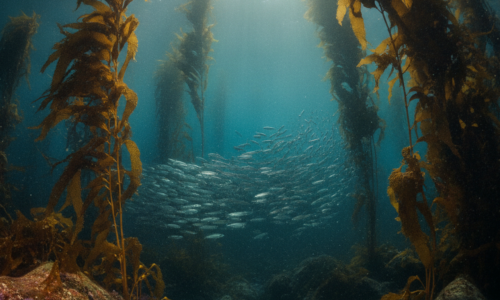
- 2.1Phenomenon: From Kelp Forest to Urchin Barren50 mins
- 2.2Salt and Survival: Brine Shrimp Hatching Across Salinities50 mins
- 2.3The Delta Smelt Debate: Causes, Criteria and Constraints100 mins
- 2.4Fire in the Forest: Testing Solutions With Prototypes and Simulations100 mins
- 2.5Performance Task — Design Brief: Protecting a California Ecosystem200 mins
- Unit 3: Evolution: Evidence and Mechanisms5
- 3.1Phenomenon: A Ring of Salamanders Around the Central Valley50 mins
- 3.2Hunting the Dots: A Natural Selection Investigation100 mins
- 3.3Many Lines, One Conclusion: The Evidence for Common Ancestry100 mins
- 3.4Adaptation in Action: Modeling Selection and Resistance100 mins
- 3.5Performance Task — Explaining the Ensatina Ring150 mins
- Unit 4: Behavior, Populations and Population Genetics5
- 4.1Phenomenon: The Elephant Seals of Año Nuevo50 mins
- 4.2Pill Bug Choices: Investigating Behavior100 mins
- 4.3Alarm Calls and Helpers: When Does Group Behavior Pay?100 mins
- 4.4Hardy-Weinberg and Genetic Drift: Is This Population Evolving?100 mins
- 4.5Performance Task — The Elephant Seal Comeback Report150 mins
Instructor



Leave a Reply